

So, you're wondering, how much does individual health insurance cost? Let's get right to it. For 2026, a good ballpark figure for the average monthly premium is somewhere between $400 and $600 for a standard individual plan. But that's just a starting point—a national average. Your actual price will hinge on a handful of key factors, like where you live, your age, and the specific level of coverage you decide on.
Decoding The True Cost Of Your Health Insurance

Figuring out what you'll really pay for health insurance can feel like trying to hit a moving target. Most people focus on the monthly premium, but that number is just one piece of a much larger financial puzzle.
It helps to think about it like buying a car. The sticker price—your premium—is what you pay every month to keep the engine running. But that doesn't account for what it costs to actually drive the car, like gas, oil changes, and unexpected repairs. Your health plan works the same way; the premium keeps your coverage active, but other costs pop up when you use it.
More Than Just The Monthly Premium
Your total healthcare spending for the year is a mix of a few different components. Getting a handle on these terms is the first step to choosing a plan that actually fits your budget and your life.
- Deductible: This is the amount you pay out-of-pocket for your medical care before your insurance plan starts chipping in. It's your initial share of the bill.
- Copayments and Coinsurance: Once you’ve hit your deductible, you’ll start sharing costs with the insurance company. You might pay a flat fee for a doctor's visit (a copayment) or a percentage of the total bill (a coinsurance).
- Out-of-Pocket Maximum: This is the absolute most you’ll have to pay for covered services in a single year. It's a critical safety net. Once you hit this limit, your plan pays 100% of the cost for all covered care for the rest of the year.
Your monthly premium keeps your insurance active, but your deductible, copays, and out-of-pocket maximum determine what you pay when you seek medical care. Getting these parts to work together is the key to affordable coverage.
Why The U.S. Market Is Different
Navigating these costs is particularly tricky here in the United States. Our country consistently has the most expensive private healthcare market in the world, mostly because of loose price regulations and billing practices that can feel unpredictable.
A recent analysis showed just how different the U.S. is. The study looked at international private medical insurance premiums—a great benchmark for true costs—and found the U.S. was significantly higher than any other nation. While global medical costs are expected to see a slight dip in 2026, experts predict that cost growth here in the U.S. will hover around 9.6%. You can dig deeper into these global healthcare cost rankings and see how they affect what you pay.
This is why having an expert in your corner is so important, especially in states with complex markets like Florida, Texas, and Tennessee. A good broker can help you make sense of the chaos, find a stable plan, and protect yourself financially.
The Key Factors That Determine Your Premium

If you've ever felt confused about why your health insurance quote is wildly different from a friend's, you're not alone. The answer to how much does individual health insurance cost isn't a single number; it's a personalized calculation based on a specific recipe. Think of your premium as a cake—the final price depends entirely on the ingredients that go into it.
Insurance carriers are legally allowed to use five key "ingredients" to calculate your monthly premium. Understanding these factors will demystify the pricing puzzle and show you which parts of your premium you can actually influence.
Your Age
Age is one of the heaviest-hitting factors in the premium recipe. As a general rule, the older you are, the higher your premium will be. This is because, statistically speaking, older individuals tend to need more medical services over time.
However, the Affordable Care Act (ACA) does put a cap on this. Insurers are not allowed to charge an older adult more than three times the premium of a younger person for the same plan. So, while a 55-year-old in Austin will pay more than a 27-year-old in the same city, that price difference is limited by law.
Your Location
Where you live has a surprisingly large impact on your insurance costs. Premiums can vary dramatically not just from one state to another, but even between different zip codes in the same county.
This difference comes down to a few local dynamics:
- Local competition: How many insurance companies are offering plans in your area? More competition often leads to better pricing.
- Cost of living: The general cost of medical services and care in your region directly influences insurance rates.
- State regulations: Each state has its own set of rules that can affect plan pricing and what's available.
This is exactly why someone living in Sarasota, Florida, might see a completely different premium than someone in another part of the country, even if they're the same age and pick the same type of plan.
Your Tobacco Use
Using tobacco is another major ingredient that can significantly increase what you pay. Insurers have the right to charge tobacco users up to 50% more for their monthly premium compared to non-users.
This "tobacco surcharge" is one of the few health-related factors that can directly raise your individual health insurance cost under current law. If you're a smoker, quitting is one of the most powerful actions you can take to lower your premiums.
It’s crucial to be honest about your tobacco use on your application. If you aren't, you run the risk of having your policy canceled for misrepresentation.
The Number Of People On Your Plan
This one is pretty straightforward: the more people you add to your policy, the higher your monthly premium will be. A plan that covers just you will naturally cost less than one that also covers a spouse and two children.
The total premium is calculated by adding up the individual premium for each person. One helpful rule to know is that for families with three or more children under 21, you'll only pay premiums for the three oldest kids.
This need for personalized coverage is part of a much larger trend. The global individual health insurance market, valued at USD 138.93 billion in 2026, is projected to nearly double to USD 230.09 billion by 2035. This growth is being fueled by rising medical costs and an increased demand for flexible plans, particularly in North America. You can find out more by exploring these global healthcare cost projections.
Your Chosen Plan Category
Finally, the "metal tier" you select—Bronze, Silver, Gold, or Platinum—plays a huge role in your final cost. These categories don't have anything to do with the quality of care you receive; they just define how you and your insurer share the costs.
We'll dive deeper into this in the next section, but the general rule is simple. You can learn more about how this monthly cost works by reading our guide about what a health insurance premium is.
By understanding these five ingredients, you gain much more control over your healthcare budget and can make smarter, more confident decisions when shopping for a plan.
How ACA Subsidies Can Lower Your Monthly Costs
That initial sticker price you see on a health insurance plan can be a bit of a shock, but it’s almost never the final number you'll actually pay. The Affordable Care Act (ACA) Marketplace isn't just a shopping website; it's a system designed to provide major financial help that can slash your monthly bill. Getting a handle on this assistance is the key to understanding what your true health insurance cost will be.
Think of this help as a government-funded discount that’s applied directly to your premium each month. The main type of assistance is called the Premium Tax Credit, though most people just call it a "subsidy." This credit lowers your monthly payment based on what you expect your income to be for the year.
Unlocking Savings With Premium Tax Credits
How much of a credit you get is tied directly to your household size and income. It's a simple concept: the less you earn, the bigger your credit, and the less you have to pay out of your own pocket for coverage. The whole system is built to make insurance affordable by capping what you’re expected to spend on a plan as a percentage of your income.
So, who gets these credits? Generally, you need to:
- Meet specific income requirements (traditionally between 100% and 400% of the Federal Poverty Level, although recent rules have expanded eligibility).
- Not have an offer of affordable coverage from a job or another program like Medicaid or Medicare.
- File a federal income tax return at the end of the year.
- Buy your plan through the official Health Insurance Marketplace.
These credits make a massive difference. Millions of Americans rely on them to turn an otherwise unaffordable premium into a manageable monthly expense. For many families, this is what makes getting good health coverage possible. You can dive deeper into the specifics in our guide on what a health insurance premium tax credit is.
How Cost-Sharing Reductions Add More Value
On top of the premium subsidies, there’s another layer of financial help called Cost-Sharing Reductions (CSRs). These are extra savings available to people whose income falls below a certain level (usually 250% of the Federal Poverty Level). The catch? You have to enroll in a Silver-level plan to get them.
While tax credits lower your monthly bill, CSRs reduce your out-of-pocket costs when you go to the doctor or get a prescription. This means you get a plan with a lower deductible, smaller copayments, and a reduced out-of-pocket maximum. It's essentially like getting a free upgrade—you pay the premium for a Silver plan but get the benefits of a much richer Gold or Platinum plan.
The combination of Premium Tax Credits and Cost-Sharing Reductions can be a game-changer. One lowers your monthly payment, and the other reduces what you pay for doctor visits and medical services, providing a two-pronged approach to making healthcare truly affordable.
Why Subsidies Are More Critical Than Ever
Knowing how to maximize these subsidies is more important now than ever before. We're seeing market trends that point toward significant premium increases in the near future. For example, ACA Marketplace premiums are projected to jump by an average of 26% in 2026. In states that use the federal Healthcare.gov platform, that increase could be as high as 30% for benchmark Silver plans.
The good news is that subsidies are designed to grow along with premiums, protecting most people from the full impact of these hikes. However, it underscores just how vital it is to get your application right so you receive every dollar of assistance you're entitled to. You can read the full research about upcoming premium changes from KFF for more details on these trends.
Navigating the subsidy system can feel complicated, especially if your income fluctuates or your family situation changes. Working with an experienced agent can ensure you report everything correctly and pick the plan that maximizes both your tax credits and any cost-sharing benefits you qualify for.
Choosing The Right Plan Tier For Your Needs
When you start shopping for a plan on the Health Insurance Marketplace, you’ll notice they're sorted into four "metal" tiers: Bronze, Silver, Gold, and Platinum. It’s easy to think these names have to do with the quality of medical care you get, but that's a common misconception. The tiers are all about how you and your insurance company split the bill.
A good way to think about it is like picking a cell phone plan. You could go with a cheaper plan that has a low monthly fee, but then you'd pay more out-of-pocket anytime you use a lot of data. On the flip side, you could choose a pricier plan with a high monthly payment that covers nearly all your data, no matter how much you stream. Metal tiers work just like that, but for your healthcare costs.
How Cost-Sharing Works For Each Tier
The real difference between Bronze, Silver, Gold, and Platinum comes down to a concept called actuarial value. That might sound technical, but it’s just the average percentage of total medical costs a plan is designed to cover. Whatever is left over is what you should expect to pay through your deductible, copayments, and coinsurance.
Here’s a quick breakdown of what that means for your wallet:
Bronze Plans: These have the lowest monthly premiums but the highest costs when you actually need care. They typically cover about 60% of your medical bills, leaving you to handle the other 40%. A Bronze plan often makes sense if you're young, healthy, and mostly want a safety net for a major, unexpected medical event.
Silver Plans: This is your middle-of-the-road option. The premiums are moderate, and so are your out-of-pocket costs. These plans cover around 70% of your healthcare bills on average. As you’ll see in a moment, Silver plans can be a fantastic deal if you qualify for financial help.
Gold Plans: With higher monthly premiums come much lower costs when you visit the doctor. Gold plans cover roughly 80% of your medical expenses. If you know you'll need regular care or are managing a chronic condition, a Gold plan can save you a lot of money over the year, even with the higher upfront cost.
Platinum Plans: These carry the highest monthly premium, but in exchange, they have the lowest out-of-pocket costs. A Platinum plan will cover about 90% of your bills. They're best for people who anticipate needing a lot of medical services and want the most predictable, stable costs possible.
If you want to dig a bit deeper into this topic, our guide on what actuarial value is in health insurance is a great resource that explains how these percentages really work.
The Hidden Power Of Silver Plans
For a lot of folks, Silver plans are where the real magic happens. If your income qualifies you for extra savings called Cost-Sharing Reductions (CSRs), you can only get them by enrolling in a Silver plan.
This is a game-changer.
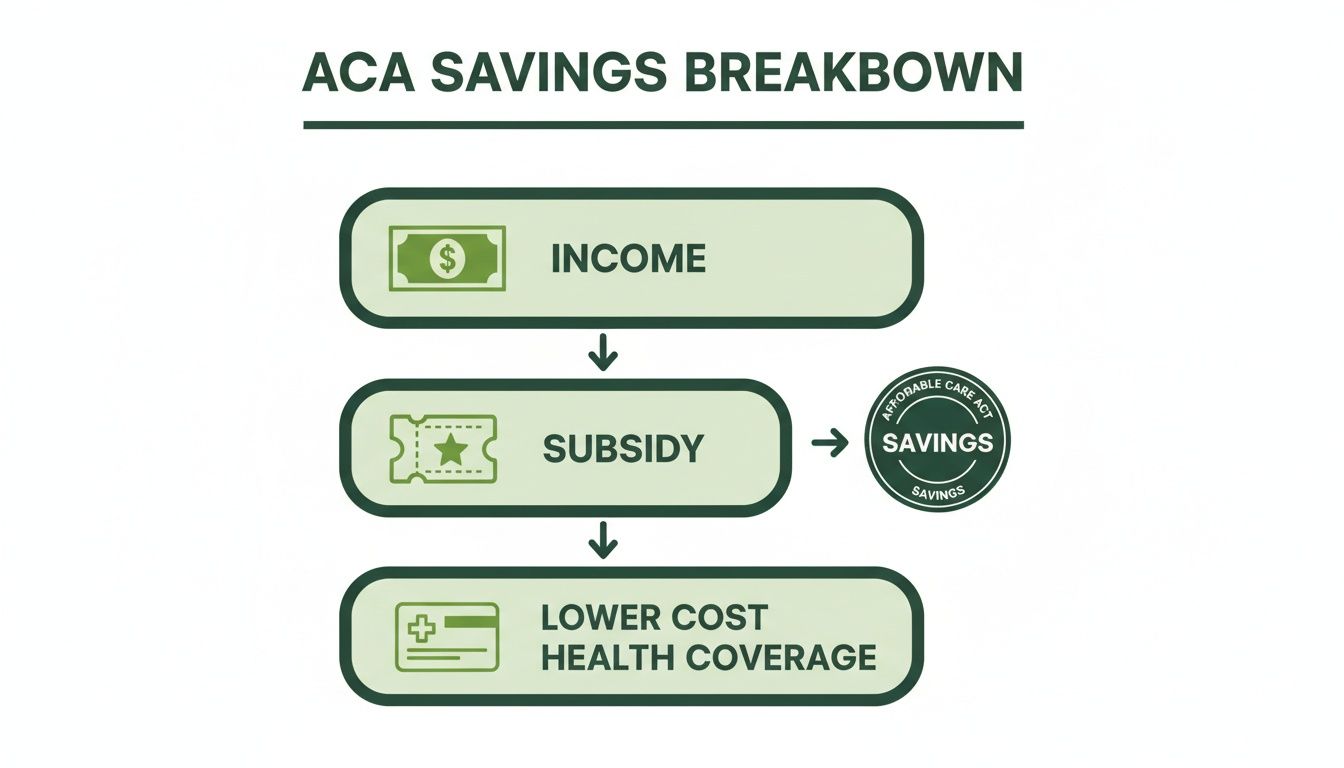
The flowchart above shows how it all connects: your income determines if you get a subsidy, which directly lowers what you pay for health coverage.
Think of CSRs as a free, built-in upgrade. They dramatically lower your deductible, copayments, and out-of-pocket maximum. In effect, you get the financial protection of a Gold or even a Platinum plan, but you’re only paying the premium for a Silver one. This makes Silver plans a true hidden gem for anyone who qualifies.
Practical Strategies to Find Affordable Health Insurance
Knowing what drives health insurance costs is one thing, but actually using that knowledge to lower your monthly premium is where the real power lies. The good news? You have more control than you might think. By making a few smart decisions, you can get a much better answer to the question, "How much does individual health insurance cost for me?"
These aren't complicated secrets or loopholes. They're practical, straightforward steps you can take right now. Let's move beyond the theory and get into the actions that will help you take charge of your healthcare budget.
Opt for a Plan with a Higher Deductible
If you’re generally healthy and don’t anticipate needing a lot of medical care, choosing a plan with a higher deductible can be a fantastic financial strategy. These plans, like many Bronze or even some Silver tiers, come with significantly lower monthly premiums. That means more cash in your pocket each month.
This strategy is all about paying less for that "just in case" peace of mind, while still having your preventive care covered. It's a trade-off, of course. You're agreeing to cover more of the initial costs yourself if something happens, but in return, you get immediate and predictable savings every single month. You can find more information about this in our guide on how to find affordable health insurance.
Master Your Health Savings Account (HSA)
Here's one of the most powerful tools available for managing healthcare costs: pairing a high-deductible health plan (HDHP) with a Health Savings Account (HSA). An HSA is a unique savings account that lets you put money aside specifically for medical expenses, completely tax-free.
It’s a win-win-win situation, thanks to its triple tax advantage:
- Your contributions are tax-deductible, which lowers your taxable income for the year.
- The money in the account can be invested and grows tax-free.
- Withdrawals are also tax-free, as long as you use them for qualified medical expenses.
Think of an HSA as your own personal healthcare fund for co-pays, dental work, prescriptions, and more. Over time, it can grow into a serious financial safety net for your future health needs.
Choose the Right Network Type
The plan's provider network has a surprisingly big impact on your monthly premium. The two most common types you'll encounter are HMOs and PPOs.
- HMO (Health Maintenance Organization): These plans typically have the lowest premiums. The catch is you must use doctors and hospitals within their network, and you'll usually need a referral from your primary care doctor to see a specialist.
- PPO (Preferred Provider Organization): These plans give you the freedom to see both in-network and out-of-network doctors without a referral. That flexibility is great, but it comes at the cost of a higher monthly premium.
If you don't mind staying within a specific network of providers to save money, an HMO is almost always the most budget-friendly option.
Beyond selecting the right plan, proactive health management can significantly reduce your long-term healthcare expenditures. A crucial step in this process is regularly monitoring and understanding your biometrics.
The Ultimate Strategy: Work with an Independent Broker
While all these tips can make a difference, the single most effective strategy is to partner with an independent insurance broker. A broker doesn't work for a single insurance company; they work for you. Their entire job is to navigate the market, comparing dozens of plans from all the major carriers to find the one that truly fits your life and your budget.
An independent agent at Pounds Health Insurance is your personal expert and advocate. We can instantly see if you qualify for subsidies, uncover savings you might have missed, and make sure you aren’t paying for coverage you don’t need. Best of all, this expertise comes at no extra cost to you.
Finding Your Personalized Health Insurance Quote

We've covered a lot of ground, looking at all the moving parts that determine what you'll pay for health insurance—from your age and where you live to plan types and government help. But national averages and sample scenarios can only paint part of the picture.
Ultimately, there's only one way to know how much individual health insurance will cost for you: getting a personalized quote. It’s the final, crucial step where all the theoretical numbers become real. This is how you cut through the estimates and get a concrete price based on your actual life.
The Advantage Of An Independent Agency
Sure, you could try to piece everything together yourself by hopping from one carrier website to another or diving into the federal marketplace alone. But there’s a much simpler way. Partnering with a local, independent agency like Pounds Health Insurance takes the guesswork out of the entire process.
Unlike agents who are tied to a single company, our only job is to serve you. Our loyalty is to your family and your budget, not a specific carrier. We'll shop plans from all the major players—think Aetna, Cigna, Blue Cross Blue Shield, and UnitedHealthcare—to find the coverage that genuinely fits your life. This client-first approach means you get honest, unbiased advice and a clear view of all your best options.
A personalized consultation is the fastest way to translate your research into an actual plan. It's a free, no-pressure chance to see your real costs and get straight answers from an expert.
Your Next Steps To Getting Covered
Whether you're self-employed, shopping for your family, or just navigating individual coverage for the first time, getting started is straightforward. We've built a simple process to help you land the right plan without all the usual headaches. For a deeper dive into the paperwork, you can learn more from our guide on how to apply for marketplace insurance.
Here’s how we help people just like you:
- For Individuals: We'll help you find that sweet spot—a plan with a premium you can afford that still gives you the coverage you need for true peace of mind.
- For Families: We can build a plan that covers everyone, from well-child visits to unexpected emergencies, while keeping the family budget on track.
- For the Self-Employed: We specialize in finding flexible coverage that can adapt to a variable income, and we're experts at making sure you get every penny of the subsidies you qualify for.
Don’t let the "what-ifs" keep you from getting covered. Let us do the heavy lifting to find a plan that aligns perfectly with your health needs and your financial reality.
Have More Questions? We’ve Got Answers.
When it comes to figuring out health insurance, the big picture is one thing, but the small, practical questions are what often trip people up. After you’ve looked at the numbers, you might still be wondering about the timing, the alphabet soup of plan types (HMO, PPO?), and real ways to save.
Let's tackle some of the most common questions we hear every day about how much individual health insurance costs and how the system really works.
Can I Just Buy Health Insurance Whenever I Want?
The short answer is usually no. For the most part, you have to sign up during the annual Open Enrollment Period. In most states, that’s a specific window of time running from November 1st to January 15th.
But what if something major happens in your life mid-year? That’s where a Special Enrollment Period (or SEP) comes in. If you experience what’s called a Qualifying Life Event, you get a 60-day window to enroll in a new plan.
These events include things like:
- Losing the health insurance you had through a job.
- Getting married or divorced.
- Having a baby or adopting a child.
- Moving to a new area where your old plan isn't offered.
Not sure if your situation qualifies? That's a perfect reason to chat with an agent. We can quickly tell you if you're eligible for an SEP.
What's The Real Difference Between An HMO And A PPO Plan?
This is probably the most common question we get! The main trade-off between an HMO and a PPO comes down to cost versus flexibility. Think of it like this: an HMO is like a guided tour with a set itinerary, while a PPO is like getting a pass that lets you explore on your own.
An HMO (Health Maintenance Organization) plan typically has a lower monthly premium. The catch is that you have to use doctors and hospitals within its specific network, and you'll almost always need a referral from your primary care doctor before you can see a specialist. It’s a more structured, budget-friendly approach.
A PPO (Preferred Provider Organization) gives you a lot more freedom. You can see pretty much any doctor you want, whether they're in the plan's "preferred" network or not. You'll save money by staying in-network, but the choice is yours, and you don’t need referrals. That freedom usually comes with a higher monthly price tag.
Is A High-Deductible Health Plan A Smart Way To Save?
It certainly can be, but it’s not for everyone. A High-Deductible Health Plan (HDHP) is often a fantastic choice if you're relatively healthy and don't expect to need much more than your annual check-up. You'll pay a lower monthly premium in exchange for having to cover more of your costs upfront before the insurance kicks in.
The secret weapon of an HDHP is its partner: the Health Savings Account (HSA). An HSA lets you set aside money before taxes to pay for medical expenses. It offers a triple tax advantage (tax-free contributions, tax-free growth, and tax-free withdrawals for medical costs), which is a powerful tool for managing your long-term health spending.
If you have a chronic condition or know you'll need regular medical care, a plan with a lower deductible might actually save you more money over the course of the year, even with a higher premium.
Ready to stop guessing and get real answers? The best way to find out what plan makes sense for your budget and your life is to talk it through with an expert. The team at Pounds Health Insurance is here to give you free, no-pressure advice. Get your personalized quote today!











