
Finding affordable health insurance feels like a puzzle, but it really boils down to two key things: figuring out what you actually need and understanding what a plan will truly cost you. It's not just about that monthly payment. If you skip this initial homework, you risk either paying for a Cadillac plan when you only need a Civic, or getting stuck with a cheap plan that leaves you holding a massive bill when you need it most.
Your Guide To Affordable Health Coverage

Before you even think about looking at plans online, the real work begins with a simple look in the mirror—at your health and your finances. If you jump straight into comparing premiums, you're flying blind. It's so easy to get drawn in by a low monthly price, only to discover later that the coverage is full of holes.
I always tell my clients to think of it like buying a car. You wouldn't just look at the monthly payment, right? You'd think about gas mileage, potential repair costs, and how much it costs to insure. Health insurance is the exact same. That "sticker price," or the monthly premium, is just the beginning of the story.
Start With Your Healthcare Needs
First things first, let's get a handle on what you and your family actually need from your health coverage. A healthy, self-employed 28-year-old is going to have completely different priorities than a family of four with a child who has asthma.
Take a few minutes to honestly answer these questions:
- Doctor Visits: How many times a year do you realistically see a doctor? Are there any specialists you see on a regular basis?
- Prescription Drugs: Are you or anyone in your family on daily medications? Jot them down so you can check if they're covered later.
- Health Status: Is anyone managing a chronic condition like diabetes? Are you expecting a major medical event, like a surgery or a new baby?
- Preferred Providers: Do you have a primary care doctor or a hospital system you absolutely love and want to keep?
Being brutally honest here is the single best way to save money down the line. It ensures you don't overpay for a gold-plated plan you'll never use, or worse, pick a plan so thin it leaves you exposed when you need it most.
The real goal isn't finding the cheapest plan—it's finding the most valuable one. That means a plan whose benefits actually match your life.
Understanding the True Cost
Once you know what you need, it's time to decode the costs. The key to learning how to get health insurance that fits your budget is looking past the premium and understanding all the other numbers that affect your wallet.
Get familiar with these terms, because they determine your total spending for the year:
- Deductible: This is the amount you have to pay out-of-pocket for medical services before your insurance company starts paying its share.
- Copayments and Coinsurance: After your deductible is met, this is your share of the cost. It might be a flat fee (like $40 for a specialist visit) or a percentage of the bill (you pay 20%, they pay 80%).
- Out-of-Pocket Maximum: This is your financial safety net. It’s the absolute most you will have to pay for covered services in one year. Once you hit this number, the insurance company pays 100%.
With this foundation, you can stop just looking for a low premium and start searching for a plan that genuinely protects both your health and your bank account.
Getting to Know the Different Types of Health Plans
After you've taken a hard look at your health needs and what your budget can handle, it's time to dive into the actual plans. The health insurance world loves its acronyms—HMO, PPO, EPO—but don't let the alphabet soup scare you off. Getting a handle on what these mean is crucial to finding a plan that won't let you down.
Think of it like choosing a cell phone plan. Do you need unlimited data and nationwide coverage, or are you mostly at home on Wi-Fi? One isn't better than the other; it's about what fits your life. The same logic applies here.
The Big Players: HMOs and PPOs
The main difference between health plans usually comes down to two simple things: which doctors you can see (the network) and how much freedom you have to choose them.
Health Maintenance Organization (HMO)
With an HMO, you operate within a set network of doctors, hospitals, and clinics. The key piece here is the Primary Care Physician (PCP), who acts as your quarterback. If you need to see a specialist, like a dermatologist or a cardiologist, you’ll need to get a referral from your PCP first.
This structure is designed to be efficient, which usually translates into lower monthly premiums and more predictable costs.
- Who it’s great for: People who are generally healthy, don't mind having a go-to doctor coordinate their care, and want to keep their monthly bills as low as possible.
- A real-world example: Think of a young graphic designer just starting her business. She rarely needs more than an annual check-up. An HMO gives her solid, affordable coverage for the essentials without a hefty price tag. The PCP referral system isn't a big deal because she doesn't need frequent specialist visits.
Preferred Provider Organization (PPO)
A PPO is all about flexibility. You have a network of "preferred" providers, and staying within that network will always be your cheapest option. But the big perk is that you can go out-of-network to see any doctor you want, and you don’t need a referral to see a specialist.
That freedom comes at a price, of course. Premiums for PPOs are typically higher, and your costs for seeing an out-of-network doctor will be, too.
- Who it’s great for: Anyone who wants direct access to specialists or has a specific doctor they want to continue seeing, even if that doctor isn't in a particular network.
- A real-world example: Consider a family whose son sees a highly-specialized pediatric therapist. With a PPO, they can ensure he continues his care with that specific provider without jumping through hoops, even if it costs a bit more.
The choice between an HMO and a PPO almost always comes down to cost versus flexibility. Figure out which one is more important to your peace of mind and your wallet.
Other Smart Options to Consider
Beyond the two mainstays, there are other types of plans that can be a great fit, especially if you're looking for a middle ground or a way to be more strategic with your healthcare dollars. Digging into all the Florida health insurance options can really open your eyes to new ways to save.
Exclusive Provider Organization (EPO)
An EPO is a smart hybrid of an HMO and a PPO. Like an HMO, you generally have to stay within the plan’s network for care to be covered (emergencies are the exception). But like a PPO, you usually don't need a referral from your PCP to see a specialist. It gives you more direct access than an HMO but with a cost structure that's often more affordable than a PPO.
The Power Couple: HDHPs and HSAs
If you're relatively healthy and want to turn your health insurance into a financial tool, you absolutely need to know about the High Deductible Health Plan (HDHP). The name says it all: the deductible is higher, but in exchange, your monthly premium is much lower.
But here's where it gets really powerful. An HDHP makes you eligible to open a Health Savings Account (HSA), which is arguably one of the best savings accounts in existence.
An HSA is a special bank account for medical expenses that comes with a triple tax advantage:
- Contributions are tax-deductible, lowering your taxable income for the year.
- The money grows completely tax-free.
- Withdrawals are also tax-free, as long as you use the money for qualified medical expenses.
The money is 100% yours. It's not a "use-it-or-lose-it" account like an FSA; it rolls over year after year. You can even invest the funds, letting it grow like a 401(k) for your future healthcare needs. An HDHP paired with an HSA is an incredible strategy for anyone who wants to lower their monthly costs and build long-term, tax-free wealth at the same time.
How To Get Help Paying For Health Insurance
A lot of people I talk to think they make too much money to get a break on their health insurance bill. It’s one of the biggest myths out there. The reality is, millions of Americans are eligible for serious financial help and have no idea. Finding a plan that doesn't break the bank usually comes down to knowing how to tap into government programs designed to do just that.
Your most powerful tool here is the Affordable Care Act (ACA) Marketplace. Don't just think of it as a website to shop for plans. It's the gateway to subsidies that can slash your monthly premium, sometimes even down to zero. And this isn't a one-size-fits-all deal; the assistance is built to flex with your life and your finances.
Unlocking Premium Tax Credits
The main type of help you'll find on the ACA Marketplace is the Premium Tax Credit (PTC). The easiest way to think about it is like a discount coupon from the government for your health insurance. How big that discount is depends on just two things: your estimated household income for the year you need coverage and how many people are in your family.
This system is designed to be flexible. I’ve worked with freelance writers whose income is a rollercoaster. When they have a slow quarter, they can hop onto the Marketplace, update their income, and watch their tax credit increase, which immediately lowers what they pay the next month. It’s a lifesaver.
You also don't have to wait until you file taxes to see the savings. Most people take the credit upfront. It’s called an Advanced Premium Tax Credit (APTC), and it gets paid directly to your insurance company every month. This means the bill you see is already reduced.
Who Qualifies For These Subsidies
You’d be surprised at how many people qualify for these tax credits. The general rule of thumb used to be that you were eligible if your household income was between 100% and 400% of the federal poverty level (FPL). But thanks to recent changes, that upper income limit has been temporarily removed, opening the door for many more families to get help.
The key takeaway is this: your premium for a mid-tier "Silver" plan won't cost more than 8.5% of your household income. This cap has been a total game-changer, especially for middle-income families, self-employed folks, and early retirees who used to face sky-high insurance costs.
Even though family premiums seem to be climbing every year, using the ACA marketplace to get these subsidies is the single best strategy for keeping costs under control. It’s a crucial buffer as medical and pharmacy costs keep rising. For a deeper dive, check out our guide on how to save money on health insurance.
Exploring Medicaid And CHIP
For families and individuals with lower incomes, the Marketplace also connects you to two other critical programs: Medicaid and the Children’s Health Insurance Program (CHIP). These programs offer comprehensive health coverage for little to no cost.
The rules are different in every state, but eligibility is almost always based on your income and household size.
- Medicaid: This program is typically for low-income adults, pregnant women, and people with certain disabilities. In states that expanded Medicaid, it often covers any adult under a certain income threshold, no questions asked about health status.
- CHIP: This is a fantastic program that provides top-notch, affordable coverage for kids (and sometimes pregnant women) in families who make too much for Medicaid but still can't afford a private plan.
Think about a family going through a job change. If a parent gets laid off, their income might suddenly drop into the Medicaid or CHIP range. Instead of paying a fortune for COBRA, they could get their kids covered through CHIP for a tiny fee, ensuring they have great healthcare during a really stressful time.
On top of this, managing the cost of specific prescriptions is a huge piece of the puzzle. For expensive medications, understanding medication costs and saving tips when without insurance is essential. When you combine these kinds of strategies with the right insurance plan, the financial relief can be massive. By looking at every option—from tax credits to state programs—you can find a path to coverage that protects both your family's health and your wallet.
A Smart Method For Comparing Health Plans
That low monthly premium is tempting, isn't it? It’s often the first number people look at, but I've seen countless times how focusing on that single figure can be a huge mistake when searching for affordable health insurance. The best deal isn't just the cheapest plan on paper; it's the one that delivers real value and protects your finances when you actually need medical care.
To make a smart choice, you have to look at the whole picture. This means changing your mindset from "What's the monthly payment?" to "What's my total potential cost for the year?" It’s a subtle shift, but it’s crucial. A plan with a slightly higher premium could easily save you thousands if you face a medical emergency.
This quick visual guide really boils down the essential process for getting the financial help you might need.
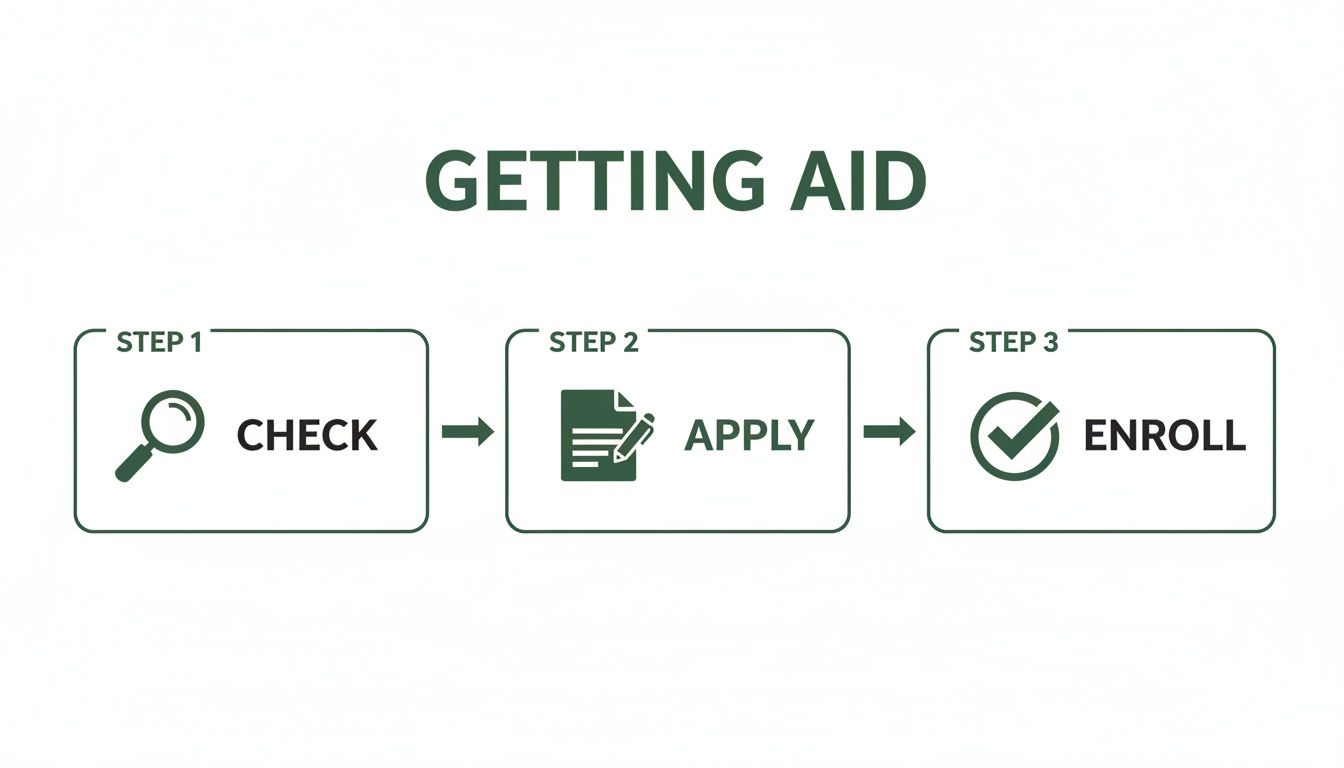
This simple flow—checking your eligibility, applying for aid, and then enrolling—is the fundamental path to securing assistance and bringing your healthcare costs down.
Look Beyond The Premium At Total Costs
Figuring out a plan's total potential cost is easier than it sounds. You just need to weigh a few key numbers: the premium, the deductible, and the out-of-pocket maximum. The out-of-pocket maximum is your ultimate financial safety net. It’s the absolute most you will have to pay for covered medical services in a single year. Once you hit it, the insurance company pays 100% for the rest of the year.
Here’s a real-world scenario I see all the time:
- Plan A has a $350 monthly premium with an $8,000 out-of-pocket max.
- Plan B has a $450 monthly premium with a $4,000 out-of-pocket max.
If you stay perfectly healthy, Plan A is cheaper. But if you have an unexpected surgery, you could easily hit that $8,000 limit. With Plan B, your costs are capped at $4,000. Even after paying a little more in premiums, Plan B could end up saving you thousands.
Your real mission is to balance what you pay every month with what you might have to pay if something serious happens. The out-of-pocket maximum reveals the worst-case financial scenario.
Check The Provider Network Carefully
The next critical step is making sure your plan actually works for you where you live and with the doctors you trust. This is all about the provider network—the list of doctors, hospitals, and specialists who have agreed to accept your insurance. If you go outside this network, you could be hit with massive surprise bills or find your insurance won't pay at all.
Before you commit to a plan, ask yourself these questions:
- Is my primary care doctor in-network?
- Are my family's specialists (like a pediatrician or cardiologist) included?
- Is my preferred local hospital or urgent care clinic covered?
Never assume they are. Insurance company websites have easy-to-use search tools to check. Spending five minutes on this can prevent major headaches and huge out-of-network bills down the road.
Verify Your Prescriptions Are Covered
Just as important is the plan’s drug formulary, which is simply its list of covered prescription medications. A plan that seems affordable can become a financial nightmare if it doesn't cover a medication you take every day.
When you look at the formulary, don't just see if your drug is listed—check which "tier" it's in. Lower-tier drugs (usually generics) have much lower copays than higher-tier drugs (often specialty or brand-name). For anyone managing a chronic condition, this step is absolutely essential. If you want a more detailed breakdown, we offer more tips on how to compare health insurance plans in our dedicated guide.
Use Metal Tiers To Your Advantage
ACA Marketplace plans are organized into four "metal tiers" that make it easier to compare them: Bronze, Silver, Gold, and Platinum. These tiers have nothing to do with the quality of care you receive; they're all about how you and the insurance company split the costs.
- Bronze: Lowest monthly premiums, but you'll pay the most when you need care.
- Silver: Moderate premiums and moderate costs. Critically, these are the only plans eligible for extra cost-sharing reductions if you qualify.
- Gold: High monthly premiums, but your costs are low when you get medical care.
- Platinum: Highest premiums and the lowest out-of-pocket costs.
Choosing the right tier helps you match your budget with your expected medical needs. A young, healthy person might lean toward a Bronze plan to save on premiums, while someone with a chronic illness might choose a Gold plan to keep their out-of-pocket expenses predictable and low.
Considering Alternatives and Supplemental Coverage
Sometimes, a standard, year-long health plan just doesn't line up with what’s happening in your life. We see it all the time—people changing jobs, recent grads losing student coverage, or folks just waiting for a new plan to kick in. These gaps can leave you feeling exposed.
That's when it makes sense to look at other options. Think of these plans not as replacements for comprehensive coverage, but as smart, strategic tools. They're there to manage costs, bridge gaps, and give you some peace of mind when things are in flux.
Short-Term Health Plans for Temporary Gaps
Short-term health insurance is exactly what it sounds like: a temporary safety net. These plans are built to protect you from unexpected, major medical bills for a limited time—usually anywhere from one month up to a year, depending on your state.
The main draw? They're often much cheaper than ACA-compliant plans. That's because their scope is much narrower.
Imagine you just graduated and your new job doesn't start for three months. A short-term plan is a perfect fit here. It's not meant for routine check-ups, but it’s there to shield you from the crushing cost of a sudden illness or accident.
You have to be clear about their limitations, though. Short-term plans don't have to cover the ten essential health benefits mandated by the ACA.
This means they almost never cover:
- Pre-existing conditions
- Maternity care
- Mental health services
- Prescription drugs
Short-term plans are a fantastic tool for very specific, temporary situations. They protect against financial catastrophe but are absolutely not a substitute for long-term, comprehensive health insurance.
Filling the Gaps with Supplemental Insurance
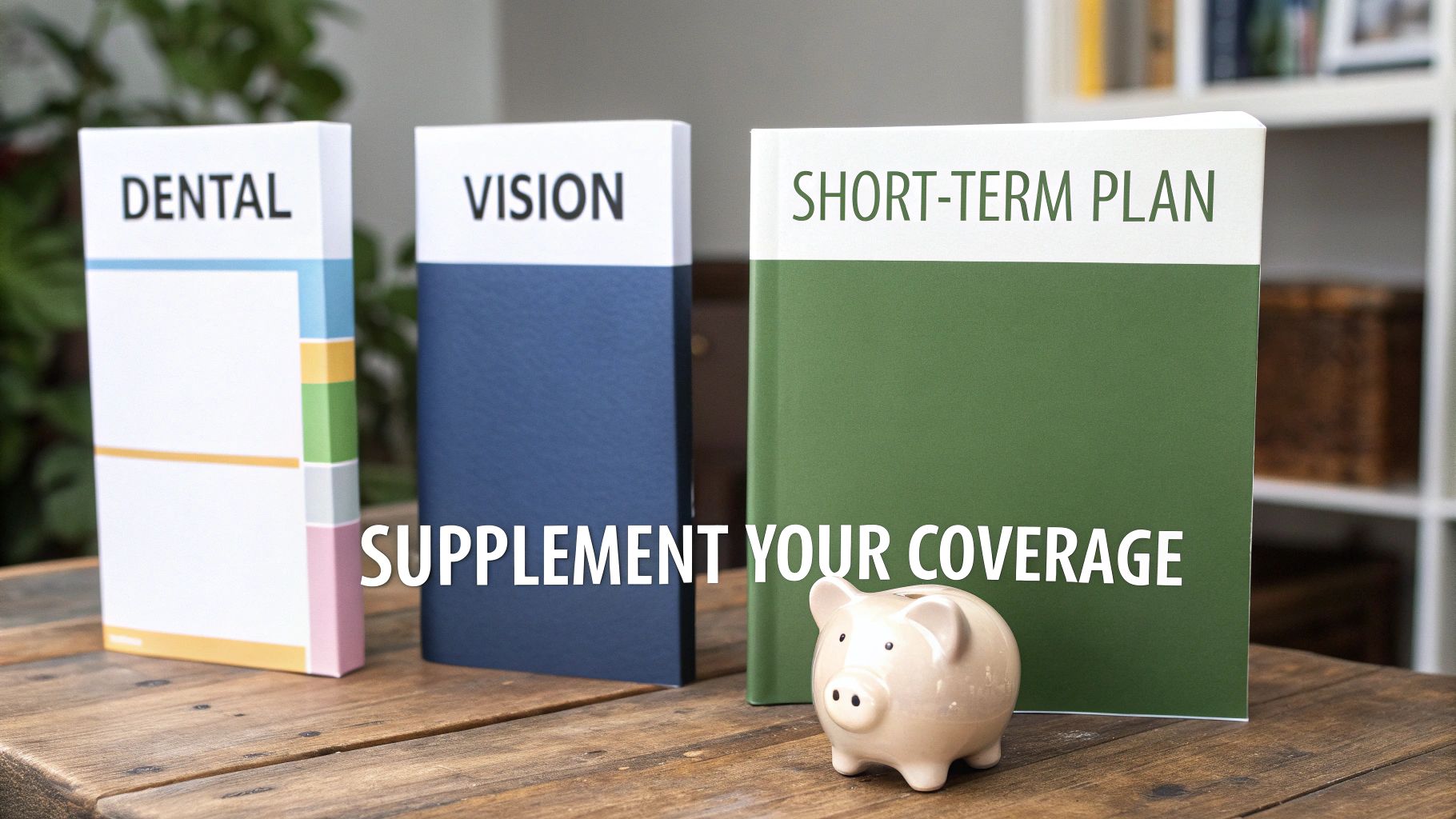
Even the best major medical plans have holes. Deductibles can be high, copays add up, and most policies won't touch things like routine dental work or a new pair of glasses. This is exactly where supplemental insurance comes in handy, acting like a patch for those specific coverage gaps.
These policies work a bit differently, often paying benefits directly to you for specific events, which you can then use to cover those out-of-pocket costs your main plan leaves behind. It's also become more common for people to pair their insurance with proactive wellness tools, like using at-home health tests to stay on top of their health.
A few common types of supplemental insurance include:
- Dental Insurance: Helps cover everything from routine cleanings to fillings and crowns.
- Vision Insurance: Covers eye exams, glasses, and contacts.
- Critical Illness Insurance: Provides a lump-sum cash payment if you’re diagnosed with something serious, like a heart attack, stroke, or cancer.
- Accident Insurance: Helps pay for costs tied to an injury, from the ER visit to follow-up physical therapy.
These add-on policies are typically very affordable and can be the difference between a minor inconvenience and a major financial setback. If you want to dive deeper, you can check out our guide that answers the question, "what is supplemental health insurance coverage" and how it might work for you.
A Quick Word on Health Sharing Ministries
You may have also heard about health-sharing ministries. These are organizations where members, who usually share a common religious or ethical belief system, pool their money through monthly contributions to help pay for each other's medical bills.
While the monthly costs can look attractive, it’s critical to understand that these are not health insurance.
They aren't regulated by state insurance departments, so there is no guarantee your bills will be paid. They can also legally deny payment for pre-existing conditions or for lifestyle choices that don't align with their stated beliefs. They work for some people, but they come with significant risks you need to weigh carefully.
Answering Your Lingering Questions About Affordable Health Insurance
Even with the best game plan, finding the right health insurance always brings up a few last-minute questions. It's a complicated world, so it's completely normal to want to clear up a few final details. We've gathered some of the most common questions we hear from people just like you, with straight-to-the-point answers to help you feel confident in your choice.
Think of this as a final sanity check. Getting these things right means no nasty surprises later on, and the plan you pick will actually work for your life and your wallet.
When Can I Actually Sign Up for a Plan?
The big one to circle on your calendar is the Open Enrollment Period. This is the annual window when anyone, for any reason, can shop for and enroll in a new health plan on the ACA Marketplace. For most states, this window runs from November 1st to January 15th.
If you let that period pass you by, your options get pretty slim. You typically can't just sign up whenever you want. The main exception is if you experience what's called a Qualifying Life Event (QLE).
A QLE triggers a Special Enrollment Period, which is a personal 60-day window for you to get coverage outside of the normal Open Enrollment timeframe. Some of the most common QLEs include:
- Losing job-based health insurance
- Getting married or divorced
- Having a baby, adopting, or placing a child for adoption
- Moving to a new zip code where your old plan isn't offered
It's crucial to act fast if you have a QLE. If you miss that 60-day window, you'll likely be stuck waiting until the next Open Enrollment rolls around.
I’m Self-Employed. Are There Options for Me?
Absolutely. In fact, people who are self-employed are one of the main groups the ACA Marketplace was designed to help. Before the ACA, freelancers and small business owners often got the short end of the stick, facing brutal premiums for subpar plans. The Marketplace changed all of that.
As a self-employed person, your income can be a moving target. The Marketplace is built for that reality. You simply estimate your net income for the coming year, and that figure is used to see if you qualify for Premium Tax Credits (subsidies) that can dramatically reduce your monthly bill. If you have a great month or a slow one, you just hop into your account, update your income, and your subsidy adjusts accordingly.
Don't think being self-employed means you're on your own. The Marketplace gives you a direct line to the same affordable plans as everyone else, with financial help that understands the ups and downs of running your own business.
What if My Income Changes During the Year?
Life happens. You might land a big project, lose a client, or switch from part-time to full-time work. If you're getting subsidies through the Marketplace, it is absolutely essential to report these income changes right away.
Here’s why:
If your income goes down, you'll likely qualify for a larger tax credit. That means your monthly premium payment will drop. You might even find yourself newly eligible for programs like Medicaid or CHIP.
If your income goes up, your subsidy will probably need to be reduced. By reporting it, you'll start paying the correct, slightly higher premium. The alternative is getting a nasty surprise at tax time when the IRS determines you were overpaid and asks for that money back. A quick update saves a huge headache later.
Does a Health Plan Cover My Teeth and Eyes?
Usually, no. Standard health insurance plans on the Marketplace are focused on medical care. While they are required to include pediatric dental and vision benefits for children, coverage for adults is almost always a separate purchase.
This is where supplemental insurance becomes your best friend. You can buy standalone dental and vision plans to cover things like:
- Routine cleanings and check-ups
- Fillings, crowns, and other major dental work
- Yearly eye exams
- A new pair of glasses or a supply of contact lenses
These plans are typically very affordable and can be a financial lifesaver when you need care that your main health plan won't touch. Without one, you’re paying for every single one of those services out of your own pocket.
Trying to piece all of this together can feel overwhelming, but you don’t have to do it alone. At Pounds Health Insurance, our agents are here to be your guide. We help you cut through the confusion, compare your options side-by-side, and find a plan that actually fits your budget and your life. For a free, no-pressure chat and some fast quotes, come see us at https://poundshealthinsurance.com.