You are probably here because health insurance suddenly became your job.
Maybe you are self-employed in Sarasota, you left a job in St. Petersburg, or your family in Bradenton needs coverage and there is no HR department handing you a neat packet with three plan choices. Instead, you are staring at unfamiliar words like deductible, premium tax credit, Silver plan, HMO, and network.
That confusion is normal.
Florida is one of the biggest ACA markets in the country, and that scale matters to everyday shoppers. In 2023, Florida’s individual health insurance market grew 25.2% to more than 3.6 million people, driven by the ACA Marketplace, and individual plans have become the dominant form of commercial coverage in the state (Florida market report.pdf)). For many Floridians, the florida health insurance marketplace is not a backup option. It is the main path to coverage.
If you want a broader overview of how individual and family coverage works across the state, this guide to Florida health insurance options explained is a useful companion. What follows is the practical version. The kind of explanation a first-time applicant usually wishes they had before opening HealthCare.gov.
Starting Your Florida Health Insurance Journey
A lot of first-time applicants start in the same place. They know they need coverage, but they do not know where to begin.
One common example is the freelancer who had employer insurance last year and now has to shop alone. Another is the family whose monthly budget has no room for a bad guess. In both situations, the florida health insurance marketplace becomes the place where the search usually starts.
Why Florida Feels Different
Florida’s market is large, active, and heavily centered on individual coverage. That changes the experience for shoppers.
When a state has this many people relying on marketplace-style coverage, plan choice matters. Carrier participation matters. Local hospital networks matter even more. A plan that looks fine on a screen can feel very different when you try to use it with your doctor.
The First Goal Is Not Picking A Plan
The first goal is understanding the system.
Before you compare Bronze to Silver, or HMO to PPO, you need to answer a few basic questions:
- Can I use the Marketplace?
- Do I qualify for financial help?
- Which kind of plan fits how I use care?
- Will my doctors, specialists, and hospitals be in-network?
A good first step is not “Which premium is cheapest?” It is “Which plans fit my doctors, prescriptions, and budget together?”
That is the mindset that keeps people from choosing a plan they regret a month later.
What Is The Florida Health Insurance Marketplace
The simplest way to think about the florida health insurance marketplace is this. It is an official, regulated shopping platform for individual and family health insurance.
It is not just a random insurance website. It is the place where approved ACA plans are offered under federal rules.
Florida Uses HealthCare.gov
Florida uses the federally-facilitated Marketplace, which means most applicants use HealthCare.gov rather than a separate Florida-run exchange. Plans offered there must meet federal standards, and the platform is where eligible shoppers access financial help tied to ACA coverage.
Consider it a shopping center with rules.
Every store cannot sell whatever it wants. To be in this shopping center, a plan has to meet coverage requirements. That includes core consumer protections such as coverage for pre-existing conditions and preventive care.
What The Marketplace Does
The Marketplace handles a few jobs at once:
- It lets you compare plans in one place. You can review premiums, deductibles, provider networks, and plan types side by side.
- It screens for financial help. If your household qualifies, the system can apply savings to your coverage.
- It standardizes the shopping process. Plans still differ, but they are presented within the same structure so you can compare more clearly.
- It provides a formal enrollment path. If you want ACA subsidies, this is the route.
That last point matters. A lot of shoppers assume any ACA-compliant plan automatically comes with tax credits. It does not. The official marketplace is where those savings are accessed.
What You Will See On The Screen
When you apply, the site asks about your household, income, where you live, and whether you have access to other coverage. Based on that information, it shows plans available in your county.
That county detail matters more in Florida than many people expect. Carrier options and networks vary by area. A plan available in one county may not be available in another, and even when the carrier name is the same, the network can be different.
Why This Matters For First-Time Applicants
A first-time applicant often assumes the Marketplace is only for people with very low income. That is a common misunderstanding.
The better way to think about it is this. The Marketplace is where many Florida residents shop when they do not have employer coverage, want individual or family insurance, and need a structured way to compare plans and check for financial help.
The marketplace is the doorway. The key decision still comes afterward, when you compare benefits, networks, and total cost.
Confirming Your Eligibility To Enroll On The Marketplace
Before you spend time comparing plans, make sure you are eligible to enroll through the Marketplace.
This part is more straightforward than people think, but a few details create confusion.
If you want a second reference point while reviewing the rules, this breakdown of Affordable Care Act eligibility requirements can help.
The Basic Checklist
You can generally use the Marketplace if these statements fit your situation:
- You live in Florida. Residency matters because plan availability is tied to where you live.
- You are lawfully present in the United States.
- You are not incarcerated.
Those are the basic gatekeeping rules.
Coverage Questions That Change The Answer
The harder part is not residency or lawful presence. It is whether you have access to other coverage.
For example:
- If you are already enrolled in Medicare, you are not the typical Marketplace applicant.
- If an employer offers coverage, that can affect whether Marketplace coverage is the right move.
- If you are self-employed with no non-family employees, you are usually shopping as an individual rather than as a small group.
That last point surprises many freelancers. They assume having a business automatically means they can buy a small-group plan. In many cases, they are still shopping in the individual market.
Common Florida Situations
A few real-world examples make this easier.
A graphic designer in Bradenton who left a full-time job and now works on contract usually shops as an individual. A married couple in Sarasota with one spouse freelancing and the other staying home may apply as a household. A small business owner in St. Petersburg with employees may need to compare group options outside the individual Marketplace route.
The Marketplace is designed mainly for individuals and families. It is not a one-size-fits-all portal for every business setup.
When Timing Matters
You usually enroll during Open Enrollment or after a qualifying life event.
Qualifying events can include things like losing other coverage, moving, getting married, or having a baby. Those events can trigger a special enrollment window. If none apply, timing can limit when you can sign up.
If you recently lost job-based coverage, act quickly. Waiting too long can mean missing the window and having fewer choices until the next enrollment period.
A Simple Self-Test
If you are unsure, ask yourself these three questions:
- Am I a Florida resident who is lawfully present and not incarcerated?
- Do I need individual or family coverage rather than Medicare?
- Did I lose coverage recently, or am I applying during Open Enrollment?
If the answer is yes across the board, you are likely in the right place.
Understanding Your Savings Subsidies And Tax Credits
A lot of Florida shoppers reach this point expecting bad news on price.
Then they see the savings.
For many self-employed Floridians, gig workers, and families around Tampa Bay, Marketplace coverage only starts to make sense after the financial help is applied. If you want a clearer primer on the monthly discount side of that help, this explanation of the health insurance premium tax credit walks through the basics.
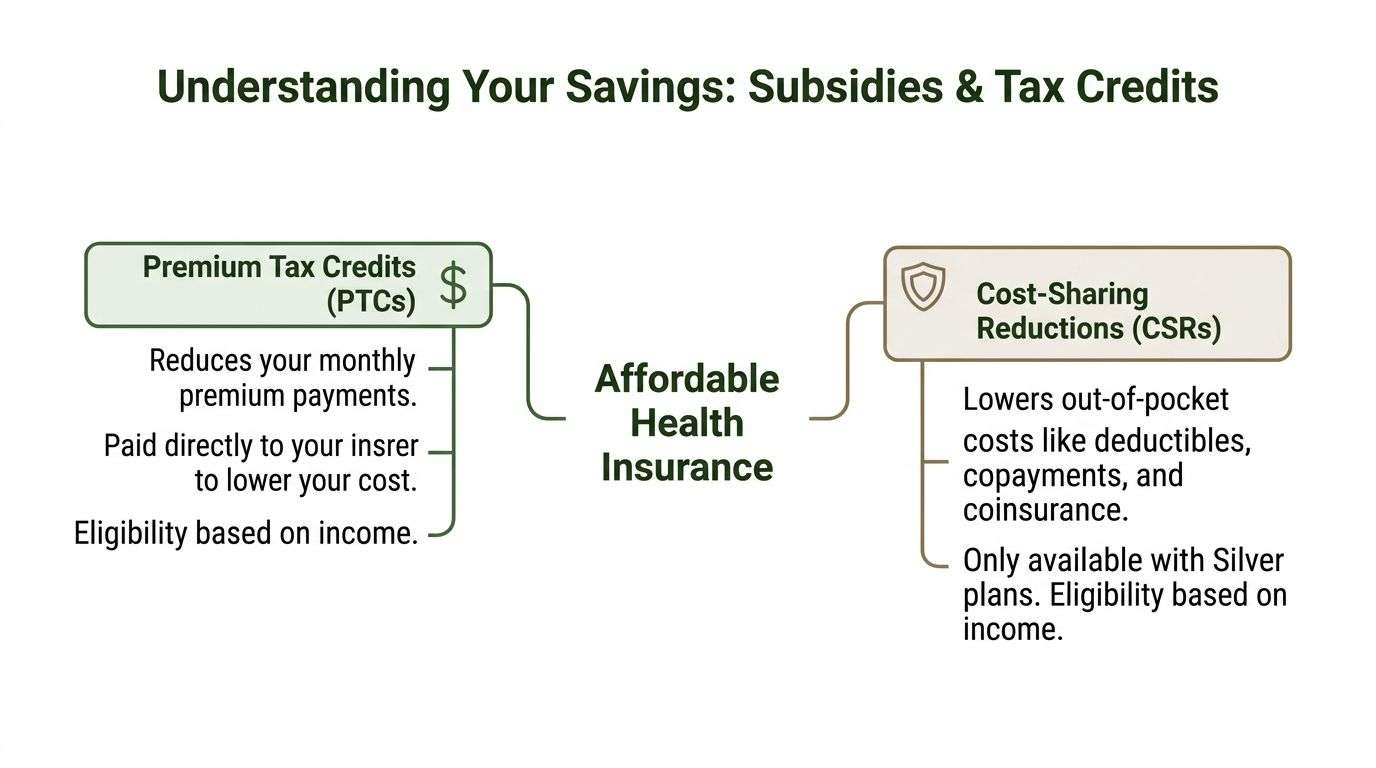
Premium Tax Credits Lower Your Monthly Premium
A Premium Tax Credit lowers the amount you pay each month for health insurance.
It works like a coupon applied before you pay the bill. The Marketplace estimates your discount based on your household details, then applies that help to your monthly premium if you choose to use it in advance.
The amount is based on factors such as:
- Household income
- Family size
- Where you live in Florida
- The cost of a benchmark Silver plan in your area
That last point confuses first-time applicants. Your subsidy is tied to a benchmark plan in your county, not to the exact plan you pick. In places like Tampa, St. Petersburg, or Clearwater, the benchmark can differ from one area to another, which changes the amount of help available.
Cost-Sharing Reductions Lower What You Pay When You Use Care
A Cost-Sharing Reduction, or CSR, is separate from the premium tax credit.
Instead of lowering your monthly bill, CSR lowers the cost of using the plan. That can mean a lower deductible, smaller copays, or a lower out-of-pocket maximum.
The easiest way to separate the two is this. Premium tax credits help you afford the plan each month. CSRs help the plan work better when you need doctor visits, tests, prescriptions, or hospital care.
There is one rule many applicants miss. CSRs only come with Silver plans.
Why A Silver Plan Can Be The Better Buy
Many people get tripped up here.
They sort plans from lowest premium to highest premium and assume the cheapest monthly option is the best value. That can be a costly mistake, especially for Florida families with regular pediatric visits, prescriptions, or ongoing specialist care.
A Bronze plan may still fit someone who rarely uses medical care and mainly wants protection against worst-case bills. But if you qualify for CSR, a Silver plan can lower your deductible and out-of-pocket costs enough to make it the better deal overall.
That matters a lot in Florida because provider networks can be tight. In the Tampa Bay area, a lower-premium plan only helps if your doctors, urgent care centers, and nearby hospitals are in network. A local broker can often spot a plan that looks cheap on paper but becomes expensive once you add out-of-network care or limited specialist access.
A Simple Example
Take two Tampa Bay shoppers.
One is a healthy self-employed web designer in Sarasota who mostly wants a lower monthly bill and sees a doctor once or twice a year. A Bronze plan may work fine.
The other is a parent in Brandon with two children, regular prescriptions, and a specialist visit every few months. If that household qualifies for CSR, a Silver plan may cost a little more each month but much less over the year.
The premium is only one part of the price.
Your Income Estimate Needs To Be As Accurate As Possible
Your subsidy is based on projected household income, so accuracy is important.
This is a common trouble spot for:
- Freelancers with uneven monthly income
- Small business owners whose revenue changes during the year
- Families adding or losing a job
- Contract workers with seasonal income swings
If you estimate too low, you may owe back some of the subsidy at tax time. If you estimate too high, you may miss savings you could have received during the year.
For self-employed Floridians, this part often feels harder than picking the plan. Income can rise, drop, or change month to month. The safest approach is to report major income changes during the year instead of waiting until you file taxes.
The Main Point
Marketplace savings come from two different tools. One lowers your monthly premium. The other can lower what you pay when you get care.
If you understand that difference before you shop, you are much less likely to choose a plan that looks cheaper at first glance but costs more when real life happens.
Choosing Your Plan Metal Tiers And Networks
A lot of Florida shoppers get stuck here.
They understand that a subsidy may lower the monthly premium, but then the screen fills up with Bronze, Silver, Gold, HMOs, PPOs, deductibles, and provider names. At that point, choosing a plan can feel like choosing a phone plan in another language.
The simplest way to sort it out is to separate the decision into two buckets. Metal tier tells you how you and the insurance company usually split costs. Network tells you which doctors, hospitals, and specialists the plan will treat as in-network.
Metal Tiers Tell You How Costs Are Shared
Bronze, Silver, Gold, and Platinum are not quality grades. They are pricing structures.
A warranty package is a good comparison. One version costs less upfront but leaves you with a bigger repair bill later. Another costs more upfront and covers more when something goes wrong. Health plans work in a similar way.
In general, Bronze plans have lower monthly premiums and higher out-of-pocket costs when you use care. Gold and Platinum usually flip that tradeoff. Silver sits in the middle. If you want a clearer explanation of the percentages behind those tiers, this guide on what actuarial value means in health insurance explains it in plain English.
How To Read The Tiers In Real Life
Here is the practical version:
- Bronze often fits a person who wants the lowest monthly premium and is comfortable taking on more risk if care comes up.
- Silver deserves a close look because it can work very differently depending on your income.
- Gold often appeals to people who expect regular doctor visits, ongoing treatment, or steady prescription costs.
- Platinum tends to have the highest monthly premium and the lowest cost when you receive care, where available.
For self-employed people in Florida, this choice often depends on cash flow. If your income changes month to month, a lower premium can feel safer. But if you already know you use care regularly, the lower premium can backfire once deductibles and copays start adding up.
Why Silver Deserves Extra Attention
Silver is the only metal tier tied to cost-sharing reductions for people who qualify.
That matters because a Silver plan can end up acting more like a richer plan than its name suggests. The monthly premium is only part of the story. For a Tampa family with pediatric visits, prescriptions, or a child seeing a specialist, the difference often shows up later in the deductible, copays, and out-of-pocket maximum.
So do not compare Bronze and Silver by premium alone. Compare how the plan behaves when real care is needed.
Networks Are Just As Important As The Metal Tier
A plan can look good on paper and still be a poor fit locally.
The network is the list of doctors, hospitals, labs, urgent care centers, and specialists that have contracts with the plan. If your care stays in-network, your costs are usually lower and more predictable. If you go outside the network, the bill can change fast.
The bill can change fast. Florida shoppers, especially in the Tampa Bay area, need more than generic federal guidance. The carrier name alone does not tell you whether your preferred Sarasota hospital or St. Petersburg specialist is included in the plan’s local network. This is a detail that generic advice often misses.
That point matters even more for families with established doctors and for self-employed applicants who cannot afford an expensive surprise halfway through the year.
HMO And PPO In Plain English
These labels confuse many first-time applicants because they sound technical.
An HMO usually keeps you inside a narrower provider group and may require referrals for specialist care. An PPO usually gives you more flexibility in choosing providers, although the details still depend on the plan.
Neither one is automatically better.
If you already have doctors you want to keep, a broader network may be worth paying for. If you mainly need preventive care, urgent care, and the occasional sick visit, a tighter network may work well if your local doctors and hospitals are included.
A Better Way To Shortlist Plans
Before you enroll, check the plan against your actual care habits, not just the premium box on the screen.
Start with these questions:
- Is your primary care doctor in-network?
- Are your current specialists in-network?
- Is your preferred hospital in-network?
- Are your prescriptions covered on the drug list?
- Do you need referrals to see specialists?
That short review prevents many of the mistakes Florida applicants make during open enrollment.
For Tampa Bay households, local help can be especially useful here. Two plans from the same insurer can have different provider access depending on county, hospital system contracts, and specialist groups. A local broker who works with Florida Marketplace plans every day can often spot those network differences faster than a first-time shopper scrolling through plan summaries on their own.
Marketplace Plans Versus Private Off-Exchange Plans
Many Florida shoppers assume all individual plans work the same way.
They do not.
The biggest dividing line is whether the plan is purchased on the Marketplace or off-exchange, meaning directly from an insurer or through a broker outside HealthCare.gov.
The Most Important Difference
If you want Premium Tax Credits or Cost-Sharing Reductions, you must generally enroll through the official Marketplace.
That is the single point many people need to remember.
An off-exchange plan may still be a legitimate private health plan, but if you buy outside the Marketplace, you generally give up access to Marketplace financial help. That can be a costly mistake for someone who qualifies for subsidies and does not realize where they must enroll to receive them.
Why Someone Might Still Consider Off-Exchange
There are valid reasons to look beyond the Marketplace.
A shopper may prefer a different network structure. Another may want to compare plan designs that are not the best fit on the federal platform. Some small business situations also point people away from the individual Marketplace route.
This is why the decision should be strategic, not automatic.
The Core Decision Is Financial And Practical
To clarify: If you may qualify for savings, start with the Marketplace. It is where the affordability advantage usually lives.
If you do not qualify for subsidies, or if local network needs push you toward different plan options, comparing off-exchange plans can make sense. In some cases, the better doctor access or plan structure may outweigh the simplicity of staying on the Marketplace.
A Good Shopper Uses Both Lenses
Do not ask only, “What is the premium?”
Ask:
- Am I giving up financial help by shopping off-exchange?
- Does this plan include the doctors and hospitals I care about?
- Is the deductible workable for my household?
- Would I rather save on premium or lower my risk when I need care?
Those questions turn a confusing shopping process into a decision with logic behind it.
How To Enroll And Find Local Help In Florida
The online application is manageable, but people still get stuck in the same places. Income estimates, household questions, and network checks create most of the friction.
The Basic Enrollment Flow
The process usually looks like this:
- Create an account on HealthCare.gov.
- Enter household details, including who needs coverage.
- Estimate household income for the coverage year.
- Review eligibility results for financial help.
- Compare plans available in your county.
- Confirm provider and prescription details before selecting a plan.
- Complete enrollment and pay the first premium if required for activation.
That sequence sounds simple, but the quality of the choices depends on the information you enter.
Where First-Time Applicants Get Tripped Up
Income is a big one.
Self-employed people often do not know what number to project, especially if income changes month to month. Families also struggle with household composition, tax filing assumptions, and whether a plan really covers the doctors they want.
A Florida policy source notes that self-employed professionals and small business owners in places like Bradenton and St. Petersburg face unique challenges around network adequacy and fluctuating income, and that generic guidance often misses how to confirm access to specific local specialists (Florida Policy Institute article).
Why Local Help Matters
A local helper can often spot issues that a general call center script will not.
For example:
- A Sarasota family may need to confirm whether a local hospital system is in-network under one carrier’s HMO.
- A Bradenton freelancer may need help estimating income conservatively enough to avoid tax-time surprises.
- A St. Petersburg shopper may want to compare carrier networks for a specific specialist.
Those are not abstract questions. They shape whether the plan works once real care begins.
Navigators And Brokers
Consumers can get help from navigators and brokers, but they serve somewhat different roles.
Navigators help people understand the Marketplace and application process. Brokers can also help compare plan options and may assist with both Marketplace and off-exchange choices, depending on the situation.
If you want guidance on how to evaluate that kind of assistance, this article on how to find the right Florida health insurance broker is a practical starting point. One example of a local option is Pounds Health Insurance, a Tampa Bay-based independent agency that works with multiple carriers and helps compare individual, family, and small-group options.
Human help is most valuable before you enroll, not after you discover your doctor is out-of-network.
Frequently Asked Questions About Florida Health Insurance
What If My Income Changes During The Year
Update your Marketplace application as soon as the change happens.
That matters because Premium Tax Credits are tied to projected income. When Floridians receive those credits, they reconcile them on their federal tax return using Form 8962. If income was underestimated, part of the subsidy may need to be repaid, although lower-income households may have capped repayment amounts, including examples ranging from $350 to $1,800 for a family in 2026, according to the Florida CFO guide already cited above.
Can I Get A Marketplace Plan If My Job Offers Insurance
Sometimes yes, but the details matter.
The presence of job-based coverage can affect whether Marketplace coverage is the right route and whether financial help is available. The practical move is to compare the employer offer with Marketplace options carefully before declining anything.
I Am Self-Employed. Should I Apply As An Individual Or A Small Business
Many self-employed Floridians shop as individuals or families, not as small groups.
A small misunderstanding in this area can send you down the wrong path, so it is worth checking before enrolling.
What If I Need Help With Insurance Questions After An Accident
Marketplace coverage issues and accident-related payment issues are not always the same thing.
If you are dealing with auto accident claims and want a plain-English explanation of how insurance reimbursement can work afterward, this article on paying back your health insurance gives useful context on a topic that confuses many policyholders.
Can I Change Plans Mid-Year
Usually only if you qualify for a Special Enrollment Period.
Without a qualifying life event, plan changes are typically limited until the next Open Enrollment window. That is one reason it pays to slow down and check networks, prescriptions, and expected care before locking in your first choice.
If you want one-on-one help comparing florida health insurance marketplace plans, checking local provider networks, or reviewing whether an off-exchange option makes more sense, Pounds Health Insurance offers Florida consumers guidance on individual, family, self-employed, and small business coverage.