

When you're looking at a health insurance plan, one of the most important numbers to find is the maximum out-of-pocket limit. This figure is the absolute most you will have to pay for covered, in-network medical services during your plan year. It’s your financial safety net.
Once you spend enough on healthcare to hit that limit, your insurance plan steps in and pays 100% of all eligible costs for the rest of the year. No more copays, no more coinsurance—you're covered.
Your Financial Safety Net In Health Insurance

A great way to think about your out-of-pocket maximum is to picture a circuit breaker in your home's electrical panel. If the system gets overloaded with too much current, the breaker trips, cutting the power to prevent a fire or major damage.
Your out-of-pocket limit does the exact same thing for your finances. It’s a built-in feature of your health plan that "trips" when your medical spending gets too high, protecting you from a catastrophic financial overload.
This cap brings a crucial element of predictability to the often-unpredictable world of healthcare costs. A major accident or a sudden illness could otherwise mean endless medical bills. With this limit, you know exactly what your worst-case spending for the year will be, which is a massive help for budgeting and your overall peace of mind.
How This Financial Protection Works
You don't just write a single check to meet your out-of-pocket maximum. Instead, you build towards it throughout the year as you pay for different medical services. Every dollar you spend on these in-network costs gets you closer to the limit:
- Deductibles: This is the lump sum you have to pay for your care before your insurance plan starts paying its share.
- Copayments: These are the flat fees you pay for certain services, like a $30 copay for a specialist visit.
- Coinsurance: This is your share of the cost after you've met your deductible, often a percentage like 20% of a hospital stay.
The core purpose of the out-of-pocket maximum is to protect individuals and families from the overwhelming costs associated with significant medical events. Once you hit this limit, your insurer takes over all covered, in-network expenses for the remainder of the year.
This spending cap is one of the most critical details to look at when you're shopping for a health plan. To really use this safety net effectively, it helps to start by understanding your income and expenses.
Knowing this number allows you to compare policies based on more than just the monthly premium. For example, some people feel more secure with a higher-premium plan that has a lower out-of-pocket limit, a structure you might also see in the best catastrophic health insurance plans. This strategy ensures that if the worst happens, their total financial exposure is kept firmly in check.
What Counts Toward Your Out-Of-Pocket Maximum

Knowing exactly which expenses chip away at your out-of-pocket maximum is essential for managing your healthcare budget. Think of it like filling up a large bucket throughout your plan year. Every qualified dollar you spend on medical care is another scoop of water getting you closer to the top.
Once you've filled that bucket, your plan's best feature kicks in: your insurance company starts covering 100% of your eligible, in-network medical bills for the remainder of the year. The trick is knowing which "scoops" actually count.
The Building Blocks of Your OOP Maximum
Generally, your out-of-pocket limit is met by three main types of payments you make for covered, in-network care. These are the expenses that work together to trigger that full coverage.
Here’s what typically counts:
- Your Annual Deductible: This is the big one. It's the amount you have to pay for covered services before your insurance even starts to share the costs. Every single dollar you pay toward your deductible also counts toward your OOP maximum.
- Your Copayments: These are those fixed, predictable fees you pay for certain appointments or prescriptions—like the $40 you might pay to see a specialist. They seem small, but they absolutely add up and contribute to your limit.
- Your Coinsurance: This is your share of the cost after you’ve met your deductible. If your plan has 20% coinsurance for a surgery, your 20% portion of the final bill is a big chunk that goes directly toward hitting your OOP max.
Properly tracking these expenses is vital. That's why improving clinical documentation is so important behind the scenes; it ensures every eligible cost is recorded correctly and applied to your limit, so you don't end up overpaying.
Tracking Your Progress Toward The Limit
Every time you pay for a covered, in-network medical service, you’re getting closer to that financial safety net. To be certain about the specifics, your best bet is to always refer to your plan's Evidence of Coverage document. For a deeper dive, check out our guide on understanding your Evidence of Coverage.
The key takeaway is that your deductible, copays, and coinsurance aren't separate financial hurdles. They all work together, adding up to the same finish line: your out-of-pocket maximum.
It's also crucial to remember that these limits aren't set in stone and often increase annually. For instance, for plans starting on or after January 1, 2026, the out-of-pocket maximum for an individual is set to increase to $10,600. That’s a 15.2% jump from $9,200 in 2025. For families, the limit will climb to $21,200, also a 15.2% increase from $18,400.
What Costs Don't Count Toward Your Out-of-Pocket Max?
Knowing what gets you closer to your out-of-pocket maximum is a huge relief, but it's only half the story. Understanding what doesn't count is just as important—it’s how you avoid the sticker shock of a huge medical bill you thought was chipping away at your limit.
Think of it like a loyalty program. You only get points for specific purchases, and some things you buy just aren't eligible. Health insurance works the same way; not every dollar you spend on "health" actually counts toward your financial safety net.
The Big Four: Expenses That Are Always Excluded
One of the most common pitfalls is assuming that every check you write for healthcare is moving the needle on your out-of-pocket max. That's just not how it works. A few major expenses are always kept on a separate tab.
Here’s what you should never expect to count:
- Your Monthly Premiums: This one is simple. Your premium is the fee you pay every month just to keep your insurance active. It's like a gym membership—you pay it whether you go or not, and it doesn't count toward the cost of a personal training session.
- Services Your Plan Doesn't Cover: Most plans won't cover things that aren't deemed medically necessary, like elective cosmetic surgery. Since the insurance company was never going to pay for it anyway, you’re responsible for 100% of the bill, and none of that spending helps you reach your OOP max.
- Out-of-Network Care: This is probably the most frequent and expensive surprise for people. If you see a doctor or go to a hospital that isn't in your plan's approved network, those payments usually won't apply to your in-network out-of-pocket maximum. Getting a handle on this is crucial, and you can learn more about this in our detailed guide.
- Charges Above the "Allowed Amount": Insurance companies negotiate discounted rates with their in-network doctors. If you go out-of-network, that provider might charge way more than this pre-negotiated "allowed amount." You're often on the hook for the difference, which is called "balance billing," and that extra payment won't count.
Knowing what's excluded from your out-of-pocket calculation is just as crucial as knowing what's included. It empowers you to make smarter decisions, stay in-network, and forecast your real financial risk for the year.
The single best habit you can build is to always, always verify that your doctors, labs, and hospitals are in-network before you get care. It’s a simple step that ensures your payments are actually working for you and protects you from those nasty, unexpected bills.
Putting It All Together: A Real-World Out-of-Pocket Max Example
Definitions are one thing, but seeing how an out-of-pocket maximum plays out in real life is what makes it all click. Let's walk through a year with Sarah to see how these numbers actually work.
Sarah’s health plan has a $3,000 deductible and a $9,000 out-of-pocket (OOP) maximum. These two figures are her financial guardrails for the year.
First, The Journey To The Deductible
A few months into the year, Sarah starts dealing with nagging back pain. She sees her primary care doctor, who sends her to a specialist. That leads to a few more appointments and an MRI.
- Every visit and test has a price tag.
- Initially, Sarah pays 100% of these in-network medical bills herself.
- After a few months, her spending adds up and hits $3,000.
Just like that, Sarah has met her deductible. Now, her insurance plan finally starts to share the load. This is where her coinsurance kicks in.
Hitting The Out-of-Pocket Max
Later in the year, her doctor determines that a minor outpatient surgery is the best fix for her back. The total bill for the procedure is a hefty $30,000, and her plan’s coinsurance is 20%.
Because her deductible is already met, she’s only on the hook for her share of the coinsurance. So, her part is 20% of $30,000, which works out to $6,000.
Once she pays that, her total spending for the year hits $9,000 ($3,000 from the deductible + $6,000 from coinsurance).
Sarah has officially hit her $9,000 maximum out-of-pocket limit. For the rest of the plan year, her insurance company picks up 100% of the tab for all covered, in-network medical care. Her financial responsibility is done.
While Sarah’s story shows how the limit works, it's worth noting that most people don't actually hit their max. In 2023, folks with employer-sponsored plans paid an average of $869 out-of-pocket. That’s a far cry from the max, but that average has jumped 37% since 2013, which tells you a lot about the trend of rising healthcare costs. You can dig into more of this data on the Health System Tracker.
The Safety Net In Action
To really see the power of the OOP max, let's fast forward a few months. Sarah has a completely unrelated accident and ends up in the emergency room. The visit and treatment rack up a $15,000 bill.
How much does Sarah pay? $0.
Because she already hit her out-of-pocket maximum, her insurance plan covers the entire $15,000. This is exactly what the OOP max is designed for—it's a hard stop on your medical spending, a true financial shield that protects you from catastrophic costs.
Of course, not every dollar you spend on healthcare gets you closer to this limit. Things like your monthly premiums don't count, and neither does out-of-network care.
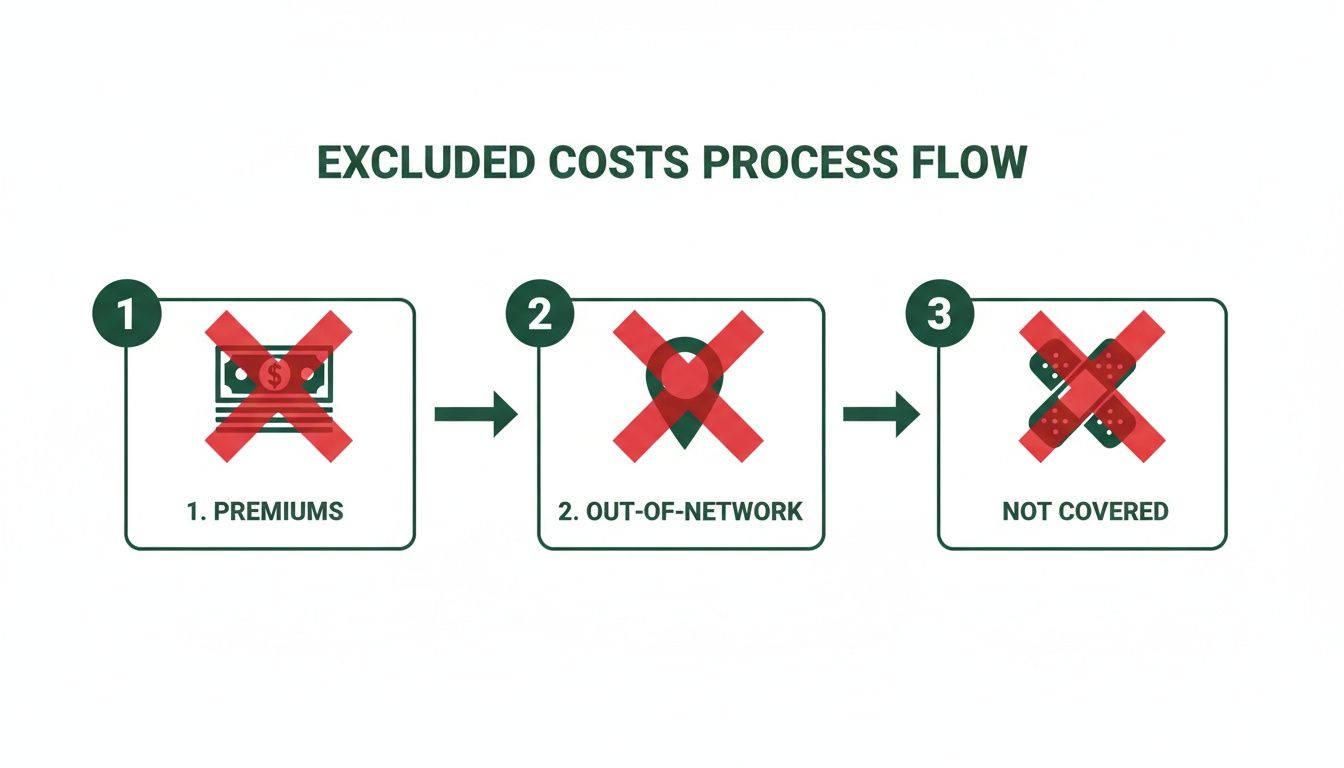
As the graphic shows, it’s only your payments for covered, in-network services—your deductible, copays, and coinsurance—that count toward reaching that all-important maximum.
How It Works For ACA And Employer Plans
The basic idea of an out-of-pocket maximum is the same everywhere, but the rules can change quite a bit depending on where you get your insurance. Whether you’re covered through the Affordable Care Act (ACA) Marketplace or a plan from your job, these subtle differences can have a big impact on your wallet.
Getting a handle on these distinctions is key to picking a plan that actually protects you when you need it most. The way these plans are set up affects how fast you hit your limit and, just as importantly, how that limit applies to your whole family.
ACA Marketplace Protections
For any plan you buy on the public health insurance marketplace, federal law puts a firm cap on your annual out-of-pocket maximum. This is a huge consumer protection that prevents any ACA-compliant plan from leaving you with unlimited medical bills for covered, in-network services.
This federal ceiling gives you a predictable top end for your medical spending each year. But, it's tied to the ever-rising cost of healthcare. For instance, forecasts for 2026 point to some serious premium hikes on the ACA marketplaces. One analysis from KFF estimates that if the current premium tax credits expire, people with subsidized plans could see their monthly payments skyrocket by an average of 114%. You can read more about how premium changes affect affordability from KFF's research.
Employer Plans And Family Limits
Health insurance from your employer often has a more complicated setup, especially when you’re covering a family. This is where the fine print around individual and family limits can really catch people off guard.
Many of these plans use what's called an "embedded" individual out-of-pocket maximum. Let's break that down with an example:
- Family Maximum: The plan has a high total out-of-pocket maximum for the whole family, say $18,000.
- Individual Maximum: But within that family limit, there's a lower cap for each person on the plan, like $9,000.
This embedded limit is a safety net for each person. If one family member has a major health issue and their personal spending hits that $9,000 individual maximum, the insurance company starts covering 100% of their eligible costs for the rest of the year.
The other family members, however, still have to pay their own way with deductibles and coinsurance until the entire family's combined spending hits that big $18,000 family maximum. This two-level system is a critical detail to understand.
These rules really bring home why you have to look closely at your options. The nuances between ACA and employer plans, especially the mechanics of family limits, can mean thousands of dollars in difference to your potential financial risk. If you want to get back to basics on job-based coverage, take a look at our guide on what is employer-sponsored health insurance. This is where getting expert guidance can be a game-changer, making sure the plan you pick is truly the right fit for your family.
Frequently Asked Questions About OOP Maximums
Even after you've got the basics down, it’s completely normal for a few questions to pop up about how these out-of-pocket maximums work in the real world. Let's clear up some of the most common points of confusion so you can feel totally in control of your health insurance costs.
Think of this as fitting the last few pieces of the puzzle into place.
Does My Out Of Pocket Maximum Reset Every Year?
Yes, it sure does. Both your out-of-pocket maximum and your deductible hit the reset button and go back to zero at the start of your plan year. For most of us, that's January 1st.
This means any money you spent toward your limits in the previous year doesn't carry over. It’s a crucial detail to keep in mind, especially if you're scheduling medical care that could span from the end of one year into the beginning of the next.
How Does The OOP Maximum Work On A Family Plan?
Family plans have two numbers you need to watch: an individual OOP maximum and a total family OOP maximum.
Here's how it works: Once one person on the plan hits their individual limit, the insurance company starts covering their eligible, in-network care at 100%. That's great for them, but it doesn't mean the whole family is covered yet.
The rest of the family members still have to pay their share until everyone's combined spending hits that higher family OOP maximum. Once that happens, the plan covers 100% of eligible care for every single person on the plan for the remainder of the year.
This two-tiered system of individual and family maximums is standard on most employer plans. Getting a handle on how they work together is the key for any family trying to budget for their total potential medical spending.
Is A Lower Out Of Pocket Maximum Always Better?
Not always, and this is where it gets interesting. A plan with a lower OOP max definitely gives you a stronger financial safety net for a worst-case scenario. But that security almost always comes with a significantly higher monthly premium. It’s the classic trade-off.
On the flip side, a plan with a higher OOP max will have lower monthly premiums. This can save you a bundle if you stay healthy and don't need much care. You’ll see this structure in many plans, and you can dive deeper into a popular option in our guide to what is a high deductible health plan.
The "best" plan really boils down to your own life and circumstances:
- Your budget: How much can you comfortably spend on premiums each month?
- Your health: Do you expect to need a lot of medical care in the coming year?
- Your risk tolerance: How comfortable are you with the possibility of a large medical bill?
If you know you have significant medical needs on the horizon, paying more each month for that lower OOP max can be a brilliant financial strategy. But if you're generally healthy, you might prefer to pocket the monthly savings and accept the higher potential risk.
Juggling the details of deductibles, family limits, and out-of-pocket maximums can feel like a lot, but you don't have to figure it all out by yourself. The experts at Pounds Health Insurance are here to offer clear, no-pressure guidance to help you find a plan that actually fits your life and your budget. Contact us today for a free consultation at https://poundshealthinsurance.com.











