

If you've ever gotten health insurance through a job, you're already familiar with employer-sponsored health insurance. It’s the most common way Americans get coverage, and for good reason. At its core, it’s a health plan your company offers as part of your benefits package.
Your employer does the heavy lifting: they shop for plans, negotiate rates for the entire team, and pay for a big chunk of the cost. This group buying power means everyone usually gets a better deal than they could find on their own.
What Is Employer-Sponsored Health Insurance, Really?

Think of it like a wholesale club membership for your healthcare. Instead of you going out and trying to find a plan alone, your employer buys coverage in bulk for the whole team. This partnership is what makes employer-sponsored health insurance work.
The company usually covers a significant portion of the monthly premium—the fee that keeps your plan active. Your share is then deducted straight from your paycheck, often before taxes are taken out. This little accounting trick actually lowers your taxable income, saving you a bit of money come tax season.
The Key Players and Their Roles
It’s a simple three-way relationship, with each party playing a distinct part:
- The Employer: They act as the plan sponsor. They choose the insurance plans, negotiate the terms with the insurance company, and pay a large slice of the premium costs.
- The Employee (You): You decide whether to enroll in the plan, pay your portion of the premium, and are the one who actually uses the benefits to see a doctor or fill a prescription.
- The Insurance Company: This is the provider behind the plan. They manage the network of doctors and hospitals, process your medical claims, and handle the administrative side of things.
This model is a cornerstone of the broader insurance industry, which thrives on spreading risk across large groups of people.
Why This Coverage Is So Common
Employer-sponsored plans are the backbone of the U.S. healthcare system, covering roughly 154 million people under the age of 65.
But access isn't universal. While nearly all large companies (97%) offer health benefits, the picture is different for smaller businesses. According to a recent KFF survey, only 59% of small firms provide health coverage, which creates a real challenge for their employees.
This fundamental structure—a blend of shared costs and pre-selected options—is how millions of Americans navigate their healthcare needs every day.
Decoding The Alphabet Soup Of Health Plans
When your employer hands you the benefits packet, the acronyms can feel like a different language. HMO, PPO, HDHP… what does it all mean? It’s easy to feel a little lost, but cracking this code is the first step toward picking a plan that actually works for you and your family.
Think of these plan types as different roadmaps for your healthcare. Some give you a very clear, guided path, while others offer more of a free-roaming, scenic route. The best one for you really boils down to what you value most: lower monthly costs, the freedom to choose your own doctors, or something in between.
The HMO: A Guided Tour Of Your Healthcare
A Health Maintenance Organization (HMO) is a bit like a well-organized guided tour. At the center of it all is your primary care physician (PCP), who acts as your personal tour guide for all things health-related.
For most medical needs, you'll start with your PCP. If you need to see a specialist, like a cardiologist or an allergist, your PCP will give you a referral to someone within the plan’s network. Speaking of networks, they're a big deal with HMOs. You generally have to use doctors, hospitals, and clinics that are part of the HMO's network for your care to be covered, except in a real emergency.
The payoff for following these rules? HMOs typically have lower monthly premiums and more predictable costs, making them a solid choice if you want to keep your budget in check and prefer a structured approach to your healthcare.
The PPO: A Flexible Travel Pass
On the other hand, a Preferred Provider Organization (PPO) is more like an all-access travel pass. You have a "preferred" network of providers, but you’re not stuck with it. You have the freedom to see doctors both inside and outside that network.
Want to see a specialist? You don't need a referral from your PCP—you can just make the appointment yourself. This flexibility is a huge draw for many people, but it does come at a higher price. Premiums for PPOs are usually higher than for HMOs, and you'll pay more out-of-pocket if you decide to go out-of-network. If you want maximum control over your healthcare choices and don't mind paying a bit more for it, a PPO is often the way to go.
The most popular plan type offered by employers is the PPO, with 49% of covered workers enrolled in one. This highlights how many people value the freedom to choose their own doctors and specialists without needing a referral.
The HDHP: The Pay-As-You-Go Option
Then there’s the High Deductible Health Plan (HDHP), which works more like a pay-as-you-go model. These plans come with low monthly premiums, but the trade-off is a higher deductible—that’s the amount you have to pay out-of-pocket for medical care before your insurance starts chipping in.
The real power of an HDHP is its partnership with a Health Savings Account (HSA). This is a special savings account you can use for medical expenses, and it comes with a triple tax advantage: the money you put in is tax-deductible, it grows tax-free, and you can withdraw it tax-free for qualified medical costs.
Even better, the money in your HSA is yours to keep, forever. It rolls over year after year and you can take it with you if you change jobs. Getting a handle on all these moving parts is important, and you can dive deeper by understanding health insurance terminology in our complete guide.
HMO vs PPO vs HDHP At A Glance
Feeling a bit of information overload? It happens. Sometimes seeing the key differences laid out side-by-side makes it all click. This breakdown of the core features of each plan type can help you quickly compare what matters most to you.
HMO (Health Maintenance Organization):
- Premiums & Deductible: Lower monthly premiums and lower (or no) deductible.
- Doctor Choice: You must stay within the plan’s network.
- PCP & Referrals: You must have a Primary Care Physician (PCP), and referrals are required to see specialists.
- Best For: Individuals who want predictable costs and a coordinated approach to care.
PPO (Preferred Provider Organization):
- Premiums & Deductible: Higher premiums and deductibles than HMOs.
- Doctor Choice: You have the flexibility to see both in-network and out-of-network doctors (though out-of-network costs more).
- PCP & Referrals: No PCP is required, and you do not need referrals for specialists.
- Best For: People who want flexibility and direct access to specialists and are willing to pay more for it.
HDHP (High Deductible Health Plan):
- Premiums & Deductible: The lowest monthly premiums but the highest deductible.
- Doctor Choice: Varies, as an HDHP can be structured like an HMO or a PPO.
- PCP & Referrals: Depends on whether the plan is an HMO- or PPO-style plan.
- Best For: Healthy individuals who want low premiums and the tax-advantaged savings of a Health Savings Account (HSA).
Ultimately, there’s no single "best" plan—only the plan that's best for your specific health needs, budget, and personal preferences.
Breaking Down Your Share Of The Costs
Figuring out what you'll actually pay for healthcare can feel like trying to solve a puzzle with half the pieces missing. Fortunately, with an employer-sponsored plan, you’re not going it alone. The costs are split between you and your company, which makes a huge difference in your wallet.
Let's walk through the key terms you'll see so you know exactly where your money is going.
First up is the premium. Think of this like a monthly subscription fee for your health coverage. It’s a fixed amount, usually taken right out of your paycheck, that keeps your plan active. The good news? Your employer typically foots a huge chunk of this bill—often 70-80%—making your portion much more manageable than buying a plan on the open market.
What You Pay When You Actually Need Care
Before your insurance really kicks in to cover the big stuff, you’ll have a deductible. This is the set amount you have to pay out-of-pocket for medical services each year. For instance, if you have a $1,000 deductible, you'll cover the first $1,000 of your healthcare costs. After you hit that mark, you and your insurance company start sharing the bills.
But hitting your deductible doesn't mean you stop paying altogether. From that point on, you’ll usually run into two other costs:
- Copayments (Copays): These are the straightforward, flat fees you pay for certain services. Think a $30 copay for a regular doctor's visit or maybe $50 to see a specialist.
- Coinsurance: This is a percentage of the total bill that you're responsible for after your deductible is met. If your plan has 20% coinsurance, you pay 20% of the cost, and your insurer handles the other 80%.
This diagram helps show how different types of plans balance these costs.
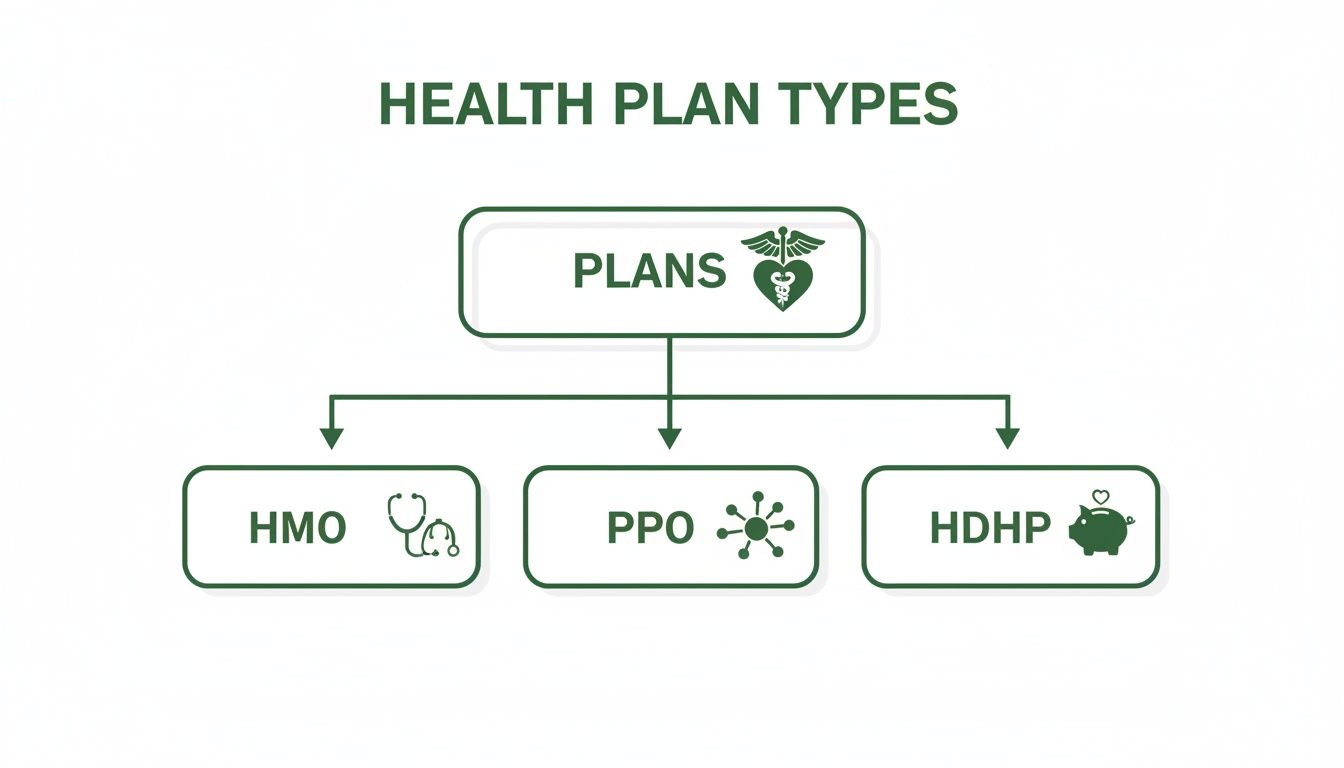
As you can see, plans like HMOs tend to focus on keeping your out-of-pocket costs predictable and low, while HDHPs are designed to have lower monthly premiums. It's all about different financial trade-offs.
Seeing It In Action
Let's put this into a real-world scenario. Say you visit a specialist, and the total charge is $200. If your plan has a $30 copay and you've already met your deductible, you simply pay that $30 at the front desk. Your insurance takes care of the rest.
Now, imagine you have a more serious procedure that costs $5,000 (after your deductible is paid). With 20% coinsurance, your share would be $1,000 ($5,000 x 0.20). Your insurance plan would then pay the remaining $4,000.
These costs can add up, but every plan has a financial safety net. This is where your what is out-of-pocket maximum comes in—it’s the absolute most you’ll have to pay for covered services in a single year.
How To Get Covered And When You Can Make Changes
When it comes to your employer's health plan, timing is everything. You can’t just sign up or switch plans on a whim. There are specific, designated times when you can enroll or make adjustments to your coverage.
The main event is the Open Enrollment Period. This is the one time each year, usually in the fall, when the doors swing open for you to pick, change, or even drop your health coverage for the year ahead. Think of it as the annual shopping season for your benefits.
Once you’ve made your decisions during open enrollment, you're generally locked in until the next one rolls around. That’s why it’s so critical to review all your options and think about what healthcare you and your family might need over the next 12 months.
When Life Changes Your Plans
But what happens if you get married in March or have a baby in July? You're not stuck. Life is full of surprises, and the rules have a built-in exception for these moments: the Special Enrollment Period (SEP).
An SEP is a 60-day window triggered by a specific, government-recognized life event that lets you change your health plan outside of the usual open enrollment season. These events are significant enough that they fundamentally change your coverage needs, giving you a chance to adapt.
A Special Enrollment Period is your opportunity to adjust your coverage mid-year in response to significant life changes. Missing this window could mean waiting until the next open enrollment, potentially leaving you without the right coverage when you need it most.
So, what kind of events kick off an SEP? Here are a few common examples:
- Changes in Your Household: Big family changes like getting married, having a baby, or adopting a child all qualify.
- Loss of Other Health Coverage: If you or a dependent loses health insurance—say, your spouse loses their job and their coverage along with it—you can get on your employer’s plan.
- Changes in Residence: Moving to a new ZIP code or county where your current plan's network doesn't exist can also trigger an SEP.
Navigating these life changes can be stressful enough without adding insurance confusion to the mix. To get a clear picture of what counts, it's worth learning more about an insurance qualifying life event and what steps you need to take. Just remember to act fast—you typically only have 60 days from the date of the event to make your changes.
Keeping Your Coverage After You Leave A Job

Leaving or losing a job throws a lot of things up in the air, and your health insurance is often the biggest question mark. The great news is you don't have to face a gap in coverage. Federal law provides a crucial safety net to help you stay insured while you figure out your next move.
The option most people have heard of is the Consolidated Omnibus Budget Reconciliation Act, or COBRA. This law lets eligible employees hang onto their employer's health plan for a limited time after their job ends. It's like extending your membership—you get to keep the exact same plan, which means your doctors stay the same and any progress you've made toward your deductible carries over.
Understanding The Cost Of COBRA
So, what's the catch? While keeping your plan sounds perfect, the cost can be a real shock. When you elect COBRA, you become responsible for paying the entire premium. That includes the part you were paying plus the (often much larger) portion your employer was covering.
To top it off, companies can legally add a 2% administrative fee. This means you could be on the hook for 102% of the plan's total cost, which is a massive financial burden for most people, especially when you've just lost your income. COBRA is a fantastic bridge, but it's often a very expensive one.
It's a particularly important consideration for those nearing the end of their careers. For instance, there are specific health insurance options for retired federal employees that are worth exploring.
Exploring More Affordable Alternatives
Thankfully, COBRA isn't a take-it-or-leave-it deal. The Affordable Care Act (ACA) Marketplace is another excellent—and often more affordable—avenue for coverage. Losing your job-based insurance is a "qualifying life event," which triggers a Special Enrollment Period, allowing you to shop for a new plan on the Marketplace right away.
Here’s why the ACA Marketplace is often a better fit:
- Income-Based Subsidies: You might qualify for premium tax credits that can dramatically lower your monthly payments. These subsidies are based on your projected income for the year, not your old salary.
- Cost-Sharing Reductions: If your income is within a certain range, you could also get a plan with lower out-of-pocket costs, like deductibles and copays.
- A Wide Variety of Plans: The Marketplace lets you compare plans from multiple insurance carriers. This gives you the power to find one that truly matches your new budget and healthcare needs.
The key takeaway is that you have choices. While COBRA offers continuity, the ACA Marketplace frequently provides a more affordable solution tailored to your current income, preventing a gap in your health coverage.
The best move is to weigh your options carefully. Think about your family's medical needs and your current budget to find the path that gives you the most security. To learn more about your choices, check out our guide on finding health insurance without a job.
Weighing The Pros And Cons Of Group Insurance
Employer-sponsored health insurance is a cornerstone of benefits packages in the U.S., but it’s not a one-size-fits-all solution. It’s a package deal with real trade-offs. For employees, it’s about balancing cost savings against personal choice. For business owners, it's a strategic decision that pits talent acquisition against financial and administrative burdens.
Let's break down what this really means for both sides of the desk.
The Upside for Employees and Employers
For most employees, the biggest and most immediate win is the cost. It's simple math: when your employer covers a significant chunk of the premium—often 70-80%—your monthly bill is dramatically lower than anything you could find on your own. On top of that, your employer’s HR team does all the heavy lifting of vetting plans, which saves you a ton of time and stress.
This creates a powerful win-win situation.
From the employee's perspective, the benefits are clear:
- Lower Premiums: With the company footing most of the bill, high-quality health insurance becomes accessible and affordable.
- Tax Savings: Your contribution to the premium is almost always taken out of your paycheck pre-tax, which lowers your total taxable income. It’s a small but meaningful financial perk.
- Guaranteed Coverage: Worried about a pre-existing condition? Don't be. Group plans are required to cover you, no questions asked.
- Simple Sign-Up: No need to navigate the confusing marketplace on your own. The enrollment process is streamlined and managed for you.
For employers, offering health insurance is a game-changer, especially for small businesses:
It’s one of the most effective tools you have for attracting and keeping great people. Health benefits are consistently one of the top things candidates look for in a job. Plus, every dollar a business contributes to employee health premiums is tax-deductible, turning a major expense into a smart financial move.
If you're thinking about this for your company, our guide on group health insurance for employees breaks down the entire process.
Acknowledging The Downsides
Of course, it's not all sunshine. The main drawback for employees is the lack of options. Your employer chooses the plan (or a couple of plans), and that’s what you get. If the network doesn't include your trusted doctor or the deductible is higher than you’d like, you don't have much say in the matter.
Another big one? Your health insurance is tethered to your job. If you leave—whether you quit or are laid off—you lose that coverage. While COBRA exists, it’s often prohibitively expensive.
For business owners, the challenges are equally significant. The cost is the elephant in the room. Providing health insurance is a massive financial commitment. Beyond the price tag, there’s the administrative headache of managing enrollment, compliance, and employee questions, which can easily overwhelm a small team.
That’s why this decision requires a hard look from all angles. By weighing these pros and cons, both individuals and businesses can figure out if a group plan truly aligns with their financial health and long-term goals.
Your Top Employer Health Insurance Questions, Answered
It's completely normal to have a lot of questions when you're trying to make sense of your health benefits. Let's break down a few of the most common ones we hear all the time.
Can I Add My Family to My Plan?
Yes, this is one of the biggest advantages of a workplace plan. Most employer-sponsored policies let you cover your spouse and dependent children. Thanks to the ACA, your kids can typically stay on your plan until they turn 26.
Of course, adding family members will raise your monthly premium. But it's almost always more affordable than trying to buy a separate health insurance policy for each person on the individual market.
What if My Doctor Isn't in the Network?
This is a critical question, and the answer really comes down to what type of plan you have. If you're enrolled in an HMO, you're pretty much stuck with in-network doctors and facilities. The only exception is a true, life-threatening emergency.
PPO plans, on the other hand, offer more flexibility. You can see an out-of-network doctor, but be prepared to pay a lot more out of pocket. Your insurance will cover a much smaller portion of the bill than it would for an in-network visit.
Your health plan is tied to your job, but the care you receive is personal. Always verify if your preferred doctors are in-network before enrolling in a plan to avoid unexpected and costly medical bills down the road.
Navigating the world of health insurance doesn't have to be complicated. Whether you're a small business owner exploring group options or an individual looking for the right coverage, Pounds Health Insurance can provide clear, no-pressure guidance. Explore tailored health insurance options today.











