

Let's be honest, health insurance premiums can be a major budget-buster. That's where the Health Insurance Premium Tax Credit (PTC) comes in. It’s a powerful tool created under the Affordable Care Act (ACA) specifically to help everyday people and families cover the cost of health insurance bought through the Marketplace.
Think of it less like a complicated tax rule and more like a direct discount on your monthly health insurance bill. It’s a refundable tax credit, which is just a fancy way of saying the government helps pay a portion of your premium, making comprehensive coverage much more affordable.
Your Guide To The Premium Tax Credit

At first glance, the term "premium tax credit" can seem a bit intimidating. But the core idea is simple: it’s designed to close the gap between the full price of a health plan and what your household can realistically afford to pay. Instead of just reducing your taxable income, this credit acts like an instant coupon applied right at the source, lowering your out-of-pocket costs every single month.
This guide will walk you through everything you need to know, moving from the basic definition to the nitty-gritty of who qualifies, how your credit amount is figured out, and the different ways you can get this financial help. Our goal is to empower you to take control of your healthcare expenses with confidence.
How Does The PTC Work?
The whole system is built on a simple premise: you shouldn't have to spend more than a set percentage of your income on health insurance. The PTC works by capping your premium contribution based on your income. The government then steps in to cover the rest of the cost for a mid-level "benchmark" plan.
It's a huge benefit, especially for self-employed individuals, freelancers, or anyone who doesn't have access to affordable health insurance through a job.
Here are the most important things to know:
- You must buy through the Marketplace. To get the credit, you have to enroll in a plan through your state's official Health Insurance Marketplace (or HealthCare.gov).
- It’s all about your income. The size of your credit is directly linked to your estimated household income for the year you need coverage.
- You have a choice. You can take the credit in advance to lower your monthly payments (most people do this) or get it all back as a lump sum when you file your federal tax return.
Thanks to recent legislation, more people qualify for these credits now than ever before. For anyone exploring their options, figuring out how to find affordable health insurance almost always begins with seeing if you're eligible for this credit. Understanding these basics is the first step toward making a smart, informed decision for your health and your wallet.
Who Qualifies for the Premium Tax Credit?
So, how do you know if you can actually get this credit? It's a great question, and figuring out if you're eligible is the first real step toward cutting your monthly health insurance bill.
The Premium Tax Credit isn't a free-for-all; there’s a specific checklist of requirements set by the government. Think of it as a puzzle—your income, access to other health plans, tax filing status, and where you buy your insurance are all pieces that have to fit together perfectly.
Checking the Main Eligibility Boxes
Let's get right to it. To qualify for the PTC, you generally need to be able to say "yes" to the following:
- You must buy your health plan through the Health Insurance Marketplace. The credit is designed specifically for these plans. If you buy directly from an insurance company (off-Marketplace), you won't be able to claim it.
- Your household income needs to be in a specific range. This is a big one. Your income is compared to the federal poverty level (FPL), and it has to fall within certain limits.
- You can't have access to other affordable coverage. This is key. If you have an offer of "affordable" insurance from your job or are eligible for programs like Medicare or most types of Medicaid, you typically won't qualify for the PTC.
- You have to file a federal tax return. Even if you normally don't owe taxes or aren't required to file, you must file a return to get this credit. You also can't use the "Married Filing Separately" status, except in very rare situations.
These rules are in place to make sure the credit helps the people it was designed for: individuals and families who don't have other good, affordable insurance options.
The health insurance premium tax credit (PTC), introduced under the Affordable Care Act (ACA) in 2014, subsidizes marketplace premiums for individuals and families earning between 100% and 400% of the federal poverty level (FPL). Enhancements via the 2021 American Rescue Plan Act, extended through 2025, temporarily removed the 400% FPL income cap, dramatically boosting affordability.
Income and the Federal Poverty Level
Your household income is probably the most important piece of the puzzle. The government uses a benchmark called the federal poverty level (FPL) to figure out who qualifies for financial help.
Your specific income number—your Modified Adjusted Gross Income (MAGI), to be exact—is compared to the FPL for your family size. For example, the income threshold for a single person is much lower than for a family of four. It's a sliding scale designed to make sure the amount of help you get is directly related to your financial situation and how many people you need to cover.
Understanding how your income lines up with these levels makes navigating all the different Florida health insurance options much less confusing, because you'll have a clear idea of what savings you might be eligible for.
What if I Can Get Insurance Through My Job?
This is a really common question and a major source of confusion. What if your employer offers you a health plan?
Here’s the rule: if your job offers a plan that is considered both "affordable" and provides "minimum value," you are not eligible for the premium tax credit.
- An "affordable" plan means your share of the premium for self-only coverage is less than a certain percentage of your household income.
- "Minimum value" means the plan is designed to cover at least 60% of total average medical costs.
It doesn't matter if you turn down that workplace plan and buy one on the Marketplace instead. The simple fact that you had access to that qualifying coverage from your job is what disqualifies you from getting the tax credit.
How Your Premium Tax Credit Is Calculated
Trying to figure out the math behind your premium tax credit can feel a bit overwhelming at first, but it really just comes down to two key pieces of information. The final amount hinges on your estimated household income for the upcoming year and the price of a specific "benchmark" health plan in your local area.
Essentially, the system uses these two numbers to determine what the government believes is an affordable monthly premium for someone in your financial situation. Your tax credit is the difference between that affordable amount and the actual cost of the benchmark plan, making sure you don't have to pay more than you reasonably can for essential coverage.
This flowchart lays out the basic eligibility steps you need to clear before the calculation even starts.
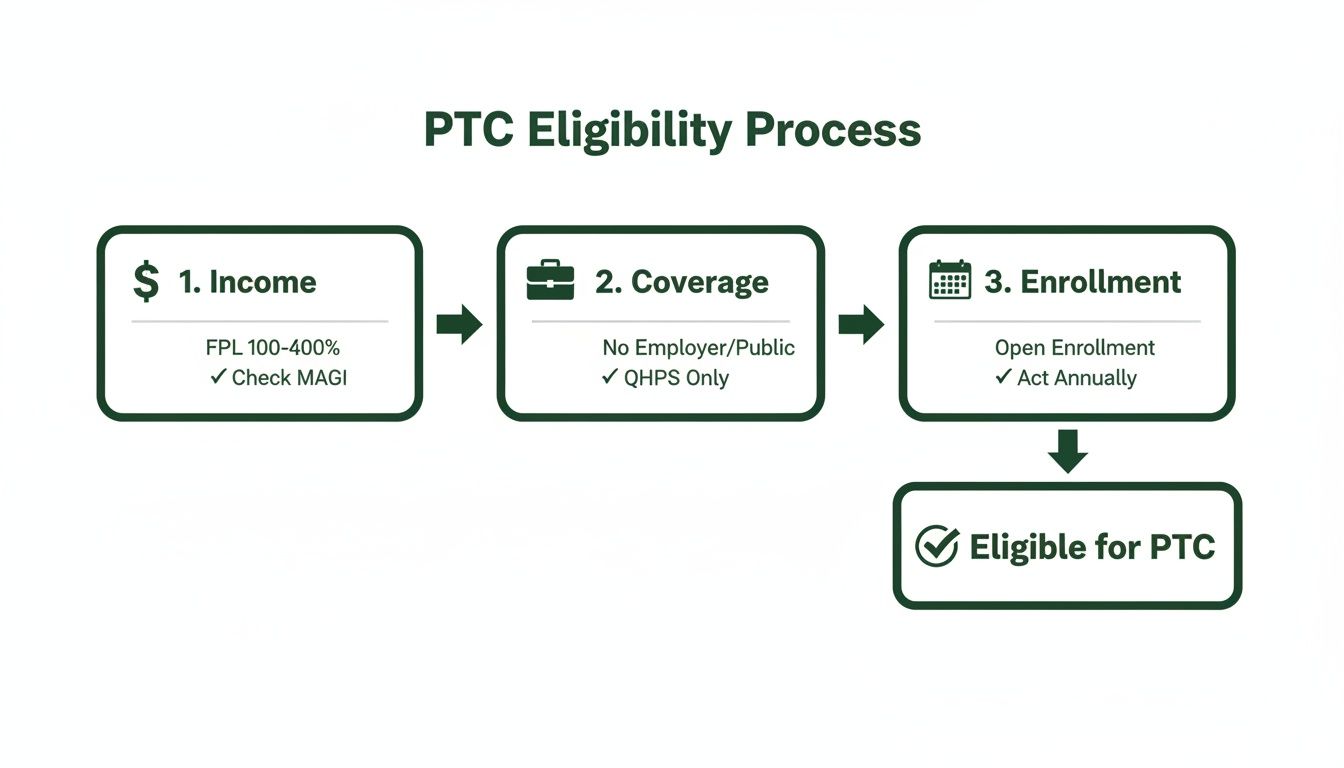
As you can see, your income, access to other coverage, and enrollment choices are the gates you pass through on the path to qualifying for the credit.
The Role of The Benchmark Plan
The entire calculation is pegged to one specific plan: the second-lowest cost Silver plan (SLCSP) available to you through the Health Insurance Marketplace. Think of the SLCSP as the official yardstick for measuring how much assistance you can get.
It's a common point of confusion, but you don't actually have to buy this specific plan. You are free to choose a Bronze, Gold, or even a different Silver plan. The key thing to remember is that the amount of your tax credit is always calculated based on the price of that one benchmark SLCSP.
This system gives you flexibility. If you pick a plan that costs less than the benchmark, your tax credit might cover the entire monthly bill. If you go for a more expensive plan, you'll just pay the difference. For a deeper dive into these plan types, our guide on understanding health insurance terminology is a great place to start.
A Practical Calculation Example
Let's walk through an example to see how this works in the real world.
Imagine a family of four with an estimated annual household income of $60,000. Based on this income, the Affordable Care Act determines they shouldn't be expected to pay more than 4% of their income for health insurance. This comes out to $200 per month.
Now, let's say the benchmark plan (the SLCSP) in their county costs $1,200 per month. Here’s how the numbers break down:
- Benchmark Plan Cost: $1,200 per month
- Family's Affordable Contribution: $200 per month
- Premium Tax Credit Amount: $1,000 per month ($1,200 – $200)
In this scenario, the family is eligible for a $1,000 tax credit each month. They can apply this $1,000 to almost any plan on the Marketplace. If they choose to enroll in the $1,200 benchmark plan, their final monthly cost would be just $200.
This example really shows how the tax credit bridges the gap between the full premium and what a family is expected to contribute, making coverage far more accessible.
Advance Payments vs. Year-End Reconciliation
Once you find out you qualify for the premium tax credit, you have a big decision to make: do you want the help now or later? This choice really comes down to two different ways you can receive your credit.
Most people go with what's called the Advance Premium Tax Credit (APTC). It's the most common and immediate way to put your credit to work. Instead of waiting until tax time, the government sends your credit directly to your insurance company every month. This payment lowers your monthly bill on the spot, making your budget a lot easier to manage right from the start.
How Do Advance Payments Work?
Think of the APTC like an instant coupon you use at checkout. When you sign up for a plan on the Health Insurance Marketplace, you’ll give them your best guess for what you’ll earn in the upcoming year. Based on that estimate, the Marketplace figures out your credit and starts paying it for you.
All you have to do is pay the difference. For example, if your plan’s premium is $600 and your APTC is $500, you only owe $100 out of pocket each month. This is what makes good health insurance affordable for so many people—it breaks down a potentially large cost into manageable monthly chunks.
The other option is to pay the full premium yourself every month. Then, when you file your federal income taxes, you'd claim the entire credit you’re owed as a single lump sum. It's less common, but this approach might work for someone whose income is hard to predict or who just prefers to settle their finances all at once at the end of the year.
The All-Important Step: Reconciliation
Here’s the catch if you take the advance payments: you have to do something called reconciliation at the end of the year. It’s basically like settling up your account with the IRS. When you file your taxes, you’ll compare the advance credit payments you received (which were based on your estimated income) with the actual credit you qualify for based on your final income.
This is all done on IRS Form 8962, the Premium Tax Credit form.
- If you got too much APTC: This usually happens if you ended up earning more than you estimated. You might have to pay back some or all of the extra credit you received.
- If you got too little APTC: This happens if you earned less than you thought you would. The extra credit you were owed gets added to your tax refund or lowers the amount of tax you owe.
The key thing to remember is that the APTC is just an estimate. Reconciliation is the process that makes sure you get the exact amount of help you were entitled to by law—no more, no less.
To avoid a nasty surprise on your tax bill, it is crucial that you report any big life changes to the Marketplace as they happen. These events can change your eligibility and the amount of your credit.
Be sure to report things like:
- A new job or a pay raise
- Losing a job or source of income
- Getting married or divorced
- Having a baby or adopting a child
- Anyone moving into or out of your home
Reconciling your APTC is a standard part of filing your taxes each year. For a more comprehensive overview of getting your financial documents in order, a general guide on preparing for tax season can be a great resource. Keeping your Marketplace profile updated is the best way to keep your advance payments accurate and avoid any financial headaches down the road.
Applying for Your Health Insurance Subsidy

Thankfully, you don't have to fill out a separate, complicated form to get the Premium Tax Credit. The application is woven directly into the Health Insurance Marketplace enrollment process. As you enter your information—like your household size and what you expect to earn for the year—the system does the heavy lifting, instantly figuring out if you qualify and how much you could save.
This integrated approach makes it much easier to access the financial help you need. The application walks you through it, so you can see your potential savings in real-time as you compare plans. For a full walkthrough of the entire process, our guide on how to get health insurance covers every step.
What Was the “Subsidy Cliff”?
You may have heard the term “subsidy cliff,” and it used to be a major problem. It described a harsh financial drop-off where if your household income went even one dollar over 400% of the Federal Poverty Level (FPL), you lost your entire premium tax credit. Imagine your monthly premium suddenly jumping by hundreds of dollars because of a tiny raise.
Fortunately, that cliff has been temporarily removed. Thanks to the American Rescue Plan Act and the Inflation Reduction Act, the rigid 400% income cap is gone for now. Instead, your premium contribution is capped at 8.5% of your household income, making coverage accessible for many more middle-income families who were previously stuck.
Getting rid of the income cap was a game-changer. It created a gradual, common-sense ramp for premium costs instead of a sudden, punishing cliff at an arbitrary income level.
The Subsidies Are Set to Expire—What Happens Next?
Here’s the catch: these enhanced subsidies are not permanent. They are scheduled to expire at the end of 2025. If Congress doesn’t extend them, the old 400% FPL income cap will snap back into place, and millions of families will face a severe financial shock.
The numbers are pretty stark. Research from KFF projects that if these subsidies expire, the average annual premium for people receiving them could leap by a staggering 114%. This isn't just a small price bump; it's a massive increase that could force families to make impossible choices between health coverage and other basic needs. You can read the full research about these projections from KFF to see the data for yourself.
If the subsidy cliff returns, we could see:
- Massive Premium Spikes: Households earning just a little over the 400% FPL mark would be hit the hardest.
- Coverage Losses: Many people will simply be priced out of their plans, likely leading to a jump in the uninsured rate.
- Serious Financial Strain: Even families who manage to keep their insurance will feel the squeeze on their monthly budgets.
This looming deadline really highlights how crucial the PTC is for keeping healthcare affordable across the country. It's more than just a tax credit; for millions, it's the lifeline that makes health insurance possible.
The Bro-ader Economic Impact Of The PTC
The Premium Tax Credit isn’t just about helping individual families afford their monthly health insurance bill. Its effects ripple out, touching the entire national economy and the healthcare system as a whole. That's why the ongoing debate in Washington about extending these enhanced credits is so critical—it’s a conversation with huge consequences for insurance coverage rates, market stability, and even state economies.
At its core, it's about simple market dynamics. When health insurance is more affordable, more people sign up. Crucially, this includes younger and healthier individuals who might otherwise skip coverage. This influx of healthier members creates a more balanced insurance pool, which helps spread the financial risk and can lead to lower premiums for everyone.
Extending Credits To Stabilize The Market
So, what happens if these enhanced credits aren't extended? We could see a negative spiral. If millions of people suddenly lose their subsidies, many will be forced to drop their coverage. This would leave a smaller, sicker, and more expensive group of people in the Marketplace, driving premiums up for everyone left and potentially pricing even more people out of the market.
This isn't just speculation. It’s a scenario that organizations like the Congressional Budget Office (CBO) analyze closely.
A permanent extension of the enhanced credits could have a profound effect on the U.S. healthcare landscape, influencing not just individual affordability but the fundamental stability of the insurance marketplaces.
A recent CBO analysis projected that making the enhanced credits permanent would lead to 3.6 million more Americans having health insurance by 2030. Better yet, the same report suggests that benchmark plan premiums could drop by an average of 7.6% each year thanks to a healthier mix of people enrolled. You can dive into the full analysis of the PTC extension on the CBO's website to see all the details.
Economic Consequences For States
The impact of letting these credits expire wouldn't be felt evenly across the country. Some states would be hit much harder than others.
Areas with higher initial insurance costs or a larger population of people eligible for subsidies could see a huge jump in their uninsured rates. This, in turn, puts a massive strain on local hospitals and community health centers, which often have to absorb the cost of caring for people without insurance.
For a closer look at your own financial picture, our guide on how to save money on health insurance offers some great practical tips. Ultimately, the future of the PTC is more than just a political talking point; it's a vital economic issue with direct implications for your wallet and the health of our entire healthcare system.
Common Questions (And Real-World Answers) About the Premium Tax Credit
It’s one thing to understand the premium tax credit in theory, but it's another to apply it to your own life. Let's walk through some of the most common questions and sticky situations people run into.
"What If My Income Changes Mid-Year?"
This is probably the single most important question to ask. Life happens—you get a raise, change jobs, or your freelance work dries up. When it does, you absolutely need to update your income information on the Health Insurance Marketplace right away.
Think of it like the GPS on your phone recalculating the route. If your income goes up, the Marketplace will likely adjust your tax credit down. Taking care of this immediately means you won’t get hit with a surprise bill when you file your taxes next year.
On the flip side, if your income drops, you could be eligible for a bigger credit, which would lower your monthly payments for the rest of the year. Staying on top of this is the key to keeping your subsidy and your budget in sync.
"I Have Insurance at Work. Can I Still Get This Credit?"
In most cases, unfortunately, no. If your employer offers a health plan that meets the government's standards for being "affordable" and providing "minimum value," you won't be eligible for a tax credit on the Marketplace.
So, what do those terms actually mean?
- Affordable: This has a specific definition. It means your share of the premium for a self-only plan costs less than a certain percentage of your household income (this percentage changes slightly each year).
- Minimum Value: This means the plan is designed to cover at least 60% of the total average costs for medical services.
Even if you don't sign up for your work plan, the simple fact that it was offered to you is usually enough to disqualify you from receiving the premium tax credit.
"Is It Possible I'll Have to Pay the Credit Back?"
Yes, it's possible, but it’s also avoidable. You only have to pay back the credit if the advance payments you received during the year (the APTC) were more than the final credit amount you actually qualified for based on your end-of-year income.
This is exactly why reporting income changes is so critical. It’s the difference between owing the IRS or getting a refund. If it turns out you received less in advance payments than you were truly eligible for, you’ll get the remaining amount back as a credit on your tax return.
Figuring out health insurance and tax credits can feel like a puzzle, but you don't have to solve it alone. The team at Pounds Health Insurance lives and breathes this stuff, and we're here to give you clear, straightforward help. We can help you find a plan that fits your life and your budget.
Ready to see what's possible? Get a free, no-pressure quote today and discover how affordable your coverage can truly be.











