
When you hear the term coinsurance, think of it as a cost-sharing deal you have with your insurance company. After you’ve paid a certain amount out of your own pocket for medical care (that’s your deductible), your insurer steps in to cover the lion's share of your bills.
But they don't cover 100% of it just yet. Coinsurance is the percentage of the bill you're still responsible for paying. It’s your share of the cost.
Your Guide To Understanding Coinsurance
Health insurance can feel like its own language, packed with confusing terms. Coinsurance is one of those terms that often trips people up, but it's actually pretty straightforward once you get the hang of it.
Think of it as a partnership. Once you’ve met your annual deductible, your health plan starts paying for most of your care. The portion you continue to pay is your coinsurance.
Unlike a copay, which is a flat fee (like $25 for a doctor's visit), coinsurance is a percentage. You’ll often see it described as a split, like 80/20 or 90/10.
- In an 80/20 plan, your insurance company pays for 80% of the covered medical cost.
- You pay the remaining 20% of that bill.
To really get a feel for coinsurance, it helps to understand how it fits into the bigger picture of what comprehensive medical insurance provides. It's a key piece of the puzzle that directly impacts what you’ll spend on more significant medical services.
The Coinsurance Analogy
Let's try a simple analogy. Picture your health plan as a big dinner bill you’re splitting with a friend. Your deductible is the amount you agreed to pay first, all by yourself.
Once you've paid your part of the bill (the deductible), you and your friend (the insurer) start splitting the rest. If you agreed to 20% coinsurance, you'd chip in 20 cents for every dollar of the remaining bill, while your insurer covers the other 80 cents.
This cost-sharing keeps going until you hit your out-of-pocket maximum for the year—a safety net we'll discuss later. For now, just remember that coinsurance kicks in after your deductible is met.
Getting these basic terms down is the first step to feeling confident about your coverage. Our guide to understanding health insurance terminology can help you build that foundation so you know exactly how all these moving parts affect your wallet.
Seeing Coinsurance in Action with a Real Example
It's one thing to talk about definitions, but it’s another to see how the numbers actually work when you’re facing a big medical bill. Let’s walk through a real-world scenario to make sense of how your deductible, coinsurance, and out-of-pocket maximum all work together to protect you.
Imagine your health plan has these details:
- Deductible: $3,000
- Coinsurance: 80/20 (Your plan pays 80%, you pay 20%)
- Out-of-Pocket Maximum: $6,350
Now, picture this: an unexpected surgery leaves you with a hospital bill for $150,000. That number is enough to make anyone’s head spin, but your insurance is designed to shield you from the full impact. Here’s a step-by-step look at what you’d actually pay.
Your Initial Responsibility: The Deductible
Before your insurance company starts splitting the costs with you, you have to meet your deductible. Think of it as your initial contribution for the year.
In this scenario, you're on the hook for the first $3,000 of that bill. Once you pay that, your deductible is officially met for the year. That brings the remaining balance down to $147,000 ($150,000 – $3,000).
The Cost-Sharing Phase: Coinsurance Kicks In
With your deductible out of the way, the 80/20 coinsurance kicks in. Now, you and your insurer are partners in paying the rest of the bill. Your 20% share of the remaining $147,000 would be a whopping $29,400.
But don't panic. You won't actually have to pay that much, and that’s because of your plan’s most important feature.
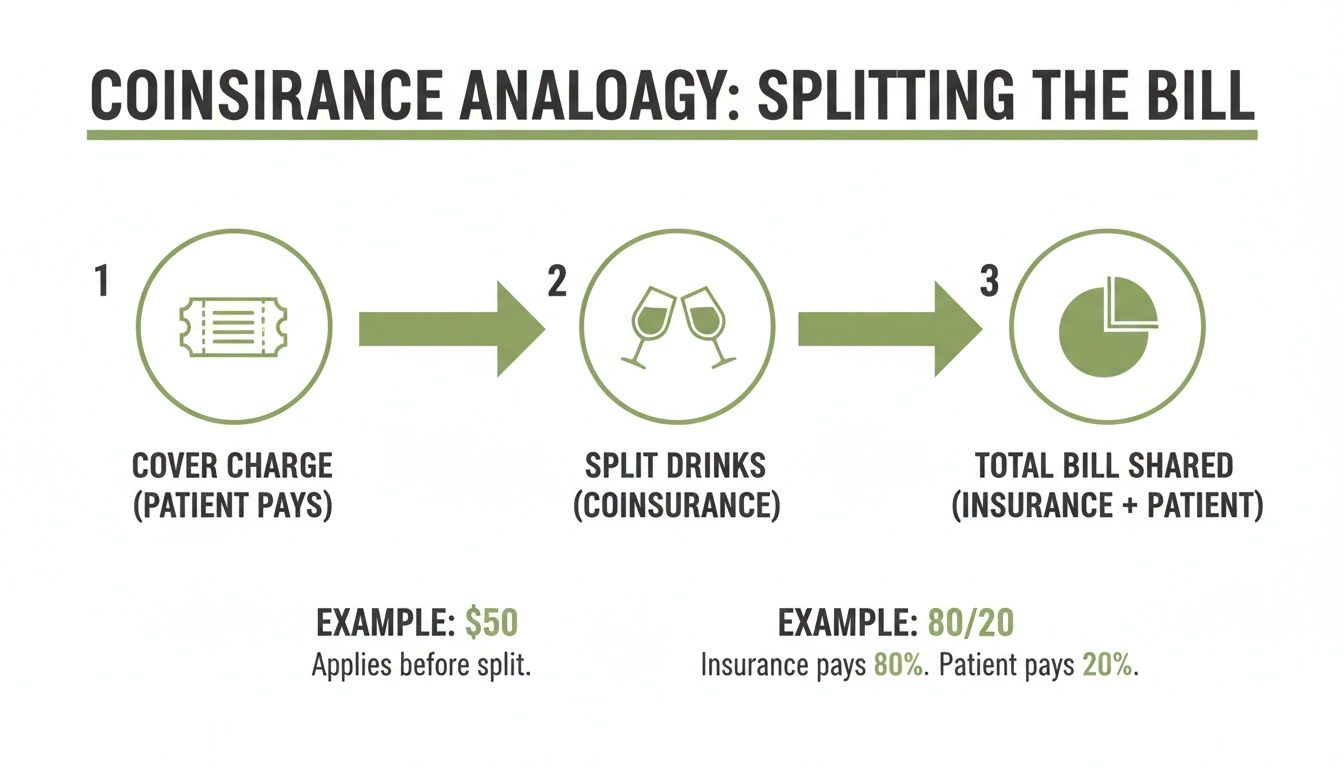
This is where the real cost-sharing begins. You've paid your "cover charge" (the deductible), and now it's time to start "splitting the bill" (the coinsurance).
Your Financial Safety Net: The Out-of-Pocket Maximum
This is where your plan saves the day. Your out-of-pocket maximum is the absolute most you will have to pay for covered medical services in a single year. For this plan, that number is $6,350.
You've already paid your $3,000 deductible, and that payment counts toward your maximum. This means you only need to pay an additional $3,350 in coinsurance before you hit your safety net.
Once your total payments for the year—your $3,000 deductible plus $3,350 in coinsurance—reach the $6,350 out-of-pocket maximum, you are done paying for covered services. Your insurance company takes over and pays 100% of the rest.
So, for that $150,000 hospital bill, your total cost is capped at $6,350. Your insurance covers the remaining $143,650. This is the true power of an out-of-pocket maximum.
Of course, these numbers apply to care you receive from approved doctors and hospitals. The costs can change dramatically if you go outside your plan's approved list, which you can learn more about by reading our guide on the difference between in-network vs. out-of-network providers.
Coinsurance, Copay, and Deductible: What's the Difference?

To really get a handle on coinsurance, you have to see how it fits in with two other major players in your health plan: the deductible and the copay. These three things are the building blocks of what you’ll pay out-of-pocket for your healthcare. They might sound alike, but each one has a very specific job.
Think of them as steps in a process. They don’t all happen at once; instead, they kick in at different times as you use your insurance. Let’s walk through the order of operations to see what each one means for your wallet.
Your First Step: The Deductible
The deductible is the amount you have to pay for your medical care before your insurance company starts chipping in. It’s a set dollar figure—say, $3,000 or $5,000—that resets every year. Until you’ve spent enough to hit that number, you are paying 100% of your covered medical bills.
Think of your deductible as the price of admission. You have to pay this amount first to unlock the full cost-sharing benefits of your plan, like coinsurance.
This is usually the biggest financial hurdle you have to clear each year. We go into a lot more detail in our guide on what a health insurance deductible means.
Your Fixed Fee: The Copay
A copay (short for copayment) is a simple, fixed fee you pay for a specific service. It’s a predictable cost. For instance, you might have a $30 copay for a regular doctor’s visit or a $50 copay when you see a specialist.
You’ll usually pay this fee right at the front desk when you check in for your appointment. The big difference between a copay and coinsurance is that a copay is:
- A set amount: You know exactly what it will be every time. It doesn't change based on the total cost of the visit.
- Sometimes independent of your deductible: On many plans, certain services (like a standard doctor visit) only require a copay, even if you haven’t met your yearly deductible yet.
Your Percentage Share: Coinsurance
And that brings us back to coinsurance. This is where things get different because coinsurance isn't a flat fee—it’s a percentage. You only start paying coinsurance after you’ve met your annual deductible. This is the part where you and your insurance company truly start sharing the costs.
While a copay is a predictable flat fee like $20-$30, your coinsurance payment will vary. You might pay 18% of a hospital stay or 20% of the bill for a major surgery, while your insurer covers the other 82% or 80%. As you can see, the higher the bill, the more your coinsurance share will be.
Let's try a simple analogy. Imagine you and a friend go out for a big dinner:
- Your deductible is like an agreement where you have to pay the first $50 of the total bill all by yourself.
- Copays are like paying a flat $5 for every soda you order, no matter how much the food costs.
- Coinsurance kicks in after you’ve paid that initial $50. Now, you and your friend (the insurance company) agree to split the rest of the food bill, with you paying 20% of what's left.
How Your Out-of-Pocket Maximum Protects You
While the idea of paying a percentage of your medical bills can sound scary, you're not on the hook for an infinite amount. Every health plan includes a crucial financial safety net called the out-of-pocket maximum. This is the absolute most you will have to pay for covered medical services in a single year.
Think of it as the ultimate spending cap for your healthcare. Once your combined payments for your deductible, copays, and coinsurance add up to this number, you stop paying. Your insurance plan takes over from there.

Hitting Your Financial Finish Line
Let's go back to that hospital stay example from before. Your total out-of-pocket payments were capped at $6,350. Even though your 20% coinsurance share of the remaining bill was technically a much larger number, you only had to pay enough to reach your out-of-pocket maximum.
Once you hit that limit, your insurance company picks up 100% of the cost for all covered services for the rest of your plan year. This is arguably the single most important protection your health plan offers against catastrophic medical bills.
The out-of-pocket maximum ensures that even in a worst-case scenario, there is a clear and defined limit to what you will have to pay. It transforms an unpredictable financial risk into a manageable, capped expense.
This protection is a fundamental part of modern health insurance. For instance, all those coinsurance payments you make directly chip away at your out-of-pocket maximum—which averaged $4,848 for single coverage in 2023 Marketplace plans. After hitting this cap, insurers cover everything, offering a critical shield against financial disaster, especially when some family deductibles can climb as high as $12,500. You can find more helpful insights on how these plan features work together in Aetna's health guide.
Why This Matters For Your Financial Health
Understanding your out-of-pocket maximum is essential when you're choosing a health plan. It tells you, in plain dollars, your total potential financial exposure for the year. A lower maximum can give you greater peace of mind, but these plans usually come with a higher monthly premium.
This cap is also your best defense against medical debt spiraling out of control. It’s a safeguard that helps you budget for healthcare and prevents an unexpected illness or injury from turning into a long-term financial burden. Still, it's wise to be aware of potential gaps in health insurance coverage that could still lead to surprise bills.
Finding A Health Plan With The Right Coinsurance
Choosing the right coinsurance level is a balancing act. It’s a strategic choice between what you pay every month for your premium and what you might have to pay out-of-pocket when you actually need care. There’s no magic number here—the best fit comes down to your health, your budget, and your comfort with financial risk.
Think of it this way: a plan with lower coinsurance, like a 90/10 split, means your insurer picks up 90% of the tab after you’ve met your deductible. You’re only on the hook for 10%. This predictability is great, but that extra security usually comes with a higher monthly premium.
On the flip side, a plan with higher coinsurance, maybe 70/30 or even 60/40, will almost always have a lower monthly premium. You save money month-to-month, but if you need to see a doctor or go to the hospital, your share of the bill will be significantly larger.
Matching Coinsurance To Your Health Needs
The best way to figure this out is to look at your own health and medical history. Let's walk through two common situations to see how this plays out in the real world.
For the Healthy Individual: If you're in good health and your doctor visits are mostly for routine check-ups, a plan with higher coinsurance (like 70/30) paired with a higher deductible can be a very smart financial move. You'll enjoy lower premiums all year, and since your odds of needing major medical care are low, you're less likely to face that larger cost-sharing percentage.
For Managing a Chronic Condition: If you have an ongoing condition that requires regular specialist visits, treatments, or prescriptions, a plan with lower coinsurance (like 90/10) is often the way to go. Yes, the premium is higher, but it’s a fixed, predictable cost. You’ll pay much less each time you need care, which provides a critical financial safety net and prevents medical bills from spiraling.
The right coinsurance creates a balance between what you pay every month and what you might have to pay if you get sick. It’s about aligning your plan's cost-sharing structure with your expected healthcare usage.
Making An Informed Decision
At the end of the day, you have to weigh these trade-offs. Ask yourself: could my budget handle a larger chunk of a surprise medical bill if it meant saving on premiums all year? Or is the peace of mind that comes from knowing my share will always be small worth a higher monthly payment?
Navigating these decisions can feel overwhelming, but you don't have to figure it all out on your own. Getting a handle on how to compare health insurance plans is the perfect starting point for finding a policy that truly works for you. A simple, clear comparison can transform a confusing process into a confident choice.
How We Can Help You Put It All Together
Figuring out the difference between a copay and coinsurance is a great first step. But let's be honest, staring at a screen with dozens of health plan options, trying to guess which one is right for you? That's a whole different ballgame.
This is where having a real person to talk to can make all the difference. At Pounds Health Insurance, our job is to turn all that confusing insurance-speak into simple, clear choices that actually make sense for your life and your wallet. We're not here to just sell you a plan; we're here to find you the right one.
Choosing a health plan is one of the most important financial decisions you'll make all year. Our goal is to replace that feeling of uncertainty with confidence, knowing you've got the best possible value and protection for your family.
Finding a Plan That Fits You, Not the Other Way Around
The best plan is one that strikes the right balance between what you pay each month and what you might have to pay if you get sick or injured. Our process is straightforward and, most importantly, it's all about you.
- We Start by Listening: Before we even look at plans, we want to hear about you. What are your family's health needs? What prescriptions do you take? What's a comfortable budget for you?
- We Do the Shopping for You: As an independent agency, we aren't tied to any single insurance company. We can compare plans from all the major carriers to find the ones that are a genuine fit for what you told us.
- We Make it Make Sense: We’ll sit down with you and lay out the top options in plain English. We'll show you exactly how the deductible, coinsurance, and out-of-pocket max would work for each one in a real-world scenario, so you can see the complete picture before you commit.
Ready to Take the Next Step?
You don't have to go it alone. Navigating the world of health insurance can be a headache, but it doesn't have to be. Best of all, our guidance and expertise won't cost you a dime.
If you're ready to find a health plan that truly works for you, let's talk. Schedule a free, no-pressure consultation with one of our friendly agents today. We're here to answer your questions and help you get the peace of mind you deserve.
Got Questions? We've Got Answers: Your Coinsurance FAQ
Even after you've got the basics down, a few tricky questions about coinsurance always seem to pop up. Think of this as your go-to cheat sheet for those "what if" moments. We've compiled the questions we hear most often to clear up any lingering confusion.
Let's dive in and make sure you feel totally confident about how your plan works in the real world.
Does My Coinsurance Apply To Every Single Medical Service?
Not necessarily, and this is a really important detail to know. Coinsurance typically kicks in for major services like hospital stays, surgeries, or visits to a specialist—but only after you’ve paid your deductible.
However, there's a major exception: preventive care. Thanks to the Affordable Care Act (ACA), most plans are required to cover a list of preventive services at 100%, even before you touch your deductible. This usually includes things like:
- Your annual physical or well-woman exam
- Standard immunizations (like the flu shot)
- Certain health screenings, such as blood pressure or cholesterol checks
The best way to know for sure is to look at your plan’s Summary of Benefits and Coverage (SBC). It will spell out exactly what's covered and when.
What's The Big Deal Between In-Network and Out-of-Network Coinsurance?
The difference is huge, and it can have a massive impact on your wallet. Insurers negotiate lower rates with "in-network" doctors and hospitals, and they pass those savings on to you.
For example, your plan might have a 20% coinsurance for an in-network specialist. But if you see an out-of-network doctor, that rate could easily jump to 40% or even 50%.
Worse yet, the out-of-network coinsurance is calculated from the insurer's "allowed amount," not what the doctor actually bills. If the doctor charges more, they can bill you for the difference—a nasty surprise called "balance billing." Sticking to your plan's network is hands-down one of the smartest ways to keep your medical costs predictable.
Can I Use My HSA or FSA to Pay for Coinsurance?
Yes, you absolutely can! Coinsurance is considered a qualified medical expense, which means you can pay for it using the funds in your Health Savings Account (HSA) or Flexible Spending Account (FSA).
This is a fantastic financial strategy. Because you contribute to these accounts with pre-tax money, you’re essentially getting a discount on your medical bills. It’s an incredibly effective way to budget for your share of healthcare costs.
Navigating the world of health insurance can feel overwhelming, but you don't have to figure it all out on your own. At Pounds Health Insurance, our job is to provide clear, personalized guidance to help you find a plan that truly fits your life and budget.
Ready to find the right coverage? Let's talk. You can schedule a free consultation today and get the expert advice you deserve.