
Hiring your next great employee is hard enough. Keeping that person is harder when a larger company down the street can wave a richer package in front of them. Most small business owners feel that pressure before they ever feel “ready” to offer benefits.
That’s why learning how to offer benefits to employees matters so much for a company with fewer than 50 people. You’re not trying to copy a giant employer. You’re trying to build a package that fits your budget, makes sense for your team, and helps good employees say yes to your job offer and no to your competitors.
Why Offering Benefits Is A Small Business Superpower
A small business rarely wins by outspending a larger one. It wins by being more intentional. Benefits are one of the clearest places to do that.

If you’ve had an employee leave for “better benefits,” you already know this isn’t just an HR topic. It affects hiring speed, retention, morale, and how stable your business feels month to month. A thoughtful benefits package tells employees you’re building a real company, not just filling shifts.
The money side matters too. Employers in the United States spend an average of 32% of total compensation on benefits beyond salary, and for an employee earning $75,000 annually, that can equate to $24,000 in benefits costs according to employee benefits statistics compiled here. That’s exactly why benefits can’t be treated like a last-minute add-on.
Benefits Change The Hiring Conversation
When a candidate compares two offers, salary gets attention first. Then the practical questions show up fast.
- Health coverage matters: Employees want to know what the deductible looks like, which doctors are in network, and how much payroll deduction they’ll pay.
- Time off signals culture: PTO, leave policies, and schedule flexibility tell people what day-to-day life will feel like.
- Financial support builds trust: Retirement contributions, life insurance, and supplemental options show that you’re thinking beyond this month’s paycheck.
A small employer with a clear, well-explained package often makes a stronger impression than a bigger employer with confusing choices.
Benefits don’t have to be extravagant to be competitive. They have to be understandable, relevant, and sustainable.
That’s the main advantage. You can build around your team instead of around a giant corporate template. If you want a closer look at how benefits support recruiting, this guide on attracting employees with benefits is a useful next read.
Building Your Benefits Strategy Foundation
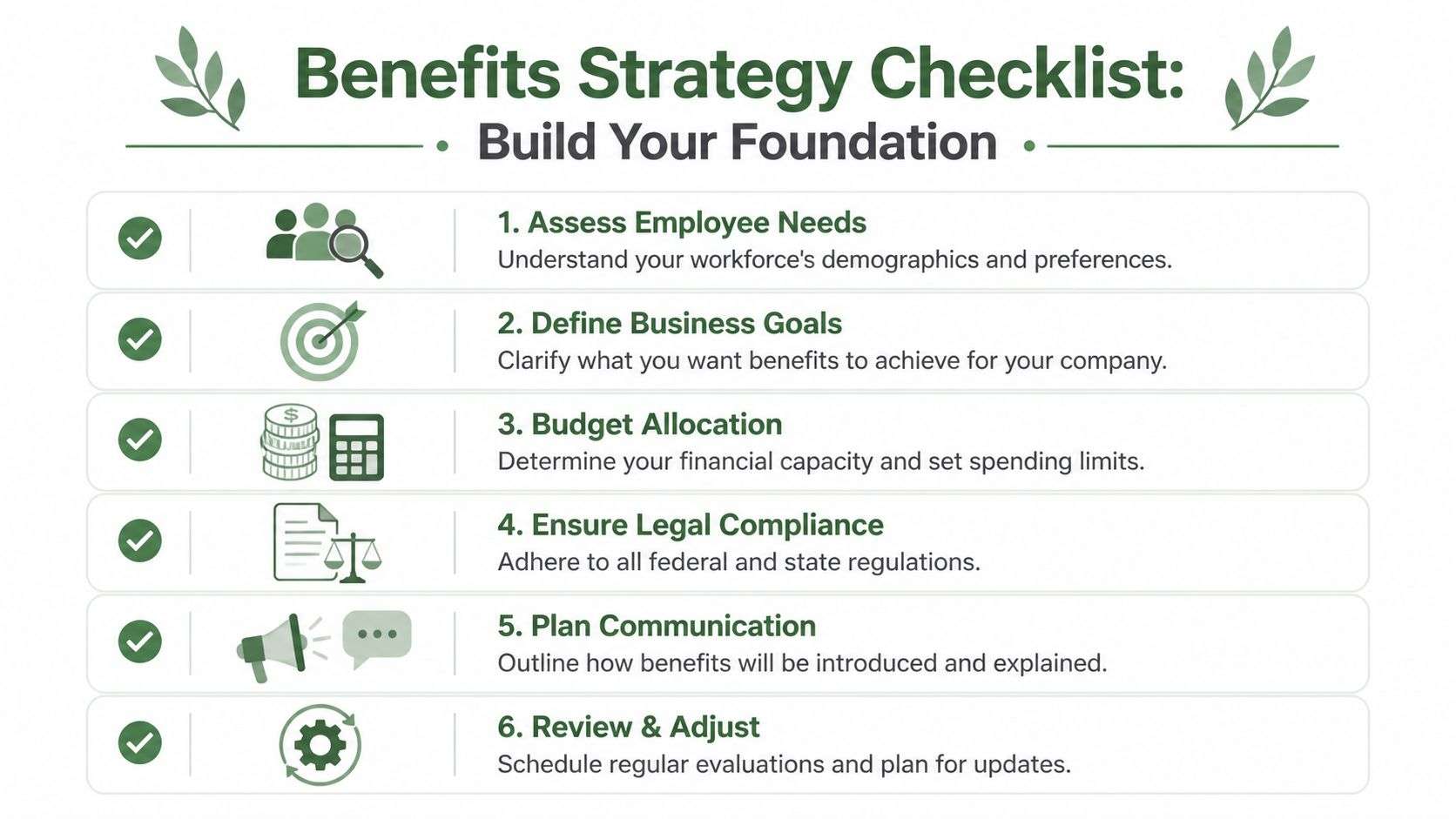
The biggest mistake first-time employers make is shopping for plans before they’ve decided what they’re trying to build. Start with the foundation. That means budget, employee needs, and a few clear goals.
Start With A Real Budget
Benefits should fit the business you have now, not the one you hope to have next year. For small businesses, a practical planning range is to allocate 20% to 30% of total payroll for benefits, with a target of keeping cost per employee under $12,000 annually according to this benefits planning guidance.
That doesn’t mean you must spend to the top of the range. It means you need a number before you start looking at carrier options. Otherwise, every meeting becomes a shopping exercise with no guardrails.
A good starting method looks like this:
- Set your annual ceiling: Decide what the business can comfortably absorb over a full year, not just per month.
- Separate core from optional: Health insurance and legally required items belong in one bucket. Nice-to-have additions belong in another.
- Plan for renewal pressure: Rates can change, and your contribution strategy should survive that conversation.
- Leave room for administration: Enrollment, notices, and employee support all take time, even when the plan itself looks simple.
Learn What Your Team Actually Wants
Owners often guess wrong here. They assume everyone wants the same package they would choose for themselves.
That’s expensive. Failing to align benefits with employee needs can be a costly mistake, with some studies showing 62% of employees report dissatisfaction with generic offerings. Conducting anonymous surveys with an 85% to 95% response rate is key to avoiding this pitfall based on this small business benefits article.
If you have a team of 8, 18, or 35 people, you don’t need a complicated research project. You do need a simple anonymous survey and a short demographic review.
Ask questions that produce useful decisions:
- Coverage priorities: Do employees care most about medical, dental, vision, or time off?
- Family status: Do you have single employees, parents, or mixed household needs?
- Budget sensitivity: Would employees prefer lower payroll deductions even if it means a higher deductible?
- Usage friction: Do people struggle to understand how health plans work, where to find in-network care, or how to use pre-tax accounts?
Practical rule: Don’t build a package around assumptions. Build it around what your employees will actually enroll in and use.
For lower-wage teams especially, complexity can become its own barrier. A plan that looks good on paper can still miss the mark if employees don’t understand how to access care or can’t predict their costs.
Set Goals Before You Choose Plans
A benefits strategy works better when it has a job to do. Sometimes the job is retention. Sometimes it’s helping recruitment in a tight labor market. Sometimes it’s bringing more structure to a growing company.
Useful goals for a small employer are usually straightforward:
- Improve hiring: Make offers more competitive for hard-to-fill roles.
- Support retention: Reduce benefit-related turnover and avoid losing trained staff.
- Create consistency: Replace ad hoc reimbursements or one-off promises with a formal program.
- Control costs: Offer meaningful coverage without letting expenses drift.
You can also set internal measures, such as enrollment levels, employee satisfaction, and how many benefits questions your team asks after rollout. Clear goals make renewal season easier because you’re not just asking, “Did rates go up?” You’re asking, “Is this package doing what we hired it to do?”
If you’re comparing different structures for smaller teams, this page on employee benefits packages for small businesses gives a useful overview of common package designs.
Decoding The Menu Of Employee Benefits
Once the strategy is set, most owners hit the next hurdle. The menu itself feels crowded. Medical plans, dental, vision, life insurance, disability, HSAs, FSAs, voluntary benefits, wellness perks, leave policies. It’s easy to feel like you’re supposed to offer everything at once.
You’re not. You’re trying to choose the right mix.

Core Benefits Most Small Employers Start With
The foundation is usually group health insurance, then a few supporting benefits around it.
Health insurance does the heavy lifting because it affects both major medical costs and everyday confidence. Employees want to know they can access doctors, urgent care, prescriptions, and specialist networks without navigating the individual market alone.
Then come the common add-ons:
- Dental insurance: Often inexpensive relative to medical coverage and easy for employees to understand.
- Vision insurance: Useful when offered at group rates, especially for employees who wear glasses or contacts.
- Paid time off: Not an insurance product, but absolutely part of your benefits package.
- Retirement plan access: Even a simple matching structure can strengthen the package.
- Life and disability coverage: Often available as employer-paid, employee-paid, or mixed-cost options.
The smart move for a smaller employer is to separate benefits into two groups. First, what you’ll fund as part of the core package. Second, what employees can elect voluntarily if they want more protection.
HSAs And FSAs In Plain English
These accounts confuse a lot of first-time employers, mostly because the acronyms sound more complicated than they are.
An HSA, or Health Savings Account, pairs with a qualified high-deductible health plan. It lets employees set aside pre-tax money for eligible medical expenses. For many small businesses, this can be a practical option when you want a lower-premium medical plan but still want to give employees a tax-advantaged way to handle out-of-pocket costs.
An FSA, or Flexible Spending Account, also uses pre-tax dollars for eligible expenses, but it works differently and usually comes with different use rules and administration requirements.
The key point isn’t memorizing every rule. It’s understanding where these accounts fit.
- HSAs work well when employees are comfortable with a qualified high-deductible structure and want to save for current and future healthcare expenses.
- FSAs can help employees manage predictable expenses, but they require stronger communication because misunderstanding the rules leads to frustration.
For small businesses, tailoring benefits is critical. Offering access to HSAs, financial education resources, and care navigation services can help support lower-income employees who might otherwise underuse complex health benefits, as discussed in this lower-income employee benefits analysis.
That point matters more than many owners realize. A benefit only helps if an employee can understand it, afford to use it, and see its value.
Voluntary Benefits Stretch Your Package
Here, small businesses can add depth without carrying the full cost of every benefit.
Voluntary benefits often include things like:
- Life insurance buy-up options
- Short-term or long-term disability
- Accident coverage
- Critical illness coverage
- Hospital indemnity plans
These options can make a package feel far more complete, especially for employees who want more protection but don’t need the employer to fully fund every piece.
A good broker will usually show you where voluntary benefits complement the medical plan instead of cluttering it. For example, a team enrolled in higher-deductible medical plans may value accident or hospital indemnity coverage more than another employer group would.
Wellness And Support Benefits Matter Too
Not every valuable benefit sits inside a traditional insurance policy. Employers also build stronger packages with employee assistance resources, care navigation, flexible wellness options, and targeted support for remote or hybrid workers.
If you’re evaluating broader culture and retention ideas, this overview of employee wellbeing program advantages is worth reviewing because it connects benefits with day-to-day employee experience in a practical way.
A tailored package usually beats a longer package. Ten benefits nobody understands won’t outperform four that fit the workforce.
That’s especially true for a company under 50 employees. Your team may not need the same mix a national employer offers. They may need solid health coverage, clear payroll deductions, access to pre-tax tools, and a few carefully chosen voluntary options.
If you’re sorting through plan categories and what health plans are required to cover, this summary of essential health benefits can help clarify the medical side.
Sourcing Your Plans A Broker Versus The Marketplace
Once you know what you want to offer, the next question is where to get it. For most small employers, this comes down to two paths. You can try the marketplace route, or you can work with a broker who shops plans and helps manage the process.
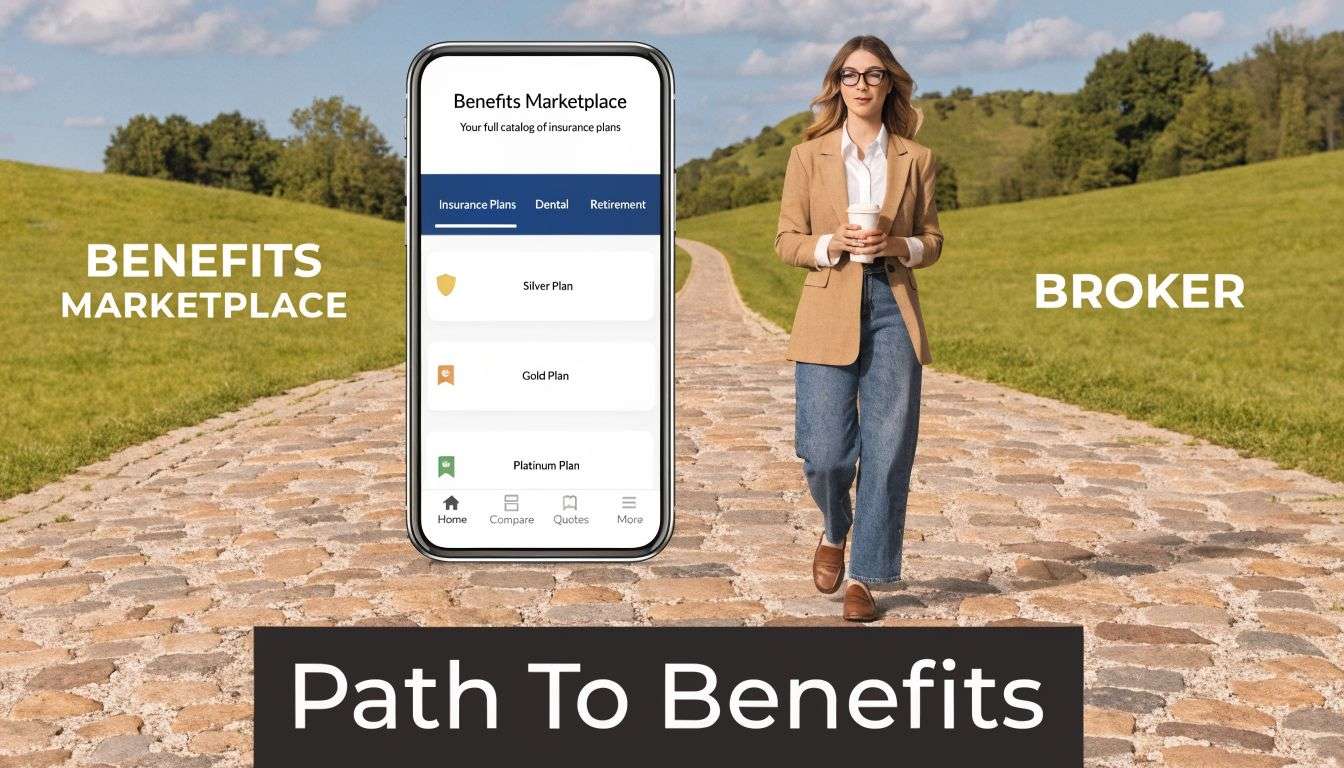
The Marketplace Path
The appeal is obvious. It feels direct. It can feel more controlled. Some employers also explore it because they’ve heard about possible small business tax credit opportunities.
For a very simple setup, that may be enough. But the trade-off is time. You still have to compare plans, understand networks, evaluate deductibles, check contribution structures, manage enrollment details, and answer employee questions. That’s a lot for an owner or office manager who already wears six other hats.
Marketplace shopping also tends to get harder when your workforce has mixed needs. One employee wants a broad network. Another cares only about payroll deduction. Another has ongoing specialist care and needs carrier-specific guidance.
The Broker Path
A broker changes the process from plan hunting to decision support. Instead of reviewing one narrow lane of options, you can compare carriers and plan structures side by side.
Strategic benefits sourcing can deliver a 2x to 4x return on investment, driven by factors like a 15% reduction in turnover. A key tactic is using a broker to shop multi-carrier options, which can yield 10% to 20% savings on small group plans according to this analytics-focused benefits strategy article.
That doesn’t mean every broker relationship produces the same result. The value comes from what the broker does:
- Compares multiple carriers: Aetna, Cigna, Blue Cross Blue Shield, UnitedHealthcare, and others may each fit different provider and budget priorities.
- Explains trade-offs clearly: Lower premium often means higher out-of-pocket exposure. Broader networks may change pricing.
- Helps with contribution design: This affects affordability for employees and predictability for the business.
- Supports enrollment and renewal: The work doesn’t stop after the plan is selected.
What Works Better For A Small Employer
If your business has very simple needs and plenty of internal time, a do-it-yourself path can work. Most owners I’ve seen prefer support once they realize how many moving parts show up during quoting, enrollment, and renewal.
A broker is especially useful when:
- Your team uses different doctors and hospitals
- You want to compare more than one carrier
- You need help explaining options to employees
- You want someone involved again at renewal, not just at purchase
Pounds Health Insurance is one example of the broker model. The agency shops small group plans across multiple carriers for teams up to 50 employees and helps employers compare network fit, pricing structure, and enrollment support through its health insurance broker services.
The right broker doesn’t just bring quotes. They help you avoid buying the wrong plan for the right price.
That distinction matters. Saving money on a plan that your employees hate or can’t use well isn’t a win.
Launching Your Benefits Program Successfully
A benefits rollout succeeds or fails in the communication phase. Owners often spend weeks choosing plans, then send one email and expect employees to understand deductibles, payroll deductions, enrollment deadlines, and account options right away.
They won’t. That’s normal.
Build A Communication Plan Employees Can Follow
Start with a simple sequence instead of one big announcement. Employees need time to absorb the basics, ask questions, and make choices.
A rollout usually works better when it includes:
- An announcement message: Explain what’s being offered, why the company is offering it, and when enrollment opens.
- A plain-language overview: Summarize each benefit without insurance jargon.
- A meeting or webinar: Give employees a chance to hear the options explained live.
- Follow-up reminders: People need prompts before deadlines.
- A contact path for questions: Employees should know exactly who to call or email.
If you have remote or hybrid staff, don’t assume recorded materials alone will solve it. Many employees still need live explanation and a place to ask practical questions.
Make Enrollment Easier Than You Think It Needs To Be
Confusion creates low participation. The fix is clarity.
Use simple comparisons. Explain terms before you expect decisions. If employees are choosing between two medical plans, tell them how each one behaves in real life. One may cost less from the paycheck but more when care is used. Another may cost more up front but offer more predictable copays.
Helpful enrollment materials often include:
- A one-page summary for each plan
- Examples of who might prefer each option
- Provider network instructions
- Payroll deduction explanations
- Account setup guidance for HSA or FSA elections
Employees don’t need a lecture on insurance theory. They need to know what this means for their family, their paycheck, and their next doctor visit.
That’s why meetings should stay practical. Focus on the decisions employees must make now.
Keep The Package Inclusive
An effective launch also reflects how people work and live. A 2026 Deloitte report shows 55% of Gen Z workers prioritize flexible wellness options over traditional health plans, and failing to offer inclusive benefits such as floating holidays or remote work stipends is a common pitfall for small businesses, as noted in this inclusive benefits discussion.
For a small employer, inclusivity often looks like design choices rather than expensive extras:
- Floating holidays instead of assuming everyone values the same calendar days
- Remote work support for employees who need home office or connectivity help
- Equal access to information so in-office and remote employees hear the same message
- Flexible wellness resources that fit different ages, family situations, and work styles
Treat Enrollment As Part Of Company Culture
The tone matters. If benefits are rolled out like paperwork, employees will treat them like paperwork. If they’re rolled out as part of how the company supports people, employees pay more attention.
That doesn’t require polished corporate language. It requires honesty. Tell employees what the company can offer now, what choices they have, and where to get help. A simple, direct rollout builds more trust than a flashy one full of jargon.
Managing And Renewing Your Benefits Year After Year
Benefits aren’t a one-time project. Once the plan is live, you move into administration, compliance, and renewal. At this stage, many small employers either get organized or get surprised.
Know The Basic Rules Without Overcomplicating Them
If your company has fewer than 50 full-time employees, the Affordable Care Act employer mandate generally won’t apply in the same way it does to larger employers. But that doesn’t mean all compliance issues disappear.
You may still need to pay attention to things like:
- Plan notices and disclosures
- Eligibility handling
- COBRA or state continuation rules
- ERISA-related documentation for private-sector plans
- Consistent treatment of employees under your plan terms
This is the part that makes owners nervous, and reasonably so. The practical answer is not to become your own benefits attorney. It’s to keep clean records, use reliable administrative support, and ask questions early.
Run A Better Renewal Process
Renewal shouldn’t begin when the new rates land in your inbox. It should begin earlier with a review of what worked and what didn’t.
Look at the year from three angles:
- Employee experience: Did people understand the benefits and use them?
- Cost control: Did the employer contribution still fit the budget?
- Plan fit: Were there repeated complaints about networks, claims friction, or limited value?
If a plan caused confusion all year, renewal is the time to fix it. If a carrier network no longer fits your employees’ doctors, that issue won’t solve itself.
What To Review Before You Sign Another Year
A useful renewal conversation usually includes the following:
- Contribution strategy: Are you keeping the same employer contribution or changing it?
- Carrier performance: Did employees have a smooth experience with the plan?
- Plan design changes: Would a different deductible, network, or supplemental option fit better?
- Participation patterns: Which benefits were valued and which were ignored?
- Administrative strain: Did enrollment and year-round support feel manageable?
A lot of small employers also benefit from reviewing broader healthcare cost containment strategies before renewal so they can make changes deliberately instead of reacting under deadline pressure.
Renewal is where a benefits program becomes strategic. The first year gets you started. The next year tells you what to improve.
That mindset keeps benefits from turning into a stale expense line. It turns them into an evolving part of your compensation strategy.
Frequently Asked Questions About Small Business Benefits
Do I Have To Offer Benefits To Part-Time Employees
Not always. Eligibility rules depend on the type of benefit, the plan design, and applicable regulations. Many small employers choose to reserve core benefits for full-time employees and offer selected voluntary options or a more limited package to part-time staff. The important thing is to set clear, written eligibility rules and apply them consistently.
What Happens If My Company Grows Past Fifty Employees
Crossing that threshold changes the compliance conversation. At that point, you should review your benefits structure promptly because additional requirements may apply, including ACA employer mandate considerations. Don’t wait until the next open enrollment to ask the question. Review it as soon as growth makes the issue realistic.
Can I Offer Different Benefits To Different Employees
Sometimes, yes, but only within compliant plan rules. You can’t casually create one-off arrangements because one employee negotiated harder than another. Different classes of employees, contribution structures, or voluntary elections may be allowed depending on the plan and setup. This is an area where documentation matters.
Should I Start With Health Insurance Or Smaller Perks
If your budget allows only a few choices, health coverage usually carries the most weight because it affects financial protection and access to care. After that, employers often add dental, vision, life insurance, disability, or flexible wellness support. Smaller perks can complement a package, but they rarely replace the value of a solid health benefit.
How Many Plan Choices Should I Give Employees
Too many choices can overwhelm people. Too few can leave obvious needs uncovered. For most small groups, a manageable number of clearly explained options works better than a long menu. Employees tend to make better decisions when the differences are easy to understand.
What If My Employees Don’t Understand Insurance
That’s common, and it’s not a sign that your team is disengaged. Insurance terms are confusing for many people. The fix is better education, simpler explanations, and access to support during enrollment and throughout the year. If employees can’t tell what a plan does, they won’t value it properly.
Is It Better To Offer A Richer Plan Or Contribute More Toward A Leaner Plan
It depends on your workforce. Some teams care most about lower payroll deductions. Others care more about copays, deductibles, or network access. The better answer comes from your employee feedback and hiring goals, not from a generic template.
If you’re ready to build a benefits package that fits a team of fewer than 50 employees, Pounds Health Insurance can help you compare options, sort through trade-offs, and choose a practical path without turning the process into a full-time job.