
Ready to find health insurance? The first step is figuring out where to apply. Your best path—whether it’s through the ACA Marketplace, directly from an insurance company, or with a broker’s help—really boils down to your job situation and whether you qualify for financial aid.
Your Starting Point For Health Insurance Enrollment

Jumping into the world of health insurance can feel like a lot to take on. Most people aren't sure where to begin, but the whole process becomes much clearer once you find your specific "on-ramp" to coverage.
Your life circumstances—whether you're self-employed, working for a startup, or in between jobs—will guide you toward one of three main enrollment routes. Getting this first part right makes everything that follows feel far less complicated.
Identify Your Main Coverage Pathway
So, where do you fit in? This initial decision will shape everything, from the plans available to you to the financial help you might get.
Your options generally fall into these buckets:
- Employer-Sponsored Plans: If your company offers health insurance, this is almost always your most straightforward option. Your HR team will walk you through the process when you're hired or during the company's annual open enrollment.
- ACA Marketplace Plans: The Health Insurance Marketplace at HealthCare.gov is the go-to for individuals, families, and freelancers who can't get affordable coverage through a job. It's the only place to access income-based savings like tax credits.
- Private Off-Exchange Plans: You can always buy a plan directly from an insurance carrier or through a broker. These plans offer the same quality of coverage as Marketplace plans but are purchased "off-exchange." This is a solid choice for people who know they won't qualify for subsidies.
Key Takeaway: Your eligibility for Marketplace subsidies hinges on your income, household size, and whether you have access to other affordable coverage. Nailing down these details is critical to making your plan affordable.
Your Pre-Enrollment Checklist
A little bit of prep work now can save you a massive headache later. Getting your documents in order before you start shopping for plans will make the application process much smoother. For many, working with an expert is the easiest way to handle this; you can learn more about finding a local health insurance broker near me on our site.
Here’s what you’ll want to have handy:
- Social Security Numbers: For everyone in your household who needs to be insured.
- Income Information: Grab recent pay stubs, W-2 forms, or last year's tax return. You'll need this to estimate your household income, which is crucial for subsidy calculations.
- Household Details: The full names, birth dates, and home addresses for everyone on the application.
- Current Insurance Info: If you have coverage now, have the policy numbers and plan details nearby.
Decoding Your Health Coverage Options
Trying to figure out health insurance can feel like a puzzle. Before you dive into the "how" of enrolling, you need to get a handle on the "what"—the different kinds of plans out there. Getting this right from the start means matching your personal health needs and budget to the right type of coverage.
You really have three main avenues for getting health insurance: the ACA Marketplace, directly from a private insurance company, or through alternative solutions for temporary needs. Each path is designed for different situations, so let's break them down so you can make a smart choice.
ACA Marketplace Plans And The Metal Tiers
The Affordable Care Act (ACA) Marketplace, which you can usually get to through HealthCare.gov, is the go-to spot for people who can't get affordable coverage through a job. The biggest reason to shop here? It’s the only place you can get financial help based on your income, like Premium Tax Credits, to lower your monthly insurance bill.
Marketplace plans are broken down into four "metal tiers." Think of them as a simple way to show how you and the insurance company will split the costs of your care.
- Bronze: These plans have the lowest monthly premiums, but you'll pay the most out-of-pocket when you actually go to the doctor. A Bronze plan often makes sense for someone young and healthy who just wants a safety net for major medical emergencies.
- Silver: With middle-of-the-road premiums and costs, Silver plans are a popular choice for a reason. They're also the only plans where you might qualify for extra savings called Cost-Sharing Reductions (CSRs), which lower your deductible and copays if your income is below a certain level.
- Gold: You’ll pay a higher monthly premium for a Gold plan, but your out-of-pocket costs will be much lower. If you have a family with young kids or you're managing a chronic condition, a Gold plan can make your medical expenses much more predictable.
- Platinum: These plans come with the highest monthly bill but the lowest costs when you need care. They are really built for people who know they'll need a lot of medical services and want the most comprehensive coverage they can get.
Choosing a metal tier is all about finding the right balance between what you pay each month and what you're prepared to pay when you use your insurance. It really comes down to what you expect your healthcare needs to be over the next year.
The ACA has opened the door to coverage for millions. In fact, the U.S. individual health insurance market hit a record 25.2 million people enrolled, a huge jump driven by enhanced tax credits. It's clear that people are finding workable options outside of traditional employer plans.
Private Health Insurance Off The Marketplace
Another route is to buy a plan directly from an insurance carrier or through a broker. We often call these "off-exchange" plans. They have to cover the same essential health benefits as Marketplace plans, but you can't use Premium Tax Credits to pay for them.
So, why would anyone go this route?
- Wider Network Choices: Sometimes, insurance companies offer different doctor and hospital networks on their private plans. If you have a specific doctor you absolutely want to keep, their off-exchange plan might be the only way.
- You Don't Qualify for Subsidies: If your income is too high for financial help, there’s no real downside to shopping off-exchange. You can see absolutely everything a carrier has to offer without worrying about missing out on savings.
Imagine a self-employed consultant who earns a good income and needs a specific PPO network that isn't sold on the Marketplace. For them, network access is more important than subsidies they wouldn't get anyway. To really get a feel for this, it helps to understand the top 4 factors to consider when choosing a health plan.
Alternatives Like Short-Term And Supplemental Plans
Beyond the big, comprehensive plans, there are other types of coverage meant to fill specific gaps. It's important to remember these are not a replacement for real health insurance.
Short-Term Health Insurance is exactly what it sounds like—temporary coverage for a few months up to a year. People often use it when they're between jobs or waiting for new coverage to kick in. The catch? These plans are not ACA-compliant and usually don't have to cover pre-existing conditions.
Supplemental Coverage, like plans for dental, vision, or critical illness, can be added alongside your main health plan. Major medical insurance often doesn't cover these things, so add-ons can help you budget for routine care and protect you from those big, unexpected bills.
Timing Is Everything: Understanding Health Insurance Enrollment Periods
One of the first things I always explain to clients is that you can't just buy health insurance whenever the mood strikes. It’s not like buying a car or a new pair of shoes. The health insurance world runs on a strict schedule, and knowing these timelines is the key to making sure you get covered and avoid any gaps.
The whole system is built around specific windows of time. This helps manage risk for the insurance companies and, in turn, helps keep costs more stable for everyone. Think of it like a train station—you have to be on the platform when the train is scheduled to leave. For health insurance, these departure times are called enrollment periods.
The Main Event: The Annual Open Enrollment Period
The big one on the calendar is the Open Enrollment Period (OEP). This is the annual window when pretty much anyone can sign up for a new health plan or make changes to their current one, no questions asked. If you don't have a major life change during the year, this is your shot to get covered.
For most states, Open Enrollment usually kicks off on November 1 and runs through January 15. This is your time to sit down, look at what’s available, compare costs and networks, and pick the plan that makes the most sense for you and your family for the year ahead. If you miss this deadline, you generally have to wait until the next OEP rolls around unless something major happens in your life.
A Little Friendly Advice: Please don't wait until the last minute. The final days of Open Enrollment are always a mad dash. Websites can get bogged down, and phone lines for support get jammed. Give yourself a head start to research your options without feeling rushed.
If you want to dig a little deeper, we have a complete guide on what Open Enrollment is for health insurance that breaks it all down.
When Life Happens: Special Enrollment Periods
So, what if you lose your job in April or have a baby in July? You can't be expected to go without insurance until November. That’s exactly what a Special Enrollment Period (SEP) is for.
An SEP is a 60-day window to get a new health plan that opens up outside of the regular Open Enrollment season. It's triggered by what the industry calls a Qualifying Life Event (QLE). The clock on that 60-day window starts ticking the day the event happens, so it’s really important to act fast.
What counts as a qualifying event? Here are the most common ones I see:
- Losing other health coverage: This is a big one. It could mean losing your job-based plan, turning 26 and no longer being eligible for a parent's plan, or losing your Medicaid coverage.
- Changes in your household: Life changes like getting married, having a baby, adopting a child, or going through a divorce all count. These events directly impact who needs coverage in your household.
- Moving to a new area: If you move to a new zip code or county where your old plan isn't available, you'll get an SEP to find a new one that works in your new location.
- A significant change in income: If your income shifts enough to change whether you qualify for subsidies (the tax credits that lower your premium), that can also trigger an SEP.
What This Looks Like in the Real World
Let's put this into practice to make it clearer.
Imagine a freelance graphic designer who just relocated from Austin, Texas, to Sarasota, Florida, for a new opportunity. Her old Texas health plan won't work in Florida. This move is a QLE, which opens up a 60-day Special Enrollment Period for her to enroll in a new Florida-based plan.
Or, think about a young couple in St. Petersburg who just welcomed their first child. The baby's birth is a Qualifying Life Event. They now have 60 days to either add their newborn to their existing plan or even switch to an entirely new plan that offers better coverage for a growing family. These rules exist so your health coverage can adapt right alongside your life.
The Practical Steps To Apply For Coverage
Okay, you've sorted through your options and have a handle on the key enrollment windows. Now it’s time to get down to business and actually apply for a health insurance plan. This is where the rubber meets the road, and I promise, breaking it down into a few manageable tasks makes it far less intimidating.
Think of it like cooking a new recipe—getting all your ingredients prepped and on the counter first makes the whole process go smoothly. Doing the same with your paperwork will save you a ton of time and keep you from having to stop mid-application to hunt down a document.
Gather Your Essential Documents
Before you even think about starting an application, getting your information in order is the single best thing you can do. This ensures everything is accurate and the enrollment goes quickly, whether you apply online, with a broker, or directly with an insurance company.
Here’s a quick checklist of what you'll want to have handy:
- Household Info: Full legal names, birthdates, and Social Security numbers for everyone in your household who needs coverage.
- Proof of Address: You'll need your home and mailing addresses.
- Income Verification: Grab recent pay stubs, W-2 forms, or your most recent tax returns. You'll need to project your household's income for the coming year to see what savings you might qualify for.
- Immigration Documents: If this applies to you, have your lawful permanent resident card ("green card") or other immigration papers ready.
- Current Insurance Info: If anyone in your household already has health insurance, you'll need those policy numbers.
Taking a few minutes to gather these items is the foundation for a stress-free application.
Choose Your Application Method
Once your documents are in a neat pile, you've got three main ways to get enrolled. The best path for you really depends on how comfortable you are with technology, whether you want some personalized advice, and if you think you'll qualify for financial help.
1. Use The Online Health Insurance Marketplace
The official website, HealthCare.gov, is the main hub for most states. It’s the only place you can get income-based subsidies, like Premium Tax Credits, that lower your monthly bill. The site walks you through eligibility, lets you compare plans side-by-side, and handles the final enrollment. It's convenient, but I've seen it get a little tricky for people with complex income situations. For a deeper dive, check out our guide on how to apply for Marketplace insurance.
2. Work Directly With An Insurance Carrier
You can always go straight to the source and apply on an insurance company's website or over the phone. This is a solid option if you already know which carrier you want and you're positive you won't qualify for a subsidy. The big drawback? You're only seeing one company's plans, which means you could easily miss out on a better or more affordable option from a competitor.
3. Partner With An Independent Broker
Working with a broker, like our team here at Pounds Health Insurance, can give you the best of both worlds. A good broker can help you enroll through the Marketplace, go directly to a carrier, or even find a plan that isn't listed on the exchange. Best of all, our guidance comes at no extra cost to you. We do the heavy lifting of shopping across multiple companies to find a plan that actually fits your budget and includes your preferred doctors.
A good broker is your advocate. We help you sidestep common application mistakes, accurately estimate your income, and actually understand the fine print of a policy before you sign up. That personalized support is invaluable.
This graphic really simplifies the two main timelines that dictate when you can sign up for a new plan.
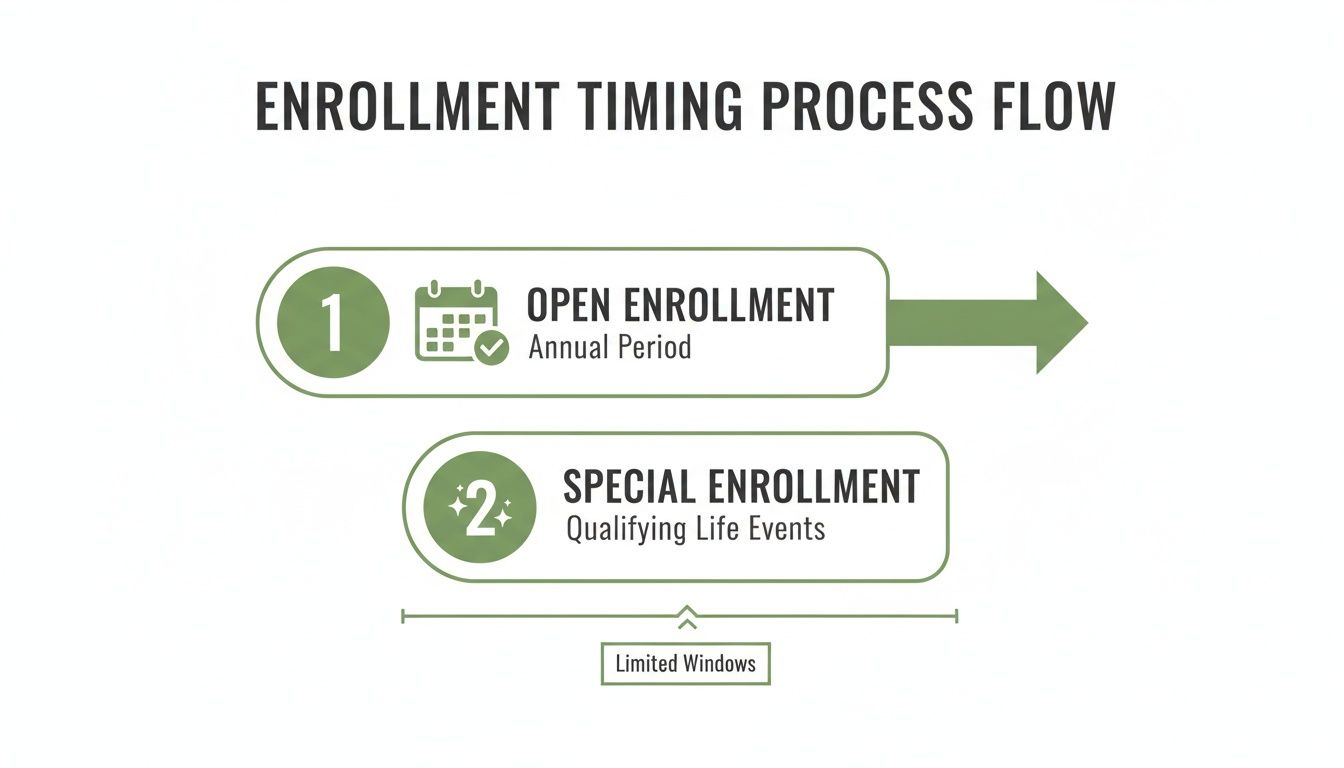
As you can see, while Open Enrollment is that fixed window each year, Special Enrollment Periods are your ticket to getting covered if you go through a major life change.
Navigating The Application Itself
If you decide to go the online Marketplace route, the application will guide you through a few key sections. You'll start by creating an account and entering basic details about your household.
Next up is the income estimate—this is often the most critical, and frankly, most confusing, part of the process. It's what determines if you get any financial help.
After the system crunches your numbers, it will show you all the plans you're eligible for, along with the final monthly cost after any tax credits are applied. From there, you can filter and sort the plans by their metal tier, deductible, network, or insurance company to narrow down your choices.
The health insurance market is massive and only getting bigger. It's projected to grow from $2.32 trillion to an astounding $4.45 trillion by 2032. Here in the U.S., major players like UnitedHealth Group (serving 44.8 million members) and Elevance Health (36.1 million members) offer a dizzying number of plans, which makes having an expert in your corner more valuable than ever.
Once you’ve made your decision and selected a plan, you'll review everything one last time and confirm your enrollment. But you're not done yet! The final, crucial step is to pay your first month's premium directly to the insurance company. This is what activates your coverage. I've seen too many people complete the application perfectly but forget this last part, only to find out later they aren't actually insured. Don't let that be you.
Unlocking Savings: Subsidies and Tax Credits Explained

Let’s be honest: the biggest hurdle to getting health insurance is often the price. But the good news is you probably don't have to pay the full sticker price. The Affordable Care Act (ACA) introduced some powerful financial aid programs to make monthly premiums and out-of-pocket costs much more manageable for millions of people.
Getting a handle on these savings is the secret to finding coverage that actually fits your budget. There are two main types of assistance you can get through the Health Insurance Marketplace, and it all comes down to your estimated household income for the year you need the plan.
Lowering Your Monthly Bill With The Premium Tax Credit
The most common way to save is with the Premium Tax Credit (PTC). Think of it as a subsidy that directly cuts down your monthly insurance payment, often by a lot. When you fill out your Marketplace application, the system automatically calculates your estimated PTC based on your income and the number of people in your household.
You get a choice here. You can have the credit paid directly to your insurance company each month, which lowers what you owe. Or, you can pay the full premium and get the entire credit back as a lump sum when you file your federal income taxes. Most people take the monthly option—it just makes budgeting easier. You can dig deeper into the specifics in our guide to the health insurance premium tax credit.
This subsidy system is a huge reason why public health exchanges have grown so much. In fact, recent data shows a 14% jump in exchange enrollment, which translates to 2.7 million new people in just one year. This kind of growth, backed by major carriers like Cigna and Health Care Service Corp, shows just how much more accessible these individual plans have become.
Reducing Your Costs When You Actually Need Care (CSRs)
The other type of assistance is called a Cost-Sharing Reduction (CSR). While the tax credit tackles your monthly premium, CSRs lower your out-of-pocket costs when you go to the doctor or hospital. That means lower deductibles, copayments, and coinsurance.
Eligibility for CSRs is also based on your income, but the cutoff is a bit stricter than it is for the premium tax credit.
The most important thing to remember is that you must enroll in a Silver plan through the Marketplace to get these cost-sharing benefits. If you qualify, the CSRs are automatically built into the Silver plans available to you, essentially giving you the benefits of a Gold or Platinum plan without the higher price tag.
Putting It All Together: Real-World Examples
So what does this look like for real people?
For a single person: Imagine a freelance writer who expects to make $40,000 this year. They would almost certainly qualify for a hefty Premium Tax Credit, which could easily slash their monthly premium by hundreds of dollars.
For a family of four: A family with two adults and two kids bringing in $90,000 would also qualify for a large PTC. Depending on where their income falls relative to the Federal Poverty Level, they could also be eligible for CSRs if they choose a Silver plan, dramatically lowering their family deductible.
Getting your income estimate right is critical. If you guess too low, you might have to pay back some of the tax credit when you file your taxes. If you guess too high, you’ll end up overpaying every month. Beyond these Marketplace savings, it's also worth looking into whether you can deduct health insurance premiums on your taxes for even more financial relief.
You’ve picked a health insurance plan—that’s a huge step! But you're not quite at the finish line just yet. A few final moves are crucial to actually activating your coverage and making sure there are no unwelcome surprises when you go to use it.
The single most important thing you need to do now is pay your first premium. Think of it as the final handshake. Your enrollment simply isn't complete until the insurance company gets that first payment. If you miss their deadline, the carrier can, and likely will, cancel your policy before it even begins.
Locking in Your Coverage and Dodging Common Mistakes
Getting through these last steps is where tiny oversights can turn into major headaches. Knowing where people usually trip up can help you sidestep these issues and get your coverage locked in without a hitch.
Where People Often Go Wrong
From my experience, I see people stumble in the same few areas time and again.
- Getting the Income Estimate Wrong: This one is a double-edged sword. If you underestimate your income, you might get a bigger tax credit upfront but have to pay some of it back at tax time. Overestimate, and you could be leaving money on the table every month by paying a higher premium than necessary. Do your best to use your most accurate, good-faith income estimate.
- Forgetting to Check the Network: It’s so easy to get fixated on a plan with a great-looking premium. But if your trusted doctors and local hospital aren't in that plan's network, that low premium won't do you much good. Always, always use the insurance company’s provider directory to verify your must-have doctors are covered before you hit "enroll."
- Ignoring the Deductible: The monthly premium is what you see first, but the deductible is what you'll feel first when you need care. A sky-high deductible can mean thousands of dollars out of your own pocket before your insurance really kicks in. For a deeper dive, check out our guide on understanding your Summary of Benefits and Coverage, which breaks down all these costs.
Expert Tip: Your health insurance policy is a contract. Read the fine print, double-check that your doctors are in, and make that first payment on time. It ensures you’ve held up your end of the bargain.
Your "What's Next?" Checklist
Once you've paid up and your plan is officially active, a few quick housekeeping tasks will make your life much easier down the road.
- Get Your ID Cards Ready: When your insurance cards arrive in the mail or your inbox, snap a picture of them with your phone and put the physical card in your wallet. You'll need the policy and group numbers on hand to schedule any appointments.
- Set Up Your Online Portal: Head over to your insurance carrier's website and create your member account. This is your command center for tracking claims, seeing exactly what’s covered, and finding in-network specialists or urgent care centers.
- Give Your Doctor a Quick Call: I know you probably checked the network directory, but it’s always smart to call your primary doctor's office one last time. Just confirm they have your new insurance on file and that they are, in fact, accepting it. This one small step can prevent a world of billing confusion later.
Got Questions? We've Got Answers
It’s completely normal to have questions as you navigate the world of health insurance. In fact, asking the right questions is the best way to avoid common pitfalls and make sure you're getting the right coverage.
Let's walk through a few of the most frequent questions we get from clients every day.
"What Happens If I Miss Open Enrollment?"
This is probably the number one question we hear, and it’s a big one. If you miss the annual Open Enrollment window, you generally can’t buy an ACA-compliant plan until the next one rolls around.
The main exception is a Qualifying Life Event (QLE). Think of these as major life changes that trigger a do-over. Things like losing your job-based coverage, getting married, having a baby, or moving to a new zip code will open up a 60-day Special Enrollment Period. During that window, you can sign up for a new plan just as you would during Open Enrollment.
Without a QLE, you might be stuck looking at short-term plans. Just be careful—they're not a true substitute for comprehensive coverage and typically won't cover pre-existing conditions.
"How Can I Be Sure My Doctor Is In-Network?"
Never assume your doctor is covered. This is one of the most important checks you need to make before committing to a plan.
Start by going directly to the insurance company's website. They all have a "Find a Doctor" or provider directory tool where you can search for your specific doctors, specialists, and even the hospital you prefer.
Here's a tip from years of experience: Always call your doctor's office to double-check. Online directories can be a step behind, and a quick phone call to confirm they accept the exact plan you're considering is the only way to be 100% certain.
"Can I Switch Plans After I've Enrolled?"
Once you've enrolled, your plan choice is pretty much set for the entire year. You can't just switch to a different plan mid-year because you find one with a lower premium or a better gym membership benefit.
The only way to change your plan outside of Open Enrollment is if you have another Qualifying Life Event (QLE). For instance, if you move to a new state where your plan isn't offered, that event would give you the chance to pick a new one that works in your new area. Otherwise, you'll have to wait for the next Open Enrollment period to make a switch.
You don't have to figure this all out alone. At Pounds Health Insurance, our job is to provide clear, personalized guidance at no cost to you. Contact us today for a free consultation and let us help you find the right fit.