

You’re probably here because you opened a few health plan options, tried to compare them, and ended up more confused than when you started. One plan has a lower monthly premium but a higher deductible. Another says your doctor is “covered,” but only in a certain network. A third looks affordable until you notice the copays, coinsurance, and prescription rules in the fine print.
That reaction is normal. Health insurance asks regular people to make financial and medical decisions using a language that often feels built for lawyers, billing departments, and large corporations. You’re expected to predict your healthcare needs, understand unfamiliar terms, spot network traps, and estimate costs that may not be clear until after you’ve already received care.
A PhRMA survey on insured Americans navigating coverage found that 39% of insured Americans do not understand what their health insurance covers, 35% struggle to manage their coverage, and that confusion rises to 42% among people in poor health. So if you’ve ever asked, “why is health insurance so confusing,” you’re not missing something obvious. You’re dealing with a system that often makes simple questions feel harder than they should be.
The Overwhelming Feeling of Choosing a Health Plan
A lot of people start the same way. They sit down with coffee, open a marketplace site or a broker quote, and tell themselves they’ll compare plans for half an hour. Then they hit the first wall.
One plan says Bronze. Another says Gold. One says HMO. Another says PPO. Then the page shows premiums, deductibles, out-of-pocket maximums, primary care copays, specialist copays, drug tiers, and network names that don’t mean much unless you already know which doctors and hospitals participate.
That’s when frustration kicks in. A lower monthly price looks good until you wonder what happens if you get sick. A richer plan looks safer until you see the premium. Then you try to compare two plans side by side and realize they aren’t built for easy comparison. They use similar words, but the rules underneath can be very different.
Health insurance often feels confusing because you’re not buying one simple product. You’re buying a bundle of rules.
People also assume the hardest part is choosing the plan. Often, that’s only the first layer. After you enroll, you still have to use the plan correctly. That means checking networks, understanding referrals, watching for prior authorization requirements, reading Explanation of Benefits forms, and figuring out why one medical visit might generate multiple separate bills.
The confusion builds because the system stacks one puzzle on top of another:
- Language confusion: Terms like deductible and coinsurance don’t sound like everyday life.
- Structure confusion: Metal levels and plan types don’t tell you everything you need to know.
- Network confusion: A doctor can take one Blue Cross Blue Shield plan and not another.
- Cost confusion: The bill you expect and the bill you receive may be very different.
If you’ve felt frozen trying to choose, that doesn’t mean you’re bad at decisions. It means the process asks too much from people without giving them plain-English guidance first.
Decoding the Secret Language of Health Insurance
The first layer of confusion is vocabulary. If the words don’t make sense, the plan won’t make sense either.

According to UConn Health data summarized here, less than one-third of insured individuals can correctly define core terms like deductible or copay. The same source notes that ACA metal tiers such as Bronze, Silver, and Gold describe cost-sharing levels, not network quality, which is one reason people choose plans that don’t work the way they expected.
If you want a fuller glossary after this, Pounds has a plain-language guide to understanding health insurance terminology.
Premium means your monthly membership fee
Your premium is the amount you pay every month to keep the plan active. Think of it like a subscription.
You pay it whether you go to the doctor or not. That’s one of the biggest reasons people get annoyed. They pay every month, then discover they still owe more when they use care.
A common misunderstanding goes like this: “If I’m paying a premium, doesn’t insurance cover everything now?” Not necessarily. The premium keeps the policy in force. It doesn’t erase deductibles, copays, or coinsurance.
Deductible is the amount you handle first
Your deductible is the amount you usually pay for covered services before the plan starts sharing costs in a bigger way.
I tell clients to think of the deductible as the front gate. Until you get through it, you’re carrying more of the expense yourself. After you get through it, the plan may begin splitting costs with you depending on the service.
That’s why a low-premium plan can still feel expensive in real life. It may save money each month but ask you to absorb more when you require treatment.
Practical rule: Don’t judge a plan by premium alone. Ask what your costs look like on an average doctor year, not just a healthy year.
Copay is the fixed ticket price
A copay is a flat amount you pay for a certain service. For example, many plans use copays for primary care visits, specialist visits, or prescriptions.
The easiest analogy is a movie ticket. You know the amount up front. If your plan says there’s a copay for a visit, that can feel simpler because you’re not guessing at a percentage.
But there’s a catch. Some services have copays before the deductible. Others don’t. Some office visits are straightforward until lab work, imaging, or procedures are added. That’s when a “simple copay visit” turns into a more complicated claim.
Coinsurance is cost sharing by percentage
Coinsurance means you and the insurance company split costs by percentage after certain conditions are met, often after the deductible.
This term confuses people because the final number depends on the allowed amount for the service. So instead of paying a flat fee, you may owe a percentage of a negotiated charge. That’s harder to predict ahead of time.
Coinsurance is why two plans can both say they “cover” a service but leave you with very different bills.
Out-of-pocket maximum is your ceiling
Your out-of-pocket maximum is your financial ceiling for covered in-network care during the plan year. Once you reach it, the plan generally pays more fully for covered in-network services.
This is the safety net many people don’t notice when they shop too quickly. A plan with a lower deductible isn’t always safer overall if its broader spending ceiling is much higher than you’re comfortable with.
Metal levels don’t mean richer care everywhere
Bronze, Silver, Gold, and other metal labels sound like hotel rankings. They aren’t.
They describe how costs are generally split between you and the plan. They do not tell you whether your doctor is in-network, whether a certain hospital is included, or whether your medication is on the formulary. That misunderstanding leads people to assume “Gold” automatically means “best for me,” when it may simply mean a different balance between monthly premium and cost at time of care.
Here’s the simplest way to hold the core terms in your head:
- Premium: What you pay to have the plan.
- Deductible: What you usually pay first before the plan shares more.
- Copay: A flat fee for certain services.
- Coinsurance: A percentage share of cost.
- Out-of-pocket maximum: Your upper limit for covered in-network spending.
Once these words become familiar, health insurance stops feeling like code and starts feeling more like math. Not fun math, but manageable math.
Navigating Plan Types and Provider Networks
The most expensive mistake isn’t typically due to a misunderstanding of the deductible. It arises from a misunderstanding of the network.
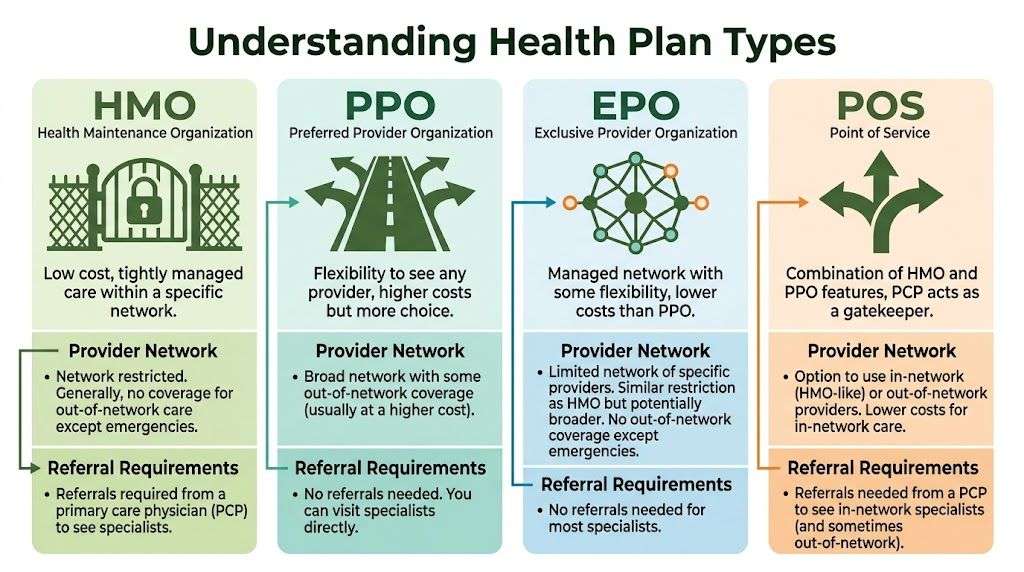
A provider network is the list of doctors, hospitals, labs, imaging centers, and specialists that have contracts with your plan. If you use providers inside that network, your costs are usually lower and the billing rules are more predictable. If you go outside it, costs can rise fast and coverage may shrink or disappear.
The easiest analogy is a phone plan. In-network care is like staying on your carrier’s system. Out-of-network care is like roaming on expensive terms.
If you want a more detailed primer before you shop, Pounds has a useful page on what a provider network is.
HMO means tighter rules and less flexibility
An HMO usually has the most structured rules. You often need to stay within the network, and many HMOs expect you to choose a primary care doctor who helps coordinate your care.
For some people, that structure works well. If your doctors are all in the network and you don’t mind referrals, an HMO can feel organized. But if you want broad provider choice or you travel often, it can feel restrictive fast.
The common surprise with HMOs is this: a doctor may be nearby, taking new patients, and even “accepting your insurer” in a broad sense, but not participating in your specific HMO network.
PPO gives more freedom, but freedom has a price
A PPO generally offers more flexibility. You may have easier access to specialists, and there’s often some level of out-of-network benefit.
That flexibility is why people like PPOs. You’re not boxed in as tightly. But broader access often comes with higher premiums or different cost-sharing.
People hear “out-of-network benefits” and assume they’re protected. Sometimes they are, but not as much as they expect. An out-of-network PPO bill can still be painful.
EPO sits in the middle
An EPO often feels like a hybrid to consumers. It may not require referrals the way some HMOs do, but it still tends to rely heavily on using in-network providers.
That combination catches people off guard. They enjoy the simpler specialist access, then find out later that out-of-network care isn’t covered the way they assumed.
POS mixes referral structure with some flexibility
A POS plan combines features people associate with HMOs and PPOs. You may need a primary doctor and referrals in some situations, while still having some out-of-network options.
This sounds flexible on paper, but it can be harder to use confidently because the rules vary by service and provider type. If someone likes nuance, that’s manageable. If someone wants simplicity, it can be exhausting.
Why the network matters more than people expect
The biggest network mistake is assuming all doctors at the same facility are treated the same way. They may not be. The hospital can be in-network while a specialist reading your test is not. The clinic can be in-network while an affiliated lab is out-of-network.
That’s why the question isn’t just “Does this plan cover my doctor?” It’s also:
- Which network is this exact plan using?
- Is my primary doctor in that exact network?
- Is my hospital in it too?
- What about the lab, imaging center, and specialists I’m likely to use?
One real-world example showed just how costly this can get. The same procedure cost $15,000 at an in-network facility and over $60,000 at an out-of-network one, for the exact same service, as described in the earlier cited source. That’s not a minor pricing difference. It’s the kind of gap that can change someone’s finances for a long time.
When clients tell me, “I just want the cheapest plan,” my next question is, “Cheapest where, on the monthly bill or when you need care?”
A simple way to compare plan types
When you’re choosing between HMO, PPO, EPO, and POS options, don’t try to memorize every rule. Ask yourself these practical questions:
- Doctor loyalty: Do you want to keep specific doctors or hospitals?
- Travel habits: Do you need flexibility outside your home area?
- Specialist needs: Do you see specialists regularly?
- Paperwork tolerance: Are you okay with referrals and tighter rules if the monthly cost is lower?
A safe shopping habit
Before enrolling, verify providers through the insurer’s own directory for that exact plan. Don’t rely only on a provider office saying, “We take Aetna” or “We take Blue Cross.” That may be true for one product and false for another.
Call the office. Check the carrier directory. Ask for the exact plan name. Then verify the hospital, physician group, and any recurring specialists.
That one habit prevents a remarkable amount of confusion later.
The Hidden Maze of Billing Claims and Authorizations
Here’s a very ordinary scenario. You twist your ankle on a Saturday, head to urgent care, get examined, and have an X-ray. The visit feels simple. Then the paperwork begins.

A week later, you get an Explanation of Benefits, often called an EOB. It looks official. It lists charges, payments, adjustments, and a patient responsibility amount. Many people think, “This must be the bill.”
It usually isn’t. It’s your insurer’s summary of how the claim was processed. If you need help sorting those forms out, Pounds has a guide on how to read an Explanation of Benefits.
Why one visit can create several bills
That ankle visit may involve more than one party. The urgent care center may bill for the facility. The clinician may bill separately. The imaging service may bill separately. If a radiologist reads the X-ray, that review may generate its own claim.
None of that feels intuitive to patients. You remember one visit, one building, one injury. The system may treat it as several billable pieces moving through several administrative channels.
That’s one reason people say health insurance feels disconnected from real life. The event is simple. The billing path isn’t.
Claims move in stages
After care is provided, the provider submits a claim to the insurer. The insurer reviews it against plan rules, network contracts, coding, medical necessity standards, and any authorization requirements. Then it decides what portion is covered and what portion may remain your responsibility.
If something doesn’t line up, the claim can be delayed, adjusted, or denied. Sometimes it’s a true coverage issue. Sometimes it’s a coding problem, a missing referral, or an authorization issue that could have been addressed before the visit.
Remember: An EOB explains processing. A provider bill requests payment. They are related, but they aren’t the same document.
Prior authorization feels backward because it is backward for patients
From a patient’s point of view, prior authorization often feels upside down. Your doctor recommends a service, medication, scan, or procedure, but your insurer wants approval before it agrees to cover it.
That creates anxiety because the patient is stuck in the middle. You’re in pain, you need care, and suddenly there’s a delay tied to paperwork and review. If you want a plain-language overview, this resource on understanding prior authorization explains why insurers use it and why patients often find it frustrating.
The practical response
When clients ask me how to stay calmer during billing, I suggest a short checklist:
- Save every document: Keep the EOB, provider bill, and any portal messages in one folder.
- Match dates and services: Make sure the bill lines up with the visit you had.
- Watch the wording: If the EOB says the claim is still processing, don’t pay too quickly.
- Call early: If something looks off, ask the provider billing office and the insurer to explain it in plain language.
Most billing confusion becomes less intimidating once you realize the system is administrative, not personal. The paperwork doesn’t mean you did something wrong. It means several organizations are still sorting out who pays what.
Understanding Marketplaces Subsidies and Enrollment Windows
For people buying their own coverage, the Affordable Care Act marketplace adds another layer of confusion. Many people use “Obamacare” as if it were one insurance plan. It isn’t. It’s a shopping platform where you can compare regulated private plans and, if you qualify, receive financial help.

That setup sounds simple until income estimates, household rules, subsidy reconciliation, plan comparisons, and enrollment deadlines enter the picture. A summary in the NCBI background on insurance coverage and affordability notes that the ACA reduced uninsured rates, but complexity remains. It also states that over 50% of insured adults now have deductibles exceeding $1,000, that 80%+ of marketplace enrollees receive ACA tax credits, and that confusion around eligibility contributes to 22% of people delaying or forgoing care.
If you’re trying to estimate financial help, an ACA subsidy calculator can make the first pass much easier.
The marketplace is a store, not a single product
Think of the marketplace like an online mall for health plans. Different insurers offer different products, with different networks, premiums, deductibles, and prescription coverage.
That matters because people often assume “marketplace plan” tells them enough. It doesn’t. Two plans sold through the same marketplace can feel completely different once you look at provider access and cost sharing.
Subsidies lower premiums, but the rules can feel slippery
A subsidy, often called an Advanced Premium Tax Credit, helps lower your monthly premium if your household qualifies. The challenge is that eligibility depends on household and income details that many people don’t track in insurance terms.
Self-employed workers feel this sharply. Freelancers, contractors, and seasonal earners may not know exactly what their year-end income will be when they enroll. That uncertainty can make people hesitate, guess, or avoid applying at all.
Here’s the plain-English version of what you need to know:
- Your income estimate matters: Marketplace assistance is tied to projected household income.
- Your household matters too: Who is in your tax household can affect eligibility.
- Changes matter during the year: If income or family status shifts, update the marketplace rather than waiting.
Enrollment windows are strict
This is one of the most surprising parts for people used to buying other forms of insurance. You usually can’t wait until you need care and then sign up whenever you want.
There are two main timing paths.
Open Enrollment
This is the main annual window when individuals can enroll in or change an ACA marketplace plan.
Miss it without another qualifying reason, and your options may narrow a lot.
Special Enrollment Periods
A Special Enrollment Period can open when you have a qualifying life event, such as losing other coverage, moving, getting married, or certain household changes.
People often hear “life event” and assume any change counts. It doesn’t. The event has to fit the rules, and timing matters. Documentation may matter too.
If you think you might qualify for a Special Enrollment Period, don’t wait. The window tied to that event may be limited, and delay can cost you your chance to enroll.
Why this part feels harder for self-employed families
Employer plans usually arrive with built-in timing and fewer shopping decisions. Individual-market buyers have to do more themselves. They need to estimate income, compare carriers, evaluate subsidies, and choose a network without an HR department walking them through it.
That’s why marketplace shopping often feels less like buying insurance and more like filing paperwork while trying to predict the future.
Why Rules Change from State to State
Another reason people ask why is health insurance so confusing is that advice from one person may not apply well to someone living elsewhere. Your cousin in another state may love a plan type, a network, or a process that works very differently where you live.
Part of that confusion comes from the split between federal and state oversight. Federal law sets broad standards for many plans, especially under the ACA. States still play a major role in regulating insurers, plan availability, consumer protections, and how coverage is sold and administered in their markets.
Federal rules create the floor
Federal law created some of the baseline protections people now expect, such as rules around pre-existing conditions and standardized categories of essential health benefits for ACA-compliant coverage.
That baseline matters because it keeps some core protections from changing wildly from place to place. It gives consumers a common starting point.
States shape the day-to-day experience
States still influence which carriers participate, which plans are offered widely, how networks are built, how certain complaints are handled, and what local market conditions look like.
That means the shopping experience in Florida may not feel the same as the shopping experience in Texas, Georgia, or Alabama. Even when the broad ACA structure is the same, the details a consumer experiences can differ.
Why local guidance matters
People often get tripped up by internet advice. A friend may say, “Just get a PPO,” or “That carrier is great,” without realizing the relevant network, service area, or product lineup may be different for you.
A better approach is to treat health insurance like real estate. National rules matter, but local conditions matter too. The right answer depends on what’s available where you live, which doctors you use, and how your state market is structured.
How Pounds Health Insurance Creates Clarity and Confidence
Once you see all the moving parts together, the confusion makes more sense. It isn’t just one problem. It’s a stack of problems.
First, the language is unfamiliar. Then the plan types vary. Then the provider networks hide important differences. Then billing adds claims, EOBs, and authorization rules. Then the marketplace adds income estimates, subsidy questions, and enrollment deadlines. Then state-level variation changes what advice applies.
That’s why many people don’t need more information. They need translation, filtering, and help applying the rules to their own lives.
What a broker actually helps with
A good broker doesn’t magically simplify the health insurance system itself. What they can do is simplify your decision inside the system.
That usually means helping you:
- Compare multiple carriers: Looking across options such as Aetna, Blue Cross Blue Shield, Cigna, and UnitedHealthcare based on your budget and doctor preferences.
- Sort ACA and private options: Some clients fit best in marketplace coverage. Others want off-marketplace or supplemental options.
- Check network fit: Not just “Is this carrier accepted?” but “Is this exact doctor, facility, and plan network the right match?”
- Estimate total cost exposure: Looking beyond monthly premium to deductible and likely usage.
- Stay supported after enrollment: Questions often come up after the card arrives, not before.
Pounds Health Insurance offers those kinds of health insurance broker services for individuals, families, self-employed clients, and small businesses in the states it serves.
Why people still get lost even when they can call the carrier
Insurance companies do have customer service teams, and many people can get useful answers by calling the number on their card. But carrier support is often focused on explaining that carrier’s own rules, not helping you compare the full market before you enroll or rethink your whole strategy after life changes.
Some people also prefer more guided service and continuity. That’s one reason the industry relies on support infrastructure, including specialized call centers for insurance companies, to handle the volume and complexity of member questions. Even with those systems, many consumers still want one person who knows their situation and can explain choices in plain language.
What confidence looks like in practice
Confidence in health insurance doesn’t mean memorizing every clause in a policy booklet. It means being able to answer a few key questions without guessing:
- What am I paying every month?
- What am I likely to pay if I use care?
- Are my doctors and hospitals in-network?
- Do I need referrals?
- Am I eligible for subsidy help?
- If something changes midyear, who do I call?
You don’t need to become an insurance expert. You need a process that helps you avoid the expensive misunderstandings.
For a family, that may mean finding a network that includes pediatricians and preferred hospitals. For a self-employed person, it may mean balancing premium savings with deductible risk. For a small business, it may mean choosing coverage that supports employees without creating unnecessary complexity for the owner.
A local, client-focused broker can help organize those tradeoffs in a way a generic quote screen usually doesn’t. Not by making the system simple, because it often isn’t, but by making the choices clearer.
If you’re comparing plans and want help from a real person who can explain networks, deductibles, ACA options, and day-to-day tradeoffs in plain English, contact Pounds Health Insurance for a free, no-pressure conversation. They can help you review your options, narrow the noise, and choose coverage that fits your doctors, budget, and needs.











