
Finding a health insurance plan that feels truly affordable can feel like a moving target, especially with costs projected to climb in 2026. But what does "affordable" really mean when it comes to your health coverage? It’s not just about finding the lowest possible monthly payment. The real answer lies in the total cost you'll face over the year.
What Affordable Health Insurance Really Means In 2026

When most people shop for health insurance, their eyes go straight to one number: the monthly premium. And while that’s a critical piece of your budget, focusing on it alone can be a costly mistake. It’s a bit like buying a car based only on the monthly payment, without considering what you’ll spend on gas, tires, and repairs.
True affordability is about the total picture—what you pay to keep the plan active and what you pay when you actually need to use it. To find a plan that protects both your health and your wallet, you have to look at all the moving parts.
The Two Sides Of Your Health Insurance Costs
I always tell my clients to think about their insurance costs in two buckets: what you pay to have coverage, and what you pay to use it. A genuinely affordable plan finds the right balance for your specific needs.
- Your Monthly Premium: This is your recurring membership fee. You pay it every month to keep your plan active, whether you see a doctor or not. We explain this in more detail in our guide on what a health insurance premium is.
- Your Out-of-Pocket Costs: This is what you pay when you get medical care. These costs include your deductible, copayments, and coinsurance.
Key Insight: A plan with a rock-bottom premium often hides a sky-high deductible. This means you might save a little each month, but you could be on the hook for thousands of dollars before your insurance company starts paying for anything significant.
This trade-off is the central puzzle of choosing a plan. If you're healthy and rarely need medical care, a plan with a higher deductible might be a smart financial move. But if you manage a chronic condition or have a family with kids who are always one playground incident away from a doctor’s visit, a plan with a higher premium and lower out-of-pocket costs could save you a fortune.
Why Costs Are Projected To Climb In 2026
Finding this balance is becoming even more important as healthcare costs continue to rise. Projections for 2026 show a global average increase of 10.3% in medical costs for employer-sponsored plans. Here in the U.S., including right here in Florida, we’re looking at an expected jump of 9.6%. You can learn more about the factors driving these increases from the experts at WTW.com.
With these trends, looking beyond the sticker price isn't just good advice—it's essential. Understanding how premiums and out-of-pocket costs work together is the first step toward making a smart decision that gives you peace of mind.
Navigating The Different Types Of Health Plans
Let's be honest—choosing a health insurance plan can feel like you're trying to crack a code. All those acronyms like HMO, PPO, and EPO are a huge stumbling block for most people. But once you understand what they mean, you're on your way to finding a plan that’s actually affordable and fits your life.
The easiest way to think about it is to compare it to something we all get: streaming services. Your health plan is like a subscription. Some give you a limited, curated library for a low monthly price, while others grant you access to just about everything, but for a higher fee. It's all about balancing access and cost.
Getting this right is more important than ever. Projections show that health insurance costs in North America are set to climb by 9.2% in 2026. While that’s a slight drop from 2025, it still squeezes the budgets of families and individuals, especially in states like Florida, Texas, and North Carolina where we're likely to see premium hikes. You can read more on these global trends at RiskandInsurance.com.
The HMO Plan: Your Curated Content Library
A Health Maintenance Organization (HMO) is like your basic streaming package—it gives you a handpicked selection of shows and movies. In this case, it’s a specific network of doctors, hospitals, and specialists who've agreed to provide care at a lower cost.
To make sure your care is covered (outside of a true emergency), you have to stick to that "in-network" list. HMOs also require you to select a Primary Care Physician (PCP), who becomes your go-to for all your health needs. If you need to see a specialist, like a cardiologist or a dermatologist, your PCP will give you a referral.
The trade-off is pretty straightforward: you give up some flexibility for lower monthly premiums and more predictable costs. If you're looking for one of the most affordable health insurance plans and are okay with a structured approach, an HMO is often a fantastic choice.
The PPO Plan: Your Premium All-Access Pass
On the flip side, a Preferred Provider Organization (PPO) is the all-access, premium pass of health insurance. Think of it as the top-tier streaming service that lets you watch content from any studio. A PPO gives you incredible flexibility. You still have a "preferred" network of providers where your costs will be lowest.
But the real hallmark of a PPO is the freedom to go out-of-network to see any doctor or visit any hospital you want, all without needing a referral. That freedom, however, comes with a higher price tag. Your monthly premiums are usually more expensive than an HMO's, and your out-of-pocket costs will be higher when you step outside the network. We dig into this more in our article on what a PPO health plan is.
Other Common Plan Types
While HMOs and PPOs are the big two, you might run into a few other plans that mix and match their features.
- EPO (Exclusive Provider Organization): This is a bit of a hybrid. Like an HMO, it insists you stay within its network of doctors and hospitals. But like a PPO, it usually doesn't require a PCP or referrals to see specialists.
- POS (Point of Service): This plan truly blends elements of both. You'll choose a PCP and get referrals for in-network care (like an HMO), but you also have the option to go out-of-network for care at a higher cost (like a PPO).
The right plan structure really comes down to your life and your priorities. A family in Sarasota, Florida, with a trusted local hospital and doctors they love might find an HMO to be a perfect, cost-effective fit. Meanwhile, a self-employed consultant who splits their time between Texas and North Carolina would probably lean toward a PPO to ensure they have coverage no matter where work takes them.
How To Unlock Savings With ACA Marketplace Subsidies
For so many people, the path to genuinely affordable health insurance runs straight through the Affordable Care Act (ACA) Marketplace. The thing is, countless Americans leave serious money on the table simply because they aren't aware of how the financial help works. The best way to think about it is that the government offers two powerful types of assistance to dramatically lower the cost of your health plan.
Getting a handle on these two types of savings—Premium Tax Credits and Cost-Sharing Reductions—is the most important step you can take to find a plan that actually fits your budget.
Your Instant Coupon For Lower Premiums
The first and most common type of help is the Premium Tax Credit (PTC). This is basically an instant discount that gets applied directly to your monthly health insurance bill. It’s a game-changer. Instead of paying the full price and hoping for a refund when you file your taxes, you can have this credit sent straight to your insurance company every month.
This immediately slashes what you have to pay out of your own pocket. For instance, if a plan’s sticker price is $450 a month but you qualify for a $350 tax credit, your real payment is just $100. It's no surprise that over 90% of people on the Marketplace use these credits.
The amount you get is based on your estimated household income for the upcoming year. The whole system is designed to make sure you don't spend more than a certain percentage of your income on premiums.
The chart below can help you think through which type of plan might be a good fit. Often, the affordability provided by subsidies makes this choice a lot clearer.
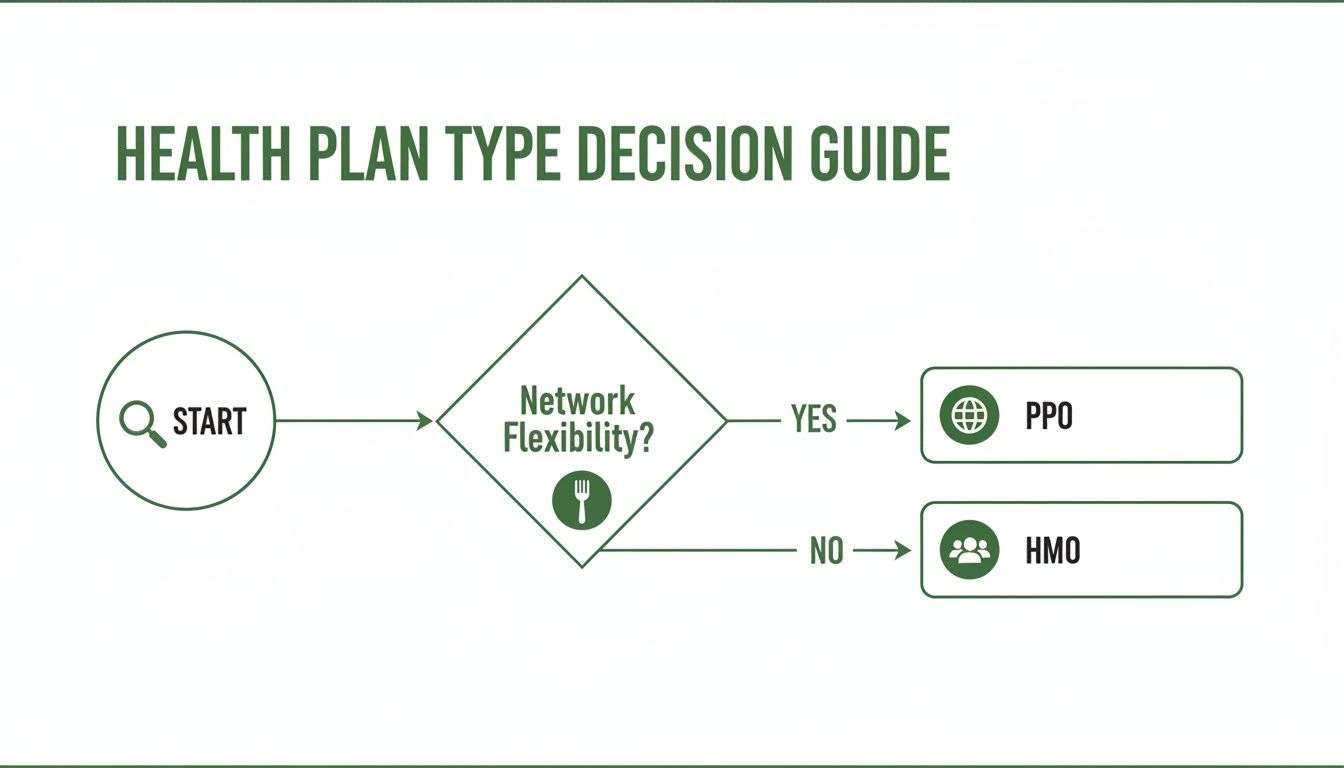
As you can see, a big part of the decision comes down to the trade-off between a PPO's network flexibility and an HMO's potential for lower costs—a trade-off that tax credits can make much easier to navigate.
Your Discount Card For Medical Care
Now, if the tax credit is like a coupon for your monthly premium, the second type of help—Cost-Sharing Reductions (CSRs)—is like a special discount card you get to use when you actually see a doctor or fill a prescription. These savings directly lower your out-of-pocket expenses like deductibles, copayments, and coinsurance.
Here's the key: to get these extra savings, you must choose a Silver-level plan from the Marketplace. If your income qualifies you for CSRs, the plan automatically comes with these stronger benefits built-in. You could end up with a Silver plan that has the low out-of-pocket costs of a much pricier Gold or Platinum plan, which is an incredible value.
Who Qualifies For These Savings?
So, who gets this help? It all comes down to your household size and your estimated income for the year.
Let’s put it into perspective with a real-world scenario. Imagine a self-employed graphic designer in St. Petersburg, Florida, who expects to make $40,000 this year. That income level would almost certainly qualify them for a large Premium Tax Credit, making their monthly payments much lower. Because that income also falls into a specific bracket, they'd also be eligible for Cost-Sharing Reductions if they pick a Silver plan.
It’s not just for individuals, either. A family of four living in Sarasota, Florida, with a total household income of $90,000 would also qualify for a hefty tax credit, making a family plan far more affordable. To dive deeper into the numbers, check out our guide on the health insurance premium tax credit.
What If You Miss The Open Enrollment Window?
Normally, you can only sign up for an ACA plan during the Open Enrollment Period each fall. But life happens, and sometimes you need coverage outside of that specific window. That's exactly what Special Enrollment Periods (SEPs) are for.
If you have what's called a Qualifying Life Event, a 60-day window opens up for you to enroll in a plan. These events are major life changes that impact your health coverage needs. Common examples include:
- Losing your health coverage (e.g., leaving a job)
- Getting married or divorced
- Having a baby or adopting a child
- Moving to a new state or zip code
This safety net ensures you and your family aren't left without coverage just because of a major life change. Figuring out if you qualify for an SEP can be tricky, but an experienced broker can quickly tell you what your options are and help you get enrolled without the headache.
What If The Marketplace Isn't The Right Fit?
The ACA Marketplace is a great starting point for many, but it's certainly not the only place to find health coverage. Your personal situation—your income, health, and what you need from a plan—might mean a different path is actually a better fit.
Think of it this way: the Marketplace is the superhighway of health insurance. It works perfectly for a lot of people. But sometimes, the best route for you is a local road or a scenic bypass. Let's look at some of those other options.
Medicaid And CHIP: Coverage For Low-Income Households
For some folks, the most "affordable" health insurance is the kind that costs little to nothing each month. That’s exactly what Medicaid and the Children’s Health Insurance Program (CHIP) are designed for. These are government programs that offer comprehensive health coverage to millions of low-income adults, kids, pregnant women, and people with disabilities.
Whether you qualify depends on your Modified Adjusted Gross Income (MAGI) and how many people are in your household. Every state sets its own income limits. The best part? You can apply for these programs any time of year—no need to wait for Open Enrollment. If your income falls below your state's threshold, this is an essential safety net you'll want to explore.
HDHPs And HSAs: The "401(k) For Your Health"
Here’s another strategy that can be incredibly powerful if you're in the right situation. It involves pairing two things: a High-Deductible Health Plan (HDHP) and a Health Savings Account (HSA).
An HDHP is just what it sounds like: a plan with a lower monthly premium in exchange for a higher deductible. You pay more out-of-pocket before your insurance starts kicking in, which can make it a very budget-friendly choice upfront.
The real magic happens when you open an HSA alongside it. I often call an HSA the 401(k) for your health because it comes with a triple tax advantage you can’t get anywhere else.
- Tax-Deductible Contributions: The money you put in is tax-deductible, which lowers your taxable income for the year.
- Tax-Free Growth: Your HSA funds can be invested and grow over time, and you won’t pay a dime in taxes on the earnings.
- Tax-Free Withdrawals: You can pull money out to pay for qualified medical costs—from doctor visits and prescriptions to dental work—completely tax-free.
Unlike a "use-it-or-lose-it" FSA, your HSA balance rolls over every single year. It’s your money, permanently. This allows you to build a tax-free nest egg for future health expenses, making it a fantastic long-term financial tool.
It’s only fair to point out that this strategy works best for those who have the extra cash to contribute. In fact, research shows that in 2023, only 4% of HSA contributions came from people with incomes under $50,000, simply because there wasn't enough left over to set aside.
Short-Term Health Plans: A Temporary Fix
Life happens. Maybe you're between jobs, waiting for new group coverage to begin, or you simply missed the Open Enrollment window. A short-term health plan can be a lifesaver, acting as a temporary "bridge" to protect you from a catastrophic medical bill.
These plans are almost always cheaper than ACA-compliant plans, which makes them tempting. But you have to know what you’re buying. Short-term plans are not regulated by the Affordable Care Act.
This means they usually won't cover things like:
- Pre-existing conditions
- Essential Health Benefits (think maternity care or mental health services)
- Preventive care like your annual physical
Because they offer much less protection, I only ever recommend them as a temporary stopgap—never a long-term strategy. To explore more complete coverage, take a look at our guide on the best private health insurance plans that provide more comprehensive benefits.
Smart Health Insurance Strategies For Small Businesses
For small business owners, offering health benefits often feels like trying to solve an impossible puzzle. You want to attract and keep great employees, but the cost of traditional group health insurance can be staggering. It's a classic catch-22.
But what if you could change the rules of the game? The good news is, you can. Modern approaches let you move away from rigid, one-size-fits-all plans and offer something far more flexible and budget-friendly. Instead of buying a group plan, you can simply offer a health benefit allowance—giving your team the power to choose while keeping your costs crystal clear.
Modern Reimbursement Models For Smart Businesses
Two of the best tools for this are the Qualified Small Employer Health Reimbursement Arrangement (QSEHRA) and the Individual Coverage Health Reimbursement Arrangement (ICHRA). Don't let the names intimidate you. Think of them as tax-smart expense accounts for health insurance.
Here’s how it works: You set a fixed monthly dollar amount you're comfortable contributing. Your employees then use that tax-free allowance to shop for their own individual health plan on the marketplace and pay for other medical costs. It's a win-win.
- Total Budget Control: You determine the exact allowance, so your monthly costs are fixed and predictable. No surprises.
- Employee Choice: Your team isn’t stuck with a single plan. They can pick the coverage that best fits their personal needs and budget.
- Serious Tax Advantages: Reimbursements are typically free of payroll taxes for your business and free from income tax for your employees.
This approach transforms benefits from a costly administrative burden into a powerful tool for recruiting and retention. For a more detailed breakdown, our guide on small business health insurance options explained is a great next step.
Actionable Strategies For The Self-Employed
If you’re a freelancer, consultant, or a one-person shop, you are the business. That means you have some unique advantages. The single most powerful tool at your disposal is the self-employed health insurance deduction.
This isn't a small write-off. It allows you to deduct 100% of the health insurance premiums you pay for yourself and your family. This deduction directly lowers your adjusted gross income, which can have a huge impact on your overall tax bill.
To really supercharge your savings, pair this deduction with a Health Savings Account (HSA). By choosing an HSA-compatible high-deductible plan, you can contribute money pre-tax, let it grow tax-free, and then withdraw it tax-free for qualified medical expenses. It’s one of the most effective ways to build a healthcare nest egg while cutting your taxes today. Understanding all the available small business tax deductions is crucial for making your health coverage truly affordable.
Offering smart benefits is more than just an expense; it’s an investment in your team and a competitive advantage in the marketplace. It shows you value your employees' well-being, which is a powerful tool for building a loyal and motivated workforce.
Let's be honest—the healthcare landscape is still challenging. Costs are rising, particularly for complex treatments. In fact, cancer has become the top driver of health insurance cost increases, with projections showing 57% of insurers expect it to be the most expensive diagnosis by 2026. For a small business, this makes having expert guidance and a smart plan more critical than ever to stay ahead of the curve. You can learn more about these projected healthcare cost trends on iamagazine.com.
Partnering With An Expert To Find Your Best Plan

Let’s be honest: trying to find affordable health insurance on your own can feel like an impossible task. You’re bouncing between websites, trying to decipher jargon, and staring at a mountain of plan options that all start to look the same. It's confusing, it's frustrating, and it’s a huge time sink.
This is precisely where working with an independent insurance broker can completely change the game. Think of us as your personal guide through the insurance maze—an expert who knows the landscape and can lead you straight to the best options for your specific situation.
How a Broker Simplifies Your Search
Instead of you spending countless hours trying to become an overnight expert, a broker does all the heavy lifting. We already have deep relationships with trusted carriers like Aetna, Blue Cross Blue Shield, Cigna, and UnitedHealthcare, and we know their plans inside and out.
We take the guesswork out of the entire process. A dedicated broker will:
- Listen to your story: We start by understanding your budget, your family’s health needs, and which doctors and hospitals are important to you.
- Do the comparison shopping: We’ll lay out the best-fit plans side-by-side in a way that’s actually easy to understand, balancing your monthly premium with your potential out-of-pocket costs.
- Uncover hidden savings: We’re experts at finding every single subsidy and tax credit you might be eligible for. You might be surprised by how much you can save.
Here’s the best part: Our expert guidance is completely free. Brokers are paid a commission by the insurance company after we help you enroll. Your plan costs the exact same whether you use our help or go it alone, so you get professional support at zero cost.
Your Advocate For True Affordability
When you work with a broker, you’re not just getting a shortcut—you’re gaining an advocate. Our loyalty is to you, not the insurance companies. Our sole mission is to find the right coverage that fits your life and your wallet, whether you live in Bradenton, Sarasota, St. Petersburg, or anywhere in between.
Stop trying to navigate the complexities of health insurance by yourself. Let a dedicated expert deliver a truly affordable plan without all the stress and confusion. It’s time to get clear answers and find the peace of mind you and your family deserve.
Your Top Questions About Affordable Health Insurance, Answered
Health insurance can feel complicated, and it's completely normal to have questions. We hear them all the time. Let’s clear up a few of the most common things people ask when they're trying to find a plan that makes sense for their health and their wallet.
Is a Low Premium Plan Always the Most Affordable Choice?
Not necessarily, and this is a trap many people fall into. A plan with a super-low monthly premium often comes with a sky-high deductible. That means you could be on the hook for thousands of dollars out-of-pocket before your insurance even starts to help.
A common mistake is choosing a plan based on the premium alone, only to face thousands in unexpected bills after a single doctor's visit. The most affordable plan is one that prevents these expensive surprises by aligning with your health and financial situation.
The truly "affordable" plan is the one that strikes the right balance between your monthly payment and how much you'd actually pay for care if you need it. We can help you look at the total picture, not just the sticker price.
What Can I Do if I Missed the Open Enrollment Deadline?
Don't panic! You might still have options. If you go through a major life change, known as a Qualifying Life Event, you can get a Special Enrollment Period. This gives you a 60-day window to enroll in a new plan outside the standard deadline.
Common qualifying events include:
- Losing health coverage from a job
- Getting married or divorced
- Having a baby or adopting a child
- Moving to a new zip code
Even without a qualifying event, you may be eligible for programs like Medicaid or CHIP. Short-term health plans can also be a good temporary solution to bridge any gaps in coverage. The best first step is to talk with a professional who can quickly sort through what you qualify for.
Why Do I Need More Than a Catastrophic Plan if I Am Healthy?
It’s tempting to go with a catastrophic plan to save a few bucks, especially if you feel perfectly healthy. But these plans are designed only for true, worst-case-scenario emergencies and offer almost zero coverage for routine care—not even a simple check-up.
A single unexpected illness or accident could leave you with a mountain of bills before that high deductible is met. In contrast, every ACA-compliant plan fully covers essential preventive care at no cost to you. Think annual physicals, crucial screenings, and immunizations. These services are key to catching problems early and staying healthy, which is the best way to save money in the long run. And when looking into what’s covered, you might have specific questions about things like walkers or oxygen tanks; you can often find answers in a good FAQ on Medical Equipment Coverage.
You don't have to figure this all out on your own. The experts at Pounds Health Insurance are here to offer free, no-pressure guidance to find a plan that protects your health and your budget.
Ready to see your options? Get a free, personalized quote today by visiting https://poundshealthinsurance.com.











