

When you start searching for a health insurance broker near me, you’re not just looking for a salesperson. You’re looking for a local partner who is genuinely invested in your well-being, someone who can act as your personal guide through the often-confusing world of healthcare coverage.
Why a Local Broker Is Your Best Health Insurance Ally
Let's be honest: trying to navigate the health insurance market on your own can be a nightmare. The jargon is dense, the options seem endless, and the stakes couldn't be higher. This is exactly why teaming up with a local, independent broker is one of the smartest moves you can make.
The key difference lies in who they work for. A captive agent is tied to a single insurance company, meaning they can only offer that company's products. An independent broker, on the other hand, works for you. Their loyalty is to your best interests, not to a specific carrier. This is a game-changer because it allows them to shop the entire market—pulling options from Aetna, Cigna, Blue Cross Blue Shield, and more—to find a plan that actually fits your life.
Personalized Guidance for Real-Life Needs
A broker's true value really comes to life in practical situations. Maybe you're a freelancer in Tampa Bay who needs a flexible PPO plan that includes your trusted doctors. Or you could be a small business owner in St. Petersburg trying to find affordable group coverage for your team of ten.
A local broker knows the regional networks and understands which plans work best in your specific area. They cut through the confusing industry-speak and lay out your choices in plain English, helping you make a confident decision. The goal is to ensure you don't overpay for benefits you'll never use or, worse, get stuck with a plan that lets you down when you need it most.
A great broker doesn’t just sell you a policy and disappear. They become your long-term advocate, helping with enrollment, stepping in to resolve claim issues, and offering guidance during annual renewals as your life and needs change.
This hands-on, personalized approach is why the health insurance brokerage market is booming. It's projected to climb to an astonishing $90.74 billion by 2029, as more people and businesses seek out expert guidance to deal with rising costs and complicated rules. You can dig into the numbers in this healthcare insurance broker market report.
The Broker Advantage Unpacked
Working with a local expert isn't just about convenience; it's about getting a better outcome. Their job is to filter out all the noise and present you with only the best, most relevant options. To learn more about their specific duties, check out our detailed guide on what a health insurance broker does.
Here’s a quick rundown of what a great local broker brings to the table:
- Market-Wide Access: Instead of seeing one company’s limited menu, you get a full view of plans from all the major carriers.
- Cost-Free Expertise: Their service costs you nothing. Brokers are paid a commission by the insurance companies, so you pay the exact same premium whether you use a broker or go directly to the carrier.
- Time Savings: They do all the heavy lifting—the research, the comparisons, and the paperwork—saving you hours of frustration.
- Ongoing Support: The relationship doesn't end once you're enrolled. Your broker is your go-to resource for questions and support all year long.
How to Find the Right Health Insurance Broker in Your Community
So, where do you start? A quick search for "health insurance broker near me" is a decent first step, but finding a great local broker often requires digging a little deeper. You’re not just looking for a name; you’re looking for a trusted advisor who really knows their stuff.
Think of it this way: you’re building a shortlist of qualified professionals, not just grabbing the first result that pops up. The brokers who appear at the top often do so because they've mastered local SEO strategies, which is interesting to know, but it doesn't always tell you the whole story about their quality of service.
That's why a mix of smart online searching and old-fashioned networking is your best bet.
Start With People You Trust
Even in our digital age, word-of-mouth is still one of the most powerful ways to find someone reliable. Before you spend hours online, tap into your personal and professional networks.
- Friends & Family: Who do they use? More importantly, why do they like them? A personal story can tell you a lot more than a website.
- Professional Circle: Ask your accountant, financial advisor, or even other local business owners. They often have a go-to person for insurance and won't recommend someone they don't trust.
- Community Hubs: Local Facebook groups or neighborhood forums can be goldmines for honest, unfiltered feedback on local professionals.
The whole point of working with a broker is to simplify the process. They’re the expert guide who helps you navigate from confusion to clarity.
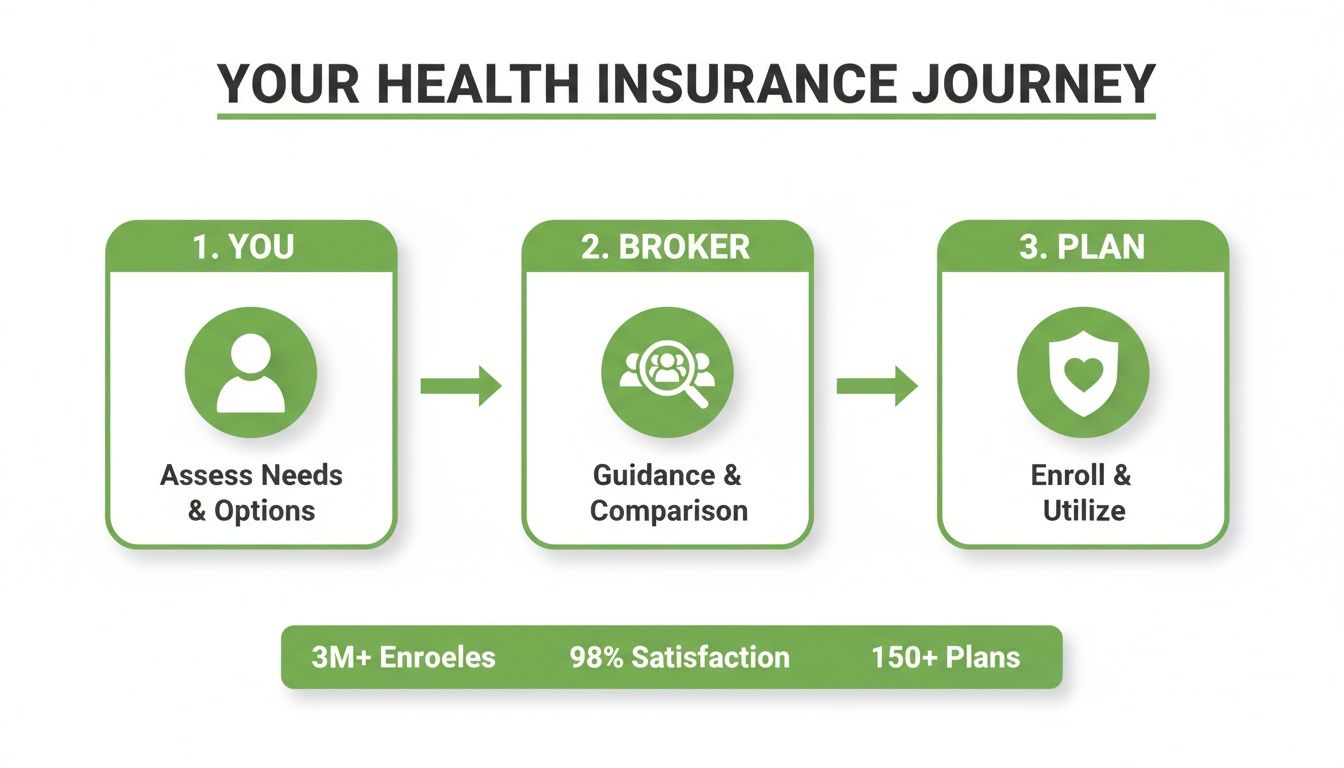
As you can see, the broker is that essential link between you and the overwhelming insurance market, filtering everything to find what truly fits. Once you have a few promising names, it's time for a quick background check.
Do Your Homework: Licenses and Specialties
Before you schedule a single call, take a few minutes to verify a broker’s credentials. This is a simple but critical step to protect yourself and ensure you’re dealing with a legitimate, qualified professional.
Every state maintains a Department of Insurance website with a public database. Just look for an "agent search" or "license lookup" tool. You can pop in their name or license number and instantly see if they are licensed and in good standing. It’s quick, easy, and provides total peace of mind.
This isn't just red tape. Verifying a license confirms the broker has met the state's strict educational and ethical requirements. It's a non-negotiable part of your due diligence.
From there, try to figure out their specialty. Does their website talk a lot about individual plans on the ACA Marketplace? Or are they focused on helping small businesses with group benefits? Finding a broker whose expertise aligns with your needs is a game-changer. Our guide on independent health insurance agents near me dives deeper into this.
Matching their specialty to your situation means you’ll get advice that’s genuinely relevant, not a one-size-fits-all sales pitch.
How To Vet Your Broker And Ask The Right Questions

You’ve got a shortlist of local brokers. Now for the most important part—figuring out who is just a salesperson and who will be a genuine advocate for your health and finances. This is your chance to interview them, and the questions you ask will tell you everything you need to know.
Don't think of this as just buying a product. You're building a professional relationship with someone who should have your back, especially when it comes time to actually use your insurance.
Questions That Go Beyond The Basics
Any broker can quote a premium. A great broker, on the other hand, can break down the complex details that make a plan either a perfect fit or a costly mistake. Let's move past the surface-level stuff and dig into questions that reveal their actual expertise.
Your first conversation should feel more like a strategy session than a hard sales pitch. It pays to be prepared.
Here are the essential questions I always recommend asking:
- Which insurance carriers are you appointed with? This is the first and most critical question. A truly independent broker needs to represent a wide variety of top-rated carriers, not just one or two. That's how you know you're getting a real, unbiased look at the market.
- How do you help clients compare on-marketplace versus off-marketplace plans? A good broker will walk you through the pros and cons of both. They should be able to clearly explain how ACA subsidies work and when it might make sense to choose an off-marketplace plan for potentially better network access.
- What does your support look like after I enroll? This is huge. You want to know if they disappear after the sale. Will they be there to help you with claim issues, answer questions about coverage, or guide you through the annual renewal process?
- How many years have you been a broker, and what’s your specialty? Experience matters in this industry. Find someone who focuses on what you need, whether that's individual, family, or small business plans.
Choosing a broker is like hiring a financial advisor for your health. Their guidance directly impacts both your physical and financial well-being, so it's vital to ensure their primary focus is on your best interests, not just earning a commission.
Understanding Their Business And Support Model
Beyond what they know, you need to understand how they work. This gives you a clear picture of what the client experience will feel like down the road. For instance, do they use modern tools? Some forward-thinking brokers have adopted live chat solutions in the healthcare industry to offer clients quick, on-the-spot answers.
The U.S. health insurance industry is a behemoth, expected to generate $1.4 trillion in revenue, with a single company like UnitedHealth Group pulling in $399.4 billion. In a market this massive and confusing, a great broker is your navigator.
Ultimately, an expert broker does more than just find you a plan—they teach you how to use it. After all, what good is insurance if you don't know what it covers? Our guide on how to verify insurance coverage is a great resource, but having a professional you can call is even better.
Getting Ready for a Productive Broker Meeting
You wouldn't show up to a doctor's appointment without knowing your symptoms, right? The same logic applies when you meet a health insurance broker. To get the most out of your consultation, a little prep work goes a long way.
Walking in with the right information helps your broker work smarter and faster for you. Think of it as giving them the puzzle pieces to your financial and healthcare life. The clearer the picture you provide, the better—and more affordable—the final result will be.
What to Bring to Your First Conversation
Your main goal is to give the broker a complete snapshot of everyone in your household who needs coverage. Being organized signals that you're ready to find a great plan and helps them zero in on potential savings right away.
Here’s a quick checklist of what you'll want to have handy:
- Who Needs Coverage: Full names, dates of birth, and Social Security numbers for every person you want to insure.
- Proof of Where You Live: A driver's license or a recent utility bill works perfectly. This confirms your location, which is crucial for finding plans with local doctor networks.
- Your Current Policy: If you already have insurance, bring those details. It gives the broker a baseline—what you like, what you don't, and what's missing.
The Two Most Important Details: Money and Health
Beyond the basics, the conversation will really focus on two things: your income and your medical needs. These are the factors that directly impact which plans you can get and, more importantly, which ones will actually save you money in the long run.
Your household income is the big one.
A solid estimate of your household's Modified Adjusted Gross Income (MAGI) is absolutely essential. This single number is the key that unlocks potential government subsidies—premium tax credits—on the ACA marketplace, which can slash your monthly premiums. A good broker knows exactly how to use this number to get you every dollar of savings you're entitled to.
You also need to come prepared to talk about how you actually use—or plan to use—your health insurance.
- Your Go-To Doctors and Hospitals: Make a list of your must-have physicians, specialists, and medical centers. Your broker will immediately start checking which plans include them in-network, so you can keep the doctors you trust.
- Your Prescription List: Write down the names and dosages of any regular medications for everyone on the plan. There's nothing worse than finding out a critical, expensive prescription isn't covered, and this simple step prevents that.
Having this info ready makes the whole process incredibly smooth. If you want a deeper dive into the application itself, check out our guide on how to apply for marketplace insurance.
From Plan Quotes to Final Coverage Decisions

Once you've had that initial chat, your broker gets to work. They’ll come back to you with a curated set of health insurance quotes, and this is where their expertise really starts to shine. They can take a stack of confusing documents and turn it into a clear, understandable path forward.
Your role here is to analyze the options and make the call. But you're not alone—your broker is right there with you, ready to explain every last detail.
Most people's eyes go straight to one number: the monthly premium. And while that's obviously important, it's a classic mistake to focus only on that figure. A plan with a tempting low premium might be hiding a massive deductible that could be a real financial shock if you ever need serious medical care.
Looking Beyond the Monthly Premium
A savvy comparison is all about understanding the total potential cost of each plan, not just what you pay every month. Your broker will help you break down all the different financial pieces that add up to what you'll actually spend on healthcare over a year.
It’s a bit like buying a car. The sticker price is just the start. You've got to think about gas mileage, insurance, and upkeep. Health insurance works the same way.
Here are the critical cost factors to weigh with your broker:
- Deductible: This is the big one. It's how much you have to pay out-of-pocket for your care before the insurance company starts chipping in. A higher deductible often means a lower premium, but you have to be sure you could comfortably cover that amount if needed.
- Copayments & Coinsurance: These are what you pay after you've met your deductible. Copays are the fixed fees you see, like $40 for a specialist visit. Coinsurance is the percentage you'll owe on bigger bills, like 20% of a hospital stay.
- Out-of-Pocket Maximum: This number is your financial safety net. It’s the absolute most you will have to pay for covered services in a plan year, protecting you from truly catastrophic medical bills.
Understanding your out-of-pocket maximum is your best defense against worst-case scenarios. It’s the ceiling on your financial risk, providing critical peace of mind no matter what health challenges arise.
Confirming Your Coverage Essentials
Okay, so you've got a handle on the costs. Now, you need to make sure the plan actually works for your life. This means double-checking that your favorite doctors, specialists, and local hospitals are all in the plan's network. Seeing an "out-of-network" provider can lead to shockingly high bills or no coverage at all, so this is a detail your broker will help you nail down.
The same goes for prescriptions. If you take any regular medications, your broker needs to check the plan's formulary—its official list of covered drugs. They'll find out which "tier" your medications are on, which directly affects how much you'll pay at the pharmacy.
This kind of diligence is more crucial than ever. With healthcare costs on the rise, 74% of employers say they're struggling with expense increases, which often pushes more costs onto individuals. A good broker helps you find the plan that shields you from these financial pressures.
The Final Steps to Enrollment
After you've picked the plan that hits that sweet spot between cost and coverage, your broker takes the wheel. They handle the entire application and enrollment process, making sure every form is filled out correctly and submitted on time.
Think of them as your personal liaison with the insurance company. They'll confirm your coverage start date and make sure your new ID cards are in the mail. This last part is where having a "health insurance broker near me" truly proves its worth—they transform a stressful administrative headache into a smooth, simple process.
For a deeper dive into this part of the process, check out our guide on how to compare health insurance plans.
A Few More Things You're Probably Wondering
It's one thing to understand the benefits of a broker in theory, but it's another to feel completely confident moving forward. Most people have a few lingering questions before they pick up the phone. Let's get those sorted out so you know exactly what to expect.
These are the practical details that really highlight the value an expert brings to the table when you're trying to find the right health plan.
So, How Much Does a Broker Cost Me?
This is always the first question, and I get it. The good news is, the answer is simple: it costs you absolutely nothing. Zero. Zilch.
A broker's guidance, expertise, and personalized help are completely free to you. We're paid a commission directly by the insurance companies for enrolling people in their plans. That commission is already baked into the premium price set by law, which means you pay the exact same monthly premium whether you use a broker, buy directly from the insurance company, or wrestle with the marketplace website on your own. You get an expert in your corner for free.
What's the Real Difference Between a Broker and an Agent?
The biggest difference is who they work for. Think of a "captive" insurance agent as an employee of one specific company—like State Farm or Blue Cross. They can only sell you that company's products. Their loyalty is to their employer.
An independent health insurance broker, like me, works for you. We're not tied to any single company. Instead, we're certified to offer plans from dozens of different insurance carriers. This freedom allows us to shop the entire market and give you unbiased advice, finding a plan that's genuinely the best fit for your situation, not just the one we're told to sell.
Can a Broker Actually Help with Marketplace (ACA) Plans?
Absolutely. In fact, this is where we can be most helpful. Navigating the Affordable Care Act (ACA) marketplace is a confusing mess for most people, but for certified brokers, it's our backyard. We're trained to quickly figure out if you're eligible for financial help.
We can see if you qualify for premium tax credits (subsidies) to lower your monthly bill or cost-sharing reductions to reduce your deductibles and copays. We handle the whole application, cut through the jargon, and make sure you get the most savings possible without the headache.
What If I Have a Pre-Existing Condition?
This is a huge source of stress for many, but I can set your mind at ease. Thanks to the ACA, insurance companies can no longer legally deny you coverage or charge you more just because you have a pre-existing condition. It doesn't matter if it's diabetes, asthma, or a past cancer diagnosis.
All ACA-compliant plans have to cover your pre-existing conditions from day one. A good broker is a huge asset here because we can specifically look for plans with networks that include your current doctors and specialists, ensuring you get to keep the care team you trust. It's all about making sure your health coverage works for your real-life health needs.
Ready to find a health plan that fits your life, without all the stress and guesswork? The team at Pounds Health Insurance is here to give you the clear, expert guidance you deserve. Let us do the hard work for you. Get your free, no-pressure health insurance quote today!











