When you hear the term Essential Health Benefits, or EHBs, think of it as the non-negotiable, foundational coverage that most modern health insurance plans are required to provide. Under the Affordable Care Act (ACA), these 10 specific categories of healthcare services set a minimum standard, making sure your plan is more than just a piece of paper—it’s a real safety net for your health.
The Foundation of Modern Health Insurance
It’s hard to imagine now, but before the ACA, buying health insurance felt a bit like the Wild West. You could purchase a plan only to discover in a crisis that it didn't cover something as basic as maternity care or prescription drugs. This left countless people holding the bag for enormous medical bills they never saw coming.
The introduction of EHBs changed everything. Think of it like buying a new car. You just assume it comes with airbags, seatbelts, and anti-lock brakes—they’re standard safety features. The ACA did the same thing for health insurance, establishing a core set of protections you shouldn't have to live without.
This created a reliable "floor" for coverage. Now, when you shop for an ACA-compliant plan, you know it automatically includes a broad spectrum of services, taking the guesswork out of the equation.
By mandating this baseline, the ACA aimed to give people peace of mind. The goal was simple: ensure your insurance will actually be there for you, whether you need a routine check-up or are facing a major medical event.
A Safety Net for Everyone
This requirement is a critical safety net, whether you're a freelancer in Sarasota or raising a family in St. Petersburg. You no longer have to cross your fingers and hope your plan covers a trip to the emergency room or essential lab work. Thanks to EHBs, these vital services are part of the deal.
Getting a handle on these benefits is the first step toward making confident healthcare decisions. Insurance lingo can be overwhelming, but knowing these 10 core protections are built-in simplifies things immensely. If you want to get more comfortable with the language of insurance, our guide to understanding health insurance terminology is a great place to start. This foundational knowledge makes it so much easier to compare plans and find one that truly fits your life.
A Breakdown of the 10 Essential Health Benefits
So, what exactly are these Essential Health Benefits? Think of them less as insurance jargon and more as a guaranteed safety net. They're the 10 core areas of healthcare that the Affordable Care Act (ACA) says every qualified health plan must cover. Let's break down what each one means for you in the real world.
The whole point was to move away from the wild west of health insurance, where you might not know what was covered until it was too late. This image really drives that point home.
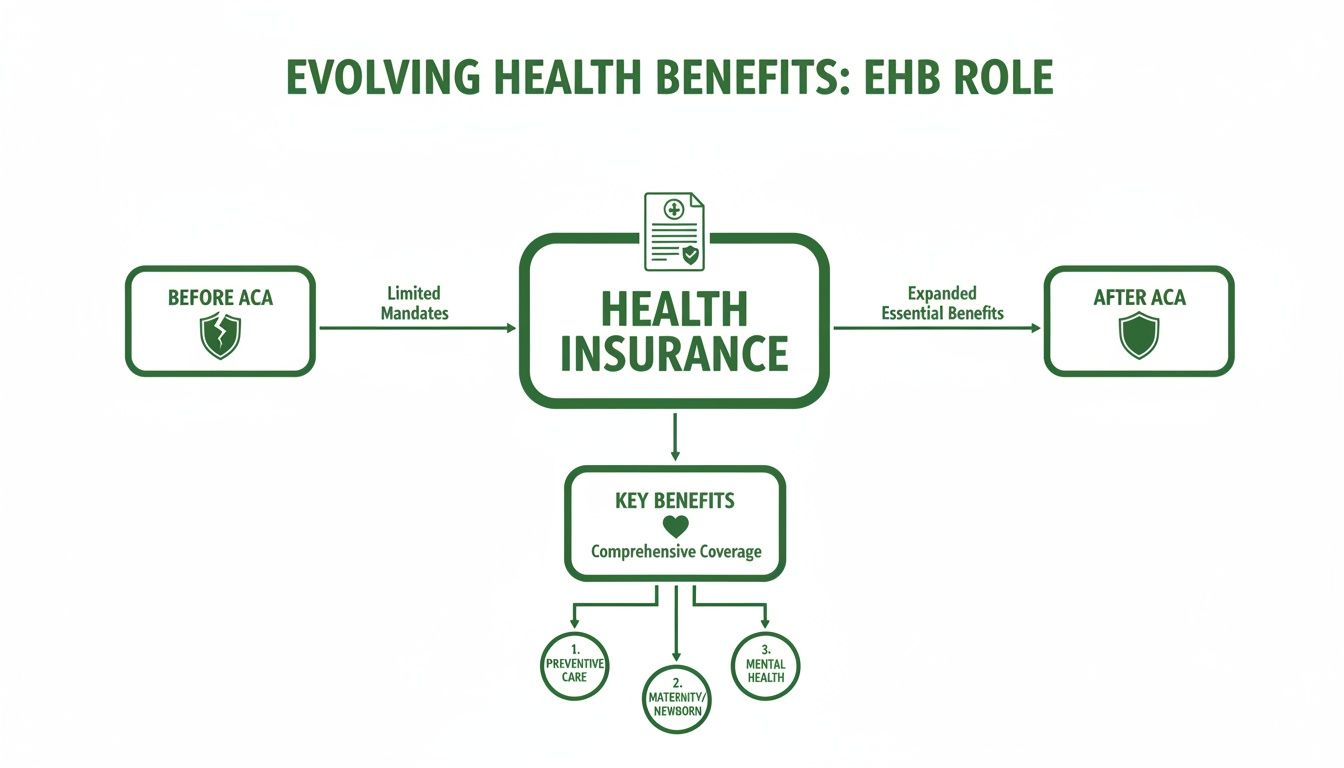
You can see the clear shift from spotty, unpredictable plans to a solid, comprehensive foundation that you can actually rely on when you need it most.
From Doctor's Visits to Hospital Stays
Two of the most basic—and most important—categories cover you whether you're in for a routine check-up or a serious operation.
Ambulatory Patient Services: This is a fancy way of saying "outpatient care." It’s any medical service you get without being admitted to a hospital. Think of your annual physical, visiting a specialist for that sore knee, or even a minor procedure done right in the doctor's office.
Hospitalization: This kicks in when you are admitted to the hospital. It’s for the big stuff—major surgeries, overnight stays for serious illness, and the kind of intensive care you can only get in a hospital setting.
For Life's Unexpected Turns
Life throws curveballs. Your health insurance needs to be ready for them. These next two benefits are designed to protect you during some of life's most critical moments.
Emergency Services is a big one. It means that if you have a true emergency, you can go to the nearest ER without worrying if it’s in your network. Your insurance has to cover it as if it were in-network and can't force you to get approval beforehand.
Maternity and Newborn Care is another game-changer. This benefit covers you before, during, and after pregnancy. We're talking prenatal visits, labor and delivery, and postpartum care for both mom and baby.
Supporting Your Whole Health—Mind and Body
Health isn't just about what you can see. The ACA made a huge step forward by requiring coverage for mental health and recovery services, putting them on equal footing with physical health.
This is a concept called parity, and it’s a big deal. It means your plan generally can't have stricter limits on mental health care than it does for, say, surgical care.
One of the most important EHBs is Mental Health and Substance Use Disorder Services. This covers counseling, therapy, and inpatient treatment. It's the reason more people can get help for conditions like anxiety and depression and access a wider range of treatments. For example, learning When to Consider Ketamine Therapy for Depression is a conversation you can have because of this coverage.
Another key piece is Rehabilitative and Habilitative Services and Devices. This helps you get back on your feet after an injury (rehabilitation) or learn a skill you never had due to a disability (habilitation). Think physical therapy after a car accident or speech therapy for a child with a developmental delay.
The Tools for Staying Healthy
Finally, a few benefits provide the essential tools your doctors need to diagnose problems, treat them effectively, and keep you healthy from the start.
- Prescription Drugs: Your plan has to cover a broad range of medications, ensuring there's at least one option in every major drug category.
- Laboratory Services: This covers the diagnostic workhorses of medicine—blood tests, X-rays, and other lab work that helps your doctor figure out what’s going on.
- Preventive and Wellness Services: This is huge. Services like flu shots, cancer screenings, and annual check-ups are often covered at no cost to you.
- Pediatric Services, including Oral and Vision Care: This guarantees that kids get the medical, dental, and vision care they need to grow up healthy.
The best way to see exactly how your plan handles these benefits is to look at the official documents. Your plan's evidence of coverage is a detailed guide that spells out every covered service.
How Preventive Care Protects Your Health and Finances
Of all the ten essential health benefits, preventive and wellness services might be the most powerful. It's the one that directly keeps you healthy and protects your wallet at the same time.
Think of it like getting the oil changed in your car. You do that small, inexpensive task to avoid a massive, costly engine failure down the road. Preventive care is exactly that—a proactive strategy designed to catch small health issues before they snowball into something much more serious.
Because of the ACA, many of these vital services—like your annual physical, routine cancer screenings, and immunizations—are often covered at 100%. That means you pay nothing out-of-pocket, which removes the cost barrier that might otherwise make you skip a check-up.

The Financial Power of Early Detection
It's impossible to separate your physical health from your financial health. Spotting a serious condition early can be the difference between a simple, manageable treatment and a financially devastating medical crisis.
When you catch things early, you often get to sidestep expensive emergency room visits, complex surgeries, and draining long-term treatments.
Imagine a small business owner here in Bradenton who gets a routine colonoscopy, which is fully covered by her plan. The screening finds a pre-cancerous polyp that’s removed on the spot. That simple, no-cost procedure just helped her avoid a future battle with colon cancer, saving her from a terrible health scare and the immense financial stress and lost income that would have come with it.
Taking Advantage of Your Preventive Benefits
To get the most out of your health plan, you have to actually use these benefits. Whether you have a plan from a big name like Aetna or Cigna, these services are there to empower you.
Here’s how to put them to work:
- Annual Wellness Visits: Always schedule your yearly check-up. It creates a health baseline and gives you a dedicated time to talk through any concerns with your doctor.
- Age-Appropriate Screenings: Make sure you're up to date on screenings for things like high blood pressure, cholesterol, and certain types of cancer based on your age and risk factors.
- Immunizations: Vaccinations are one of the simplest and most effective ways to prevent serious diseases. Check the recommended adult vaccination schedule to see what you might need.
Using these no-cost services is a smart financial move. It helps you stay healthier, avoid needing more intensive care, and keeps more money in your pocket by preventing you from having to dip into your deductible. It all ties back to understanding your plan’s cost-sharing, like knowing what is out of pocket maximum and how it affects your total yearly spending.
How States Put Their Own Spin on Health Benefits
While the ten essential health benefits provide a fantastic, nationwide safety net, the rulebook isn't exactly the same from coast to coast. Think of it like a federal mandate for all new cars to have seatbelts, airbags, and brakes. That's the basic, non-negotiable standard.
But the Affordable Care Act then lets each state decide on some of the finer details. This is where state-specific rules and "benchmark plans" come into play.
Essentially, the ACA provides the 10 broad categories, but it allows each state to define the nitty-gritty services covered within them. To do this, states choose an existing, popular health plan to serve as their official benchmark plan.
This benchmark plan becomes the template. Every other ACA-compliant plan sold to individuals and small businesses in that state must offer coverage that is at least as good as what’s in the benchmark.
Why Your State Matters: The Benchmark Effect
This is the reason a marketplace plan in Florida can look a little different from one in Texas or Tennessee, even when they both cover the same 10 EHB categories. The devil is truly in the details.
Let’s look at "Rehabilitative and Habilitative Services" as an example. The coverage can vary significantly based on the state's benchmark:
- A plan in Florida might cover up to 40 physical therapy visits a year.
- A plan in a neighboring state, following its own benchmark, might only cover 20 visits.
You'll see the same kinds of variations for things like autism spectrum disorder therapies, how many chiropractic visits are covered, or the specific types of durable medical equipment included. These differences all come down to the benchmark plan that your state chose as its model.
A benchmark plan is a state's official template for health coverage. It ensures the core benefit categories are the same everywhere, but the specific services often reflect local healthcare needs and standards.
Why Local Expertise Is Your Best Friend
This layer of state-by-state variation is exactly why understanding what are essential health benefits requires more than just memorizing a list of ten things. The details that will actually impact you and your family are decided at the state level.
Trying to figure this out on your own can be a real headache. You might see a plan that looks great on the surface, assuming the coverage for a specific treatment is standard everywhere, only to find out your state's rules are different when you need the care.
This is where a good, local insurance agent becomes invaluable. An agent who lives and breathes Florida's specific healthcare rules can cut through the confusion. They don't just compare plans on price; they dig into how each one handles the state-mandated specifics within every EHB category, making sure you end up with a plan that actually works for you, right here at home.
How To Compare Health Plans Beyond The Premium

So, now you know what Essential Health Benefits are. That's a great start. But the real work begins when you have a handful of different plans in front of you, and you have to choose just one.
It’s tempting to just look at the monthly premium—that’s the number we see first, and it feels like the most important one. But focusing only on the premium is like buying a car based on the monthly payment without checking its gas mileage or repair costs. To really find the best fit, you have to look beyond the sticker price and understand what you'll actually pay when you need care.
Think about it this way. You're looking at two plans. Plan A has a nice low premium, but the deductible is sky-high. Plan B costs more each month, but its deductible is much more manageable. If you’re healthy and only see a doctor for your annual checkup, Plan A might feel like a steal. But what happens if you break your leg or need an unexpected procedure? With Plan A, you could be on the hook for thousands of dollars before your insurance even starts to chip in. Suddenly, the "cheaper" plan becomes a massive financial burden.
This is exactly why a deeper dive is non-negotiable. A low premium can easily hide high costs that only show up when you can least afford them.
Looking Under The Hood Of Your Health Plan
To get a true picture of a plan's cost, you need to look at three critical numbers. These are the "cost-sharing" elements that determine what you'll pay out of your own pocket.
Deductible: This is the big one. It's the amount you have to pay for your medical care before your insurance company starts paying its share. If your plan has a $5,000 deductible, you are responsible for the first $5,000 of covered services.
Copayments and Coinsurance: Once you’ve hit your deductible, you’ll start sharing costs with your insurer. A copayment (or copay) is a flat fee, like $30 for a doctor’s visit. Coinsurance is a percentage of the total bill—for example, you might pay 20% for a hospital stay after your deductible is met.
Out-of-Pocket Maximum: This is your financial safety net. It’s the absolute most you will have to pay for covered services in a single year. After you hit this limit (through paying deductibles, copays, and coinsurance), your plan picks up 100% of the tab for covered benefits. It’s a crucial protection against catastrophic medical bills.
These three pieces work together to define your total financial risk. For a more detailed walkthrough, our guide on how to compare health insurance plans has some great tools to help you weigh your options.
Special Considerations For Families
If you're shopping for a family, there’s another layer to consider: pediatric services. The ACA requires all qualified health plans to cover pediatric dental and vision care as part of the EHBs.
But here’s where it gets tricky. Sometimes, pediatric dental is built right into the medical plan. More often, though, you have to buy a completely separate, stand-alone dental plan for your kids to satisfy the requirement. Always, always ask if dental coverage for children is included or if it's an extra purchase.
Getting these details right is what separates a good plan from a great one. It’s about finding that sweet spot between an affordable premium and genuine protection. Whether you're looking at a policy from UnitedHealthcare or Blue Cross Blue Shield, a careful comparison of these cost-sharing details is the only way to make sure you won't be hit with financial surprises down the road.
Your Guide To Finding The Right Health Plan
Knowing what Essential Health Benefits are is a huge first step. But let's be honest, even with that knowledge, actually picking a plan can feel like you're trying to solve a puzzle with half the pieces missing. This is where we shift from theory to practical, real-world help.
Instead of sinking hours into comparing plan documents from a dozen different insurance carriers, what if you had an expert do the heavy lifting? An independent insurance agent is that expert. They act as your personal guide, cutting through the jargon to save you time and a whole lot of stress. Their job is to find plans that actually fit your life—your budget, your family’s specific health needs, and the doctors you want to keep.
A Partner In Your Health Journey
This isn't about some high-pressure sales pitch. It’s about finding a trusted partner who can give you straight answers. A local agent provides clear, unbiased advice to help you find that perfect fit, whether you're a freelancer, a small business owner, or looking to cover your family. The best part? They work for you, not for the insurance companies.
Choosing a health plan is a major financial and personal decision. Having an experienced professional in your corner ensures you make a confident choice without the guesswork, securing both your health and financial well-being.
Trying to navigate all the options on your own is tough, but you don't have to. Our team at Pounds Health Insurance is here to make it simple, and our consultations are always free. We'll help you explore your options and find a plan that truly works.
For a deeper look into the process, check out our guide on how to get health insurance.
Your Top Questions About Essential Health Benefits, Answered
When you're trying to figure out health insurance, the term "Essential Health Benefits" comes up a lot. It's a foundational concept, but it can still be a bit confusing. Let's clear up some of the most common questions we hear.
Do All Health Plans Have to Cover EHBs?
That’s a great question, and the short answer is no. The rule requiring the ten Essential Health Benefits applies specifically to individual and small-group health insurance plans. These are the plans you'd buy for yourself or your family, either on or off the official ACA marketplace.
Things are different for large employer plans and "grandfathered" plans (those created before the ACA became law). They aren't held to the same standard, though many of them do offer robust coverage that looks a lot like the EHB list.
Is Birth Control Covered Under EHBs?
For most people, yes. Contraception for women is considered a form of preventive care, which is one of the ten EHB categories.
Federal guidelines from the Health Resources and Services Administration (HRSA) require plans to cover the full range of FDA-approved female contraceptives without you having to pay anything out-of-pocket. There's a notable exception, though: certain religious employers can be exempt from this rule.
Why Do My Benefits Look Different Than Someone's in Another State?
This is where things get interesting. While the ten EHB categories are set at the federal level, the nitty-gritty details are decided by each state.
Every state chooses a "benchmark plan" that serves as the model for all other plans sold there. This is why the number of physical therapy visits covered in Florida might be different than in Georgia, or why the specifics of mental health services can vary so much from one place to another.
This state-by-state approach is designed to let coverage reflect local healthcare needs and practices. It’s also exactly why you have to read the fine print—a plan in one state isn't the same as a plan somewhere else, even if they share the same name.
Are There Limits on My EHB Coverage?
Yes, but there's a crucial distinction to understand. ACA-compliant plans are forbidden from putting annual or lifetime dollar limits on your essential benefits. They can't just cut you off after they've spent a certain amount of money on your care.
However, they can set limits on the number of visits or services. For instance, a plan might cover 30 chiropractic visits a year. They won't cap the total dollar cost of those visits, but they will limit the quantity.
It's a lot to keep track of, but you don't have to do it alone. Having an expert guide you through the details makes all the difference. The team at Pounds Health Insurance is ready to help you sort through the options and find a plan that genuinely fits your life.
Give us a call or visit our site to get started. https://poundshealthinsurance.com