

Your health insurance premium is simply what you pay to keep your health plan active. It's usually a monthly bill, kind of like a subscription service for your healthcare.
Think of it this way: you pay for Netflix or a gym membership every month, whether you use it or not. Your health insurance premium works the same way. Paying it ensures your coverage is there for you when you need it, protecting you from having to pay the full, and often overwhelming, cost of medical care on your own.
What Is a Health Insurance Premium?
The premium is the fixed, regular payment you make to the insurance company. It’s the foundational cost of your health plan—the ticket price for admission, so to speak.
This predictable expense keeps your safety net in place. Whether you see a doctor frequently or just once a year for a check-up, your premium payment doesn't change month to month. It's the key that unlocks access to your network of doctors, hospitals, and pharmacies.
But it’s important to remember that the premium is just one piece of the puzzle. It’s easy to mix up premiums with other out-of-pocket costs like deductibles and copayments. To really get a handle on your total healthcare spending, you need to understand the full range of health insurance terminology.
This model of paying a regular fee for medical benefits isn't just a local thing; it's how insurance works around the globe. As medical costs continue to climb worldwide, these essential payments are becoming even more critical. In fact, total global health insurance premiums recently hit €1,682 billion—a massive increase of €111 billion from the prior year. This just goes to show how many people rely on this financial protection. You can dig into more global trends in the full Allianz report.
Premiums Versus Other Out-Of-Pocket Health Costs
Okay, so you've got a handle on what a premium is. That's a huge first step, but it’s really just one piece of the health insurance puzzle.
The easiest way to think about your premium is like a gym membership or a Netflix subscription. It's that fixed, predictable amount you pay every month to keep your health plan active. You pay it whether you go to the doctor a dozen times or not at all. It's your price of admission.
But that's where the comparison ends. Your premium gets you in the door, but it doesn't cover the cost of everything once you're inside. When you actually use your insurance—say, for a check-up or to fill a prescription—other costs kick in. We call these "out-of-pocket" costs because they come directly out of your wallet only when you get care.
This infographic nails the basic idea: the premium is what you pay the insurance company to keep your coverage in place.
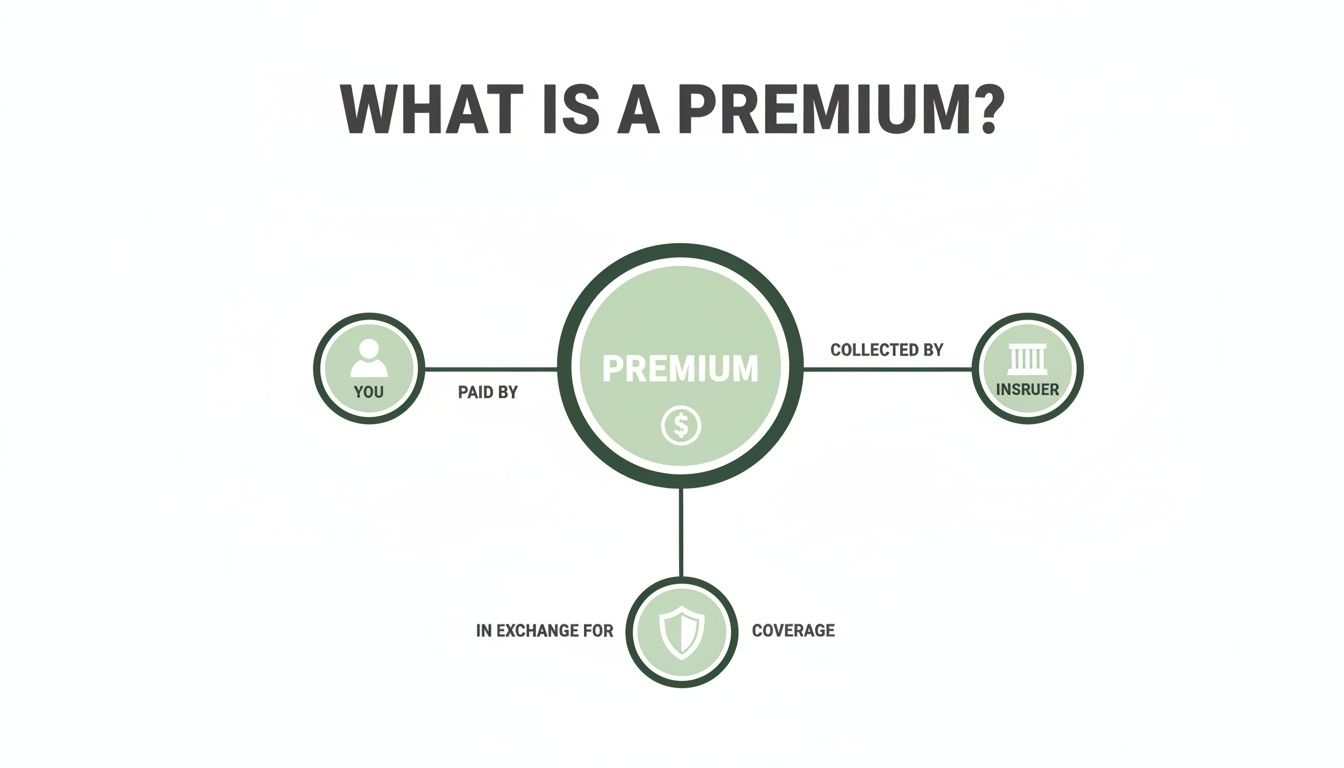
It’s the fee that keeps the agreement going between you and your insurer, ensuring you're protected.
Key Out-Of-Pocket Expenses
To really understand what you might spend on healthcare in a year, you have to look beyond the premium. Let's break down the other common costs you'll see.
- Deductible: This is the amount you have to pay for your medical care before your insurance company starts chipping in. If your plan has a $1,000 deductible, you're responsible for the first $1,000 of your covered medical bills.
- Copayment (Copay): This is a simple one. It’s a flat fee you pay for certain services. Think $25 for a standard doctor's visit or $50 to see a specialist. You usually pay it right at the front desk.
- Coinsurance: This kicks in after you’ve met your deductible. It's a cost-sharing setup where you pay a percentage of the bill. A common split is 80/20—the insurance company pays 80%, and you cover the remaining 20%.
Your financial safety net here is the out-of-pocket maximum. This is the absolute most you will have to pay for covered services in a single year. Once you hit that number, your insurance plan picks up 100% of the tab for the rest of the year.
This limit is a critical feature, as it protects you from catastrophic medical bills. If you want to dig into that topic a bit more, check out our guide on what an out-of-pocket maximum is. Thinking about these expenses is also a key part of planning for healthcare costs in retirement, as it directly impacts how you choose a plan now and in the future.
Key Factors That Determine Your Premium
Ever wonder why your health insurance premium is so different from your friend’s or neighbor’s? It’s not random. Insurance companies look at a specific set of factors to figure out how much to charge you each month, and it all boils down to risk.
Getting a handle on what goes into this calculation is the first step to understanding why your plan costs what it does. Let's pull back the curtain on what influences your monthly bill.
Your Age And Location
Two of the biggest drivers of your premium are how old you are and where you hang your hat. As we get older, we generally need more medical care—that’s just a fact of life. Insurers know this, so a 50-year-old will almost always pay a higher premium than a 25-year-old for the very same coverage.
Your zip code plays a surprisingly big role, too. The cost of healthcare, from a simple check-up to a major hospital stay, can vary wildly from one city or county to the next. If you live somewhere with pricier local medical services, you’ll see that reflected in your premium. It's why a move across state lines—or even just to the next town over—can change your insurance bill.
Plan Category And Tobacco Use
The type of plan you pick is another huge piece of the puzzle. Plans on the Health Insurance Marketplace are grouped into "metal tiers": Bronze, Silver, Gold, and Platinum. Think of them as a trade-off: Bronze plans have the lowest monthly premiums but hit you with higher costs when you actually need care. Platinum plans are the reverse, with steep premiums but much lower costs when you see a doctor.
Your habits also matter, especially when it comes to tobacco. Insurers can legally charge tobacco users up to 50% more for their premiums than non-users. This isn't a penalty; it's a reflection of the significantly higher health risks and costs associated with smoking.
One of the most important things to know is that thanks to the Affordable Care Act (ACA), insurers can no longer charge you more based on your gender or medical history. Pre-existing conditions like diabetes or cancer can't be used to deny you coverage or hike up your rates.
Family Size And Market Trends
It’s simple math: the more people on your policy, the higher the premium. Adding a spouse or kids will naturally increase the monthly cost, though it’s almost always cheaper than buying separate policies for everyone. To get a better idea of what to expect, check out our guide on the average family health insurance cost.
Finally, your premium is also affected by bigger economic forces. For example, recent data from Health Affairs shows that average family premiums for employer-sponsored plans have jumped by 6%. While that’s for job-based coverage, it signals rising healthcare costs across the board that ultimately trickle down to individual plans here in states like Florida, Georgia, and Texas.
Proven Ways to Lower Your Health Insurance Premium
Knowing what goes into your premium calculation is one thing, but figuring out how to actually lower that monthly bill is where the real power lies. The good news is, you have more control than you might think. With a few smart strategies, you can find quality coverage that doesn't break the bank.

For many people, the single most effective way to make health insurance more affordable is through government subsidies. Depending on your household income, you could qualify for assistance that dramatically slashes your monthly payment.
Look Into Financial Aid and Different Plan Types
If you're buying a plan on your own through the marketplace, your very first move should be to see if you qualify for a premium tax credit. These are subsidies created specifically to help lower the cost of coverage. You can dive deeper into how they work in our guide to the health insurance premium tax credit.
Beyond financial aid, the type of plan you select has a direct impact on what you pay each month. Think about these options:
Pick a Plan with a Higher Deductible: It might seem counterintuitive, but choosing a Bronze or Silver plan with a higher deductible usually means you'll have a much lower monthly premium. This is often a great choice for people who are relatively healthy and don’t anticipate needing a lot of medical services throughout the year.
Consider an HMO Instead of a PPO: Health Maintenance Organization (HMO) plans tend to have lower premiums than Preferred Provider Organization (PPO) plans. Why? Because HMOs operate within a more defined network of doctors and typically require a referral from your primary care doctor to see a specialist.
Open a Health Savings Account (HSA): If you opt for a high-deductible plan, you may be eligible to open an HSA. This is a fantastic tool—your contributions are tax-deductible, the money grows tax-free, and you can use it for medical expenses without paying taxes on the withdrawal. It’s a powerful way to reduce your total healthcare costs.
The one-two punch of a high-deductible plan paired with an HSA is a popular strategy for a reason. You lower your fixed monthly cost (the premium) while building a tax-free savings account to handle any medical bills that do come up. It puts you in the driver's seat for both your immediate and future healthcare finances.
How To Choose A Premium That Fits Your Life
Finding the right health insurance plan isn't about chasing the lowest monthly payment. The cheapest premium isn't always the smartest financial move. It’s really a balancing act between what you pay each month and what you'll owe when you actually go to the doctor.
The best choice always comes down to your personal health, your family's needs, and your budget.

When a Lower Premium Makes Sense
For a lot of people, especially if you're young, healthy, and don't see the doctor often, a lower-premium plan is a great fit. You're essentially paying less each month with the understanding that you'll have a higher deductible if you do need care.
This is a smart way to keep your fixed costs down, betting that you won't need major medical services in the near future.
When To Consider a Higher Premium
On the flip side, paying a higher premium can actually save you a lot of money if you have ongoing health needs. If you manage a chronic condition, expect to have a baby, or just want more predictable costs, this route makes perfect sense.
That higher monthly payment is essentially "buying down" your deductible and other out-of-pocket costs.
The key is to be realistic about your situation. A higher premium often buys you peace of mind and financial stability, protecting you from huge, unexpected bills if you know you'll need regular medical attention.
Getting this balance right is more important than ever. A recent Global Medical Trends report projects that U.S. health benefit costs will jump by over 9%, partly due to expensive specialty drugs and hospital consolidation. You can read more about these healthcare cost trends to see why planning ahead is so critical.
Finding The Right Health Plan For You
Okay, so you've got a handle on what a health insurance premium is. What's next? It's time to find a plan that actually works for you. This is where the rubber meets the road, because the best choice isn't always the cheapest one—it's about striking the right balance between your monthly premium and the medical care you expect to need.
It’s a big decision, but you don't have to go it alone.
Let Us Do the Legwork
For residents here in Tampa Bay and across the states we serve, the team at Pounds Health Insurance is in your corner. Think of us as your personal health insurance shoppers. Instead of you spending hours sifting through plans from dozens of carriers, we do the heavy lifting for you, comparing top-rated providers like Aetna and Cigna to find a plan that fits your budget and your life.
Whether you're an individual, a family, or a small business, we're here to provide no-pressure advice and personalized support.
A smart health insurance choice isn't just about the lowest monthly payment; it's about finding the perfect balance between your premium and your anticipated medical expenses for the year.
We help you dig into the details so you can feel confident in your decision. A great place to start is our guide on how to choose the right health insurance plan.
And for those welcoming family from abroad, understanding specific requirements like Super Visa medical insurance is a crucial step to ensure everyone is properly covered.
FAQs: Your Premium Questions, Answered
Alright, we’ve covered the core concepts, but I know from experience that this is where the real-world questions start to pop up. Let's walk through some of the common "what-ifs" people ask about their health insurance premiums.
Can My Premium Change During The Year?
For the most part, no. Once you enroll, your premium is set for the entire 12-month plan year. Think of it like a lease—the rate is locked in.
However, major life changes can trigger a recalculation. If you move to a new zip code, get married and add your spouse, or have a baby, your premium will likely adjust. The same goes for big income shifts that could change your eligibility for a subsidy. Outside of those specific events, you can count on your payment staying the same month to month.
What If I Miss A Premium Payment?
First off, don't panic. Missing a payment happens. Insurers are required by law to give you a grace period to catch up before they can cancel your policy.
How long you have depends on your plan:
- If you get a government subsidy (a premium tax credit), you have a 90-day grace period.
- If you pay the full premium yourself, the grace period is usually 31 days.
It’s really important to get that payment in before the grace period ends. Otherwise, you could find yourself uninsured.
Are health insurance premiums tax-deductible?
Sometimes, yes. If you're self-employed, you can typically deduct 100% of what you paid in premiums. For employees, it's a bit trickier. You can only deduct medical expenses (including premiums) that add up to more than 7.5% of your adjusted gross income (AGI). Honestly, that's a tough number for most people to hit.
Trying to piece all this together can feel overwhelming, but you don't have to do it on your own. Here at Pounds Health Insurance, we help people in Tampa Bay and across the states we serve make sense of it all.
We're real people who can help you compare plans, break down the costs, and find coverage that actually works for your budget and your life. Ready to see your options? Get a free, no-pressure quote today.











