For small business owners here in Florida, offering health insurance isn't just a perk anymore—it's a must-have to attract and keep great people. The good news is, you've got options that go beyond the old-school PPOs and HMOs. From traditional small group plans to newer, more flexible approaches like Health Reimbursement Arrangements (HRAs), you can find a way to offer valuable benefits without breaking the bank.
Cracking the Code on Florida Small Business Health Insurance
Let's face it, in Florida's tight job market, a solid benefits package can make all the difference. Think about it: research shows that a staggering 88% of workers weigh health benefits heavily when deciding on a job. That even beats out paid time off. This isn't just another line item on your budget; it's a strategic move to build a stable, dedicated team.
The tricky part, of course, is wading through all the jargon and red tape. The world of small business health insurance in Florida can feel like an alphabet soup of acronyms and confusing rules. But don't let that intimidate you. Once you grasp the basics, you'll be in a much better position to pick a plan that works for your employees and your bottom line.
Why Health Benefits Should Be a Top Priority
In a state with an economy as hot as ours, holding on to skilled employees is everything. Offering a competitive health plan shows your team you’re invested in them. That simple message can slash employee turnover and save you the headache and high cost of constantly hiring and training new people.
Beyond just keeping your best people around, offering health insurance brings some real, tangible advantages to your business:
- Serious Tax Breaks: The money you contribute to your employees' premiums is typically 100% tax-deductible.
- A Happier Team: When employees feel secure in their health coverage, they're often more loyal, satisfied, and engaged at work.
- A Healthier, More Productive Crew: Access to preventive care means fewer sick days. A healthy team is a team that shows up ready to work.
How to Make a Smart Decision
This guide is designed to cut through the noise. We'll walk you through your main options, from standard group plans to modern reimbursement models that put you in the driver's seat of your budget. We'll also cover the nitty-gritty of who's eligible and how you can tap into significant tax credits that many Florida businesses don't even know exist.
Picking a health plan is one of the biggest decisions you'll make for your company. It affects your finances, your competitive edge, and the well-being of the people who make your business run.
Getting this right starts with understanding the ground rules. A great first step is to learn more about the specific small business health insurance requirements right here in Florida. Arming yourself with this knowledge ensures you can choose a plan that's not just compliant, but a true asset to your company culture.
Understanding Your Core Health Plan Options
When you’re looking into health insurance for your small business here in Florida, the first big decision you’ll face is how the plan is paid for. This choice is the bedrock of your benefits strategy, directly impacting your budget and your team's healthcare access.
The two main paths you can take are Fully-Insured and Level-Funded plans. Grasping the difference between them is the key to picking the right fit for your company.
Think of a Fully-Insured Plan like an all-inclusive vacation package. You pay a set, predictable premium every month to the insurance company. That’s it. In exchange, the carrier takes on 100% of the financial risk for all your employees' medical bills, no matter how high they climb.
For many small business owners, this predictability is a huge plus. You know exactly what you’ll pay each month, making budgeting a breeze. The trade-off? If your team has a super healthy year with very few claims, you don't get any money back. The insurance company keeps the extra. It's the definition of "set it and forget it."
A Hybrid Approach with Level-Funded Plans
A Level-Funded Plan, on the other hand, is more like a pay-as-you-go trip that comes with a built-in safety net. You still pay a fixed monthly amount, but that payment is broken down into three buckets: one for administration, one for a claims fund, and one for stop-loss insurance (your safety net).
Here's the exciting part: if your team's actual medical claims come in lower than what was set aside in the claims fund, you can get a refund or a credit back at the end of the year.
This potential for savings is why these plans are becoming so popular, especially for companies with a generally healthy workforce. You get the cost-control benefits of self-funding, but without the risk. That built-in stop-loss coverage kicks in to protect you from any unexpectedly large claims, so you never pay more than your fixed monthly cost.
This decision tree infographic can help you visualize how to think through the key questions around coverage, cost, and your overall strategy.
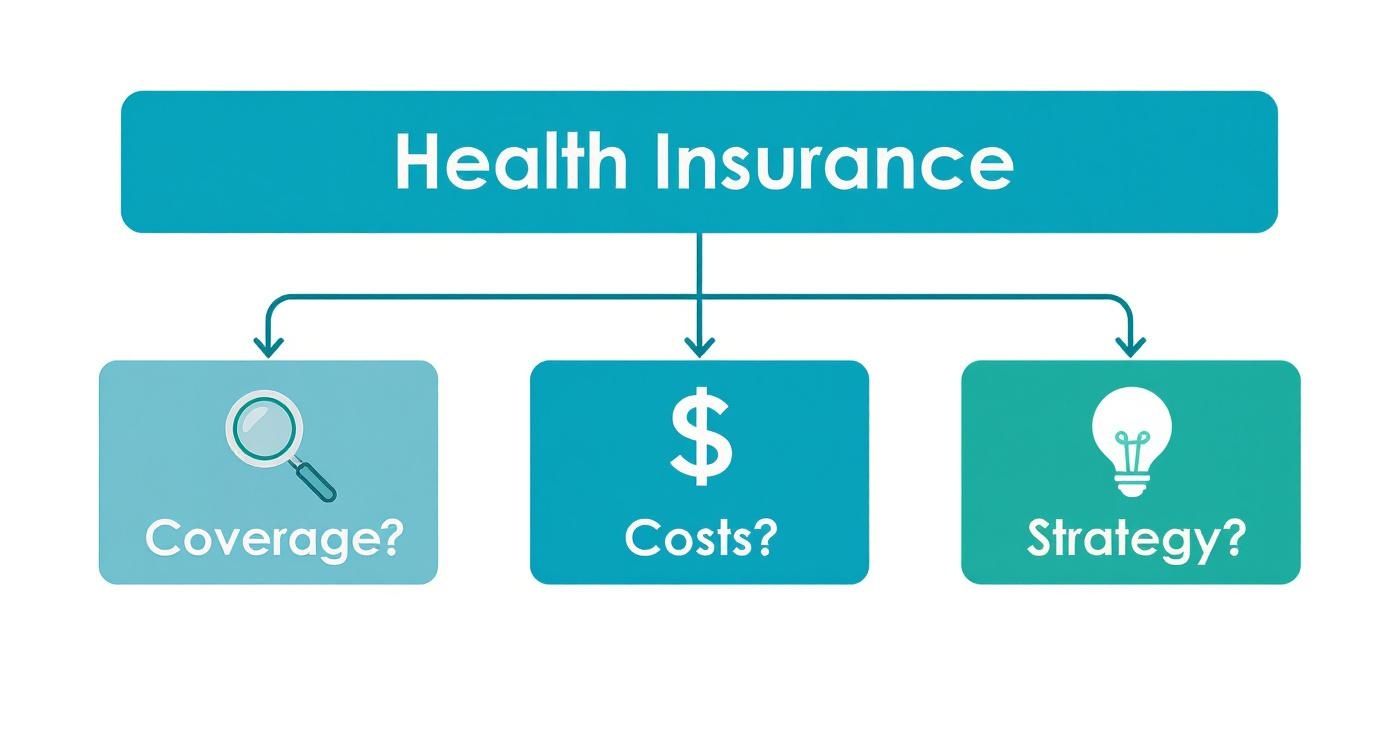
As you can see, it really boils down to your company's comfort level with risk and your desire for potential savings. This is the central fork in the road between a predictable fully-insured plan and a more flexible level-funded one.
Comparing Network Types: HMO vs. PPO
After you've figured out the funding model, the next piece of the puzzle is the network structure—usually an HMO or a PPO. This choice directly shapes how your employees will actually use their health insurance day-to-day.
The network type—HMO or PPO—determines the flexibility and cost-sharing structure for your employees. It's a trade-off between lower costs and broader provider choice.
A Health Maintenance Organization (HMO) is designed to keep costs down. It generally means lower premiums and out-of-pocket expenses for your team, but it comes with a few rules. Members have to use doctors, hospitals, and specialists within the plan’s specific network.
Key features usually include:
- A Primary Care Physician (PCP) as a "Gatekeeper": Each employee picks a main doctor who coordinates all their care.
- Referrals are a Must: To see a specialist, like a dermatologist or a cardiologist, you first need a referral from your PCP.
- No Out-of-Network Coverage: With the exception of a true emergency, getting care outside the network isn't covered.
A Preferred Provider Organization (PPO) is all about flexibility. Employees have the freedom to see any doctor or specialist they want—both in-network and out-of-network—without needing a referral. That freedom comes with a higher price tag, though. PPOs typically have higher monthly premiums and bigger out-of-pocket costs, especially when someone goes out-of-network. It’s an excellent choice for employees who want direct access to specialists or already have doctors they love who might not be in a specific HMO network.
Each of these plan types serves a different purpose. The best way to match a plan’s features to your company’s needs is to dig into all the small business health insurance options available in Florida.
Breaking Down the True Cost of Coverage
When you start looking at small business health insurance in Florida, it's easy to get fixated on the monthly premium. But that number is just the tip of the iceberg. To really get a handle on the financial commitment, you have to look under the hood at all the pieces that make up the total cost—both for your business and your employees.
Think of it like buying a car. The sticker price is your premium—the fixed, predictable monthly payment. But the real cost of ownership also includes things like fuel (deductibles), regular oil changes (copayments), and those unexpected repairs (coinsurance). Each one of these plays a huge part in how affordable a health plan actually is.
The deductible is what an employee has to pay out-of-pocket for covered services before the insurance company starts paying its share. Once that's met, copayments (a flat fee, like $30 for a doctor’s visit) and coinsurance (a percentage of the bill, like 20%) come into play.
Key Factors Driving Your Rates in Florida
Insurance carriers don’t just pull premium numbers out of a hat. They use a specific set of factors to figure out the risk involved, which directly translates to the cost of insuring your team. For a Florida-based business, these key drivers are pretty consistent across the board.
Here’s what they’re looking at:
- Employee Demographics: The average age of your team is a huge one. A younger, healthier group generally means lower premiums. An older team might see higher rates simply because the likelihood of needing medical care increases with age.
- Geographic Location: Healthcare costs can vary wildly depending on where you are in Florida. A business in Miami-Dade County will likely see different rates than one in a more rural spot like Alachua County because the costs of local provider networks are different.
- Plan Design: The type of plan you choose has a direct line to your costs. A PPO with a low deductible and a massive network will almost always cost more than a high-deductible HMO with a more limited network.
- Industry Type: Believe it or not, your industry can matter. Businesses with higher physical risk, like construction or manufacturing, can sometimes face higher premiums than lower-risk, office-based companies.
Knowing these variables helps you understand why your quote might be completely different from another company's, even if you’re a similar size.
Unlocking Significant Savings with Tax Credits
Let's be honest: the rising cost of healthcare is a major headache for small business owners. In Florida, the average monthly cost for small group health insurance hovers around $286 per person. For a small team of five, that's $1,432 a month. With premiums for employer-sponsored family plans jumping 24% since 2019, it's no shock that this is the #1 concern for 68% of small business owners. You can dig deeper into Florida's health insurance cost trends to see the full picture.
To help soften the blow, the federal government offers a powerful incentive that many businesses don't even know about. The Small Business Health Care Tax Credit is a potential game-changer, designed specifically to make offering coverage more affordable. This credit can be worth up to 50% of the premiums you pay—a massive relief for your bottom line.
Imagine a local craft brewery with 10 employees, each earning an average of $25,000. If their annual premium cost is $40,000, they could qualify for a $20,000 tax credit. That literally cuts their health insurance bill in half.
Of course, you have to meet certain criteria to qualify. It's not for everyone, but many small businesses in Florida are surprised to find they're eligible.
Checking Your Eligibility for the Tax Credit
The rules are pretty straightforward and focus on your company's size and what you pay your employees. You might be eligible for this tax credit if you check these four boxes:
- Fewer than 25 Full-Time Equivalent (FTE) Employees: The FTE calculation can be a little tricky, but it’s basically a way of counting both your full-time and part-time staff.
- Average Annual Wages Below a Certain Threshold: You have to pay average annual wages below an amount that's adjusted for inflation each year. It’s around $56,000 per FTE, but it’s crucial to check the current year's limit.
- Contribute at Least 50% of Employee Premiums: Your business has to cover at least half the cost of the premium for employee-only coverage.
- Purchase a Plan Through the SHOP Marketplace: This is a big one. To claim the credit, you must enroll in a qualified plan through the Small Business Health Options Program (SHOP).
These requirements are there to make sure the credit gets to the small businesses that need it most. It's well worth looking into—it could turn what feels like a major expense into a manageable investment in your team.
Finding a More Flexible Way to Offer Health Benefits
For a long time, traditional group health plans were the only option for Florida small businesses. But let's be honest, the old one-size-fits-all model doesn't always work anymore. Today's businesses need smarter, more flexible ways to take care of their teams without breaking the bank.
Thankfully, the landscape has changed. Newer approaches give you, the employer, more control over your budget while empowering your employees to pick coverage that actually makes sense for their lives. The two big players in this new world are the SHOP Marketplace and something called an ICHRA.
The SHOP Marketplace: The Go-To for Group Plans
For many Florida businesses, the SHOP Marketplace is the most straightforward path to offering quality, ACA-compliant health plans. Think of it as a dedicated online portal, run through HealthCare.gov, built specifically for businesses with 1 to 50 full-time equivalent employees. It lets you easily compare plans from different insurance companies side-by-side.
The real headline here is the Small Business Health Care Tax Credit. If your business qualifies, this credit can slice your premium costs in half, covering up to 50% of what you pay. That's a massive help, and it’s why SHOP has become such an essential tool for small businesses here in Florida. Many of the principles of choice and flexibility overlap with other plan types, and you can learn more about how Florida health insurance for the self-employed works to see these concepts in a different context.
ICHRAs: The "Health Insurance Allowance"
While SHOP makes getting a group plan easier, the Individual Coverage Health Reimbursement Arrangement (ICHRA) flips the script entirely. Instead of you picking a plan for everyone, an ICHRA works more like a tax-free health insurance allowance. You're essentially giving your employees a monthly budget to go out and buy their own plan.
Here’s how it works: You set a fixed amount you’ll contribute each month. Your employees then use that money to shop on the individual marketplace and purchase a plan that fits them perfectly. This has some serious perks:
- You Know Your Costs: You decide the allowance, and that’s it. No more getting blindsided by huge premium increases at renewal time. Your budget is predictable.
- Your Team Gets to Choose: An employee in their 20s has very different needs than one in their 50s. They can pick the network, deductible, and features that work for them.
- Less Admin Work for You: You’re out of the business of managing a complicated group plan. It simplifies things tremendously.
An ICHRA lets you offer a fantastic health benefit on a budget you can actually control, all while giving your employees the kind of personalization they value. It’s a true win-win.
This model is catching on fast, especially with startups and modern companies who value its flexibility, but businesses of all kinds are starting to see the benefits.
Creative Strategies in the Real World: A Florida Example
Seeing how these ideas work in practice is what really matters. We’ve seen Florida companies get creative by offering multiple options to satisfy a diverse team. For example, a local construction company we know decided to offer two plans: a traditional PPO and a high-deductible health plan (HDHP) paired with a Health Savings Account (HSA).
To sweeten the deal, the company kicked in $50 a month to every employee's HSA, making the high-deductible plan much more attractive. The result? Nearly 60% of their team chose the HDHP option. This move saved the company roughly 15% on its total insurance bill and, just as importantly, their employees were happier with their options. It just goes to show that a little creative thinking can go a long way in controlling costs.
A Step-By-Step Guide to Eligibility and Enrollment
Figuring out how to offer small business health insurance in Florida can feel like a maze, but it’s really just a series of straightforward steps. Once you understand the basic rules of the road—from who qualifies to how the sign-up process works—the whole journey gets a lot easier.
The very first step is simple: confirming your business actually counts as a "small group" in the eyes of Florida insurers.
In Florida, a small group is generally any business with 1 to 50 full-time equivalent (FTE) employees. This covers the vast majority of small businesses, from your local coffee shop and tech startup to a family-run retail store. And yes, the owner counts as an employee, so even a company with just the owner and one other W-2 employee can typically get a group plan.
Confirming Your Eligibility
Before you can even start looking at plans, you have to clear a couple of basic hurdles that insurance carriers put in place. These aren't meant to be difficult; they're just standard industry practice to keep the system balanced.
The most important rule is employee participation. Insurers need to see that a good portion of your eligible employees—usually around 70%—actually sign up for the plan. This requirement prevents a scenario where only people with high medical needs enroll, which would send costs skyrocketing for everyone.
A common myth is that small businesses are stuck with a strict annual enrollment window, just like individuals are. That's not the case at all. You can actually start a new group plan at any point during the year, which gives you incredible flexibility.
This ability to enroll year-round is a huge plus. It means you can add benefits when it’s right for your company, not when a rigid calendar tells you to.
Your Enrollment Checklist
Once you know your business qualifies, the rest of the process follows a pretty clear path. I find it helps to think of it as a simple checklist to keep everything organized and moving forward.
Here’s a no-fuss, four-step process for getting your team covered:
- Gather Employee Information: First, you’ll need to collect some basic details from every eligible employee: their date of birth, home zip code, and the same info for any dependents they want to cover. This employee census is what we use to get accurate quotes from the carriers.
- Select Your Plan: This is the fun part. You'll work with a broker to compare different plans (like HMOs vs. PPOs), check out their doctor networks, and weigh the costs. You'll also decide how much you'll contribute to your employees' premiums—the standard is at least 50% for their coverage.
- Complete the Master Application: As the business owner, you’ll fill out one master application for the whole company. This form includes your legal business name, federal tax ID, and the details of the plan you picked.
- Distribute Employee Applications: Finally, each employee who is enrolling will fill out their own application. Once all the forms are gathered and sent to the insurance carrier, your new group health plan is ready to go live.
Things can get a little more complex if you have a varied workforce. For example, knowing the ins and outs of providing health insurance for seasonal workers requires a specific game plan. But by following these core steps, you can get your team the valuable benefits they need without all the headaches.
Why Partnering with a Florida Insurance Broker Is a Smart Move

Let's be honest. After reading about funding models, eligibility rules, and tax credits, your head is probably spinning. Trying to juggle all of that while actually running your business is a recipe for burnout. This is exactly why bringing in a local, independent insurance broker isn't just a good idea—it's a game-changer.
Think of a broker as your dedicated guide for small business health insurance in Florida. They don't work for a single insurance company. Instead, they work for you. Their entire job is to get to know your business, understand your budget, and find the right fit for your team in a ridiculously complex market.
This partnership immediately opens up a world of options you'd never find by yourself. Brokers have access to everything, from public marketplace plans to private, off-market deals that often have better pricing or more flexible features. They do the legwork and bring the best choices directly to you, saving you days of frustrating research.
Beyond Just Finding a Plan
Here's where the real value kicks in. A great broker does so much more than just help you pick a plan once a year. They become a genuine part of your team, taking on the administrative and compliance headaches that can easily derail a small business owner.
This ongoing support is what truly makes the difference.
- Compliance Guidance: They’ll keep you on the right side of ever-changing state and federal regulations, so you don't have to worry about surprise fines.
- Enrollment Management: From setting up the initial plan to handling new hires and life event changes, they manage the paperwork so you don't have to.
- Claims Support: When an employee runs into a frustrating claims issue, your broker is the one who gets on the phone with the carrier to fight for them.
- Renewal Strategy: Long before your plan is up for renewal, they’re already shopping the market, negotiating rates, and looking for better options to ensure you’re always getting the best value.
In short, they take the entire world of health insurance off your shoulders. This allows you to get back to what you actually love doing—growing your business. It's not just about convenience; it's about having a trusted advisor who helps you make smart financial decisions for your company and your people.
An experienced broker does more than just sell you a policy. They provide year-round advocacy, expert insights, and a clear strategy to maximize the value of your benefits investment.
Take the Next Step with Expert Guidance
Going it alone in the insurance market is a huge gamble. It's incredibly easy to overpay for a plan that doesn't quite fit or to completely miss out on major cost-saving opportunities. A local Florida broker helps you get it right from day one.
When you work with an expert, you get advice that's built around your specific business, not some generic template. If you're ready to see what's out there, getting professional help with your small business health plans in St. Petersburg, Tampa, Bradenton, and Sarasota will give you the clarity and confidence you need. Don't leave such a critical decision to chance.
Your Top Questions Answered
When you're looking into small business health insurance in Florida, a few key questions always come up. Let's walk through the most common ones I hear from business owners just like you. My goal here is to give you straightforward answers so you can feel confident in your next steps.
Do I Have to Offer Health Insurance to My Employees in Florida?
Legally? No, not if you have fewer than 50 full-time equivalent (FTE) employees. The Affordable Care Act (ACA) doesn't mandate coverage for businesses under that size.
But the real-world answer is a bit different, especially in Florida's tight job market. Offering health benefits has become a non-negotiable for attracting and keeping great people. Smart business owners see it less as an expense and more as a crucial investment in their team's health and happiness, which pays off in better morale, productivity, and loyalty.
What's the Smallest "Group" I Can Have for a Group Plan?
This one surprises a lot of people. In Florida, you typically only need one W-2 employee who isn't the owner or their spouse to qualify for a small group health plan.
That's right—a company with just two people, the owner and one employee, can often get a group plan. This opens the door for even the smallest businesses, from a solo founder making their first hire to a tiny family shop, to offer competitive benefits.
The fact that a two-person company can get a group health plan is a game-changer in the Florida market. It really levels the playing field, letting micro-businesses offer benefits that can stand up against much larger companies.
It means that providing quality health insurance isn't a privilege reserved for big corporations.
How Much Do I Have to Chip in for Employee Premiums?
Most insurance carriers in Florida have a pretty standard rule of thumb. As an employer, you're generally required to contribute at least 50% of the monthly premium for the employee's own coverage (not including their family). This is a foundational part of how small group plans work.
Of course, 50% is just the starting line. Many employers choose to contribute more—say, 75% or even 100%—to make their benefits package really stand out. Some also help cover a portion of the costs for dependents, which can be a huge draw for employees with families.
Can I Offer Different Plans to Different Employees?
This is a great question, and it's where things get a bit more nuanced. The short answer is that you have to be careful. You can't just offer different plans to different individuals based on personal preference; you must offer the same options to all "similarly situated" employees to avoid discrimination issues.
But you can create distinct "classes" of employees based on legitimate, objective business criteria. This lets you tailor benefits for different segments of your workforce.
- Full-time vs. Part-time: A common approach is offering a full benefits package to full-time staff and a more limited one (or none at all) to part-timers.
- Job Role or Seniority: You could have one set of plans for your management team and another for your hourly or entry-level staff.
- Geography: If your team is spread out across Florida, you might offer different plans in Orlando versus Tampa to align with local doctor and hospital networks.
Setting up these employee classes the right way is absolutely critical for staying compliant. This is one of those areas where getting advice from an experienced broker isn't just helpful—it's essential for avoiding costly mistakes and legal headaches down the road.
Getting clear on these questions is the first step toward making a smart, informed decision for your business and your team. The next is talking to someone who does this all day, every day. The team at Pounds Health Insurance is here to give you the expert guidance you need to find a plan that actually works for your budget and your people.
Explore your Florida small business health insurance options today.