When you’re your own boss in Florida—whether you’re a freelancer, consultant, or small business owner—you call the shots. That freedom is fantastic, but it also means you’re in the driver’s seat for finding your own health insurance. For most self-employed Floridians, the best place to start is the ACA Health Insurance Marketplace. It’s the central hub for shopping private plans and, crucially, getting financial help to make them affordable.
Why Your Health Insurance Strategy Matters

As a solo entrepreneur, you’re the engine of your business. If you get sidelined by an unexpected illness or injury, everything can grind to a halt. That’s why having the right health insurance isn’t just a personal necessity; it’s a fundamental part of your business plan.
Think of it this way: you wouldn’t run your business without the right software or professional insurance. Health coverage is the same—it’s the tool that protects your most valuable asset: you. A single major medical bill could put both your personal savings and your business’s future at risk.
What This Guide Will Cover
Figuring out health insurance for the self employed in Florida can feel like you’ve been handed a complex puzzle without the picture on the box. This guide is here to lay out all the pieces and show you exactly how they connect. We’ll walk through the process step-by-step so you can make a choice you feel good about.
Here’s a look at what we’ll break down:
- The ACA Marketplace: How it functions and why it’s the go-to resource for freelancers.
- Plan Types and Metal Tiers: We’ll decode the alphabet soup of HMOs and PPOs, and explain what Bronze, Silver, and Gold really mean for your wallet.
- Costs and Subsidies: Learn how to accurately estimate your fluctuating income to get the most financial aid possible.
- Enrollment Periods: We’ll cover the specific times of the year you can sign up and what to do if you need coverage outside that window.
The right plan for you depends on your income, health needs, and what subsidies you qualify for. Through the ACA Marketplace, many self-employed Floridians can access Premium Tax Credits that dramatically reduce monthly premiums—sometimes bringing a $300 to $600 plan down to a much more manageable number. You’ll find plans from trusted providers like Florida Blue and AvMed, who offer solid options for independent workers.
The real trick to finding the right plan is to balance your monthly premium with the coverage you’ll actually use. It’s a strategic move that means looking past the sticker price to understand your deductible, doctor network, and total out-of-pocket costs.
To help you get started, this table summarizes the main paths you can take to get coverage.
Key Health Insurance Pathways for the Self Employed
| Insurance Pathway | Who It’s For | Key Feature |
|---|---|---|
| ACA Marketplace Plan | Most self-employed individuals, especially those with variable income. | The only place to get income-based subsidies (Premium Tax Credits). |
| Private Off-Marketplace Plan | Individuals who don’t qualify for subsidies due to higher income. | Potentially wider network options, purchased directly from an insurer or broker. |
| Spouse’s Employer Plan | Individuals whose spouse has access to an employer-sponsored group plan. | Often provides comprehensive and cost-effective family coverage. |
| Short-Term Health Insurance | People needing a temporary bridge in coverage (e.g., between jobs). | Low premiums but offers limited coverage and doesn’t cover pre-existing conditions. |
This guide is your roadmap. From figuring out if you can get financial help to learning how to pick the right health insurance plan in the Sarasota area, you’ll have the insights needed to secure coverage that truly fits your life as a Florida entrepreneur.
Getting Your Health Insurance Through the ACA Marketplace
For most self-employed folks in Florida, the Affordable Care Act (ACA) Marketplace is ground zero for finding health insurance. The best way to think of it isn’t as some government-run health plan, but more like a regulated online shopping mall for insurance. It’s a place where private insurance companies list their plans, letting you compare everything side-by-side on a level playing field.
The Marketplace, which you can get to at HealthCare.gov, is the only place to get financial help that lowers your monthly premiums. This is a game-changer for freelancers, gig workers, and solo business owners whose income can be a bit of a rollercoaster. It makes top-notch plans from major carriers genuinely affordable.
Below is the homepage you’ll see—it’s the front door for millions of people looking for coverage.
This page is built to get you right into the application process, whether you’re here in Florida or another state that uses the federal platform. You’ll see clear buttons to either start from scratch or log in to manage your plan, making it the central hub for everything.
The First Step: Estimating Your Income
Before you can see what kind of financial help you qualify for, you have to estimate your household income for the upcoming coverage year. When you’re self-employed, this can feel a lot like trying to predict the weather. You don’t have a steady paycheck; your income is a jumble of client payments, project fees, and the natural ups and downs of business.
The magic number the Marketplace cares about is your Modified Adjusted Gross Income (MAGI). Don’t let the name scare you. It’s not just your total sales—it’s your gross income after you subtract certain deductions, which is fantastic news for any business owner.
Here’s how you can get a handle on your MAGI:
- Forecast Your Gross Income: Start by making a realistic projection of your total self-employment earnings for the year. A good starting point is to look at what you made last year and then adjust for any new clients or big projects on the horizon.
- Subtract Your Business Deductions: This is where the magic happens. You get to deduct all the legitimate expenses that keep your business running, which can significantly lower your MAGI.
- Add in Other Income: Don’t forget to include any other money you or your household brings in. This could be anything from investment gains to your spouse’s W-2 income.
The goal isn’t perfection; it’s a reasonable, good-faith estimate. If your income takes a nosedive or you land a huge contract mid-year, just be sure to log in and update your Marketplace application. This will adjust your subsidy and keep you from having a headache at tax time.
What Counts as a Business Deduction?
Deducting your business expenses is the single best tool you have to lower your MAGI and, in turn, increase the financial help you can get. These are simply the costs of doing business.
Common deductions for self-employed Floridians include:
- Home Office: A percentage of your rent or mortgage, utilities, and internet bill if you have a dedicated workspace.
- Business Travel: Mileage, flights, or hotel stays for work-related trips.
- Professional Fees: Money you pay to your accountant, a lawyer, or for memberships in professional organizations.
- Supplies and Software: Any materials or digital tools you need to do your job.
- Self-Employment Tax: You can deduct one-half of what you pay in self-employment taxes.
By keeping good track of these expenses, you give the Marketplace a much clearer picture of your actual income. This directly affects the affordability of your Florida health insurance for self employed options. It’s also smart to see how these Marketplace plans compare to other choices. For a deeper dive, check out our guide on private health insurance vs. Marketplace plans to figure out which path makes the most sense for you.
Choosing the Right Plan Type and Metal Tier
Alright, you’ve made it to the ACA Marketplace. Now comes the part that feels a bit like ordering a custom meal: you have to pick your main course (the plan type) and your side dishes (the metal tier). It’s where you really dial in your coverage.
Think of it this way: choosing a plan type is like picking your favorite grocery store. Do you prefer the curated selection at a local market, or do you want the massive variety of a superstore? Then, picking a metal tier is like deciding how you’ll pay—do you want a low membership fee but pay more for each item, or a higher fee for bigger discounts at checkout?
Let’s walk through these choices so you can build a plan that truly works for you as a self-employed Floridian. It’s all about finding that sweet spot between what a plan covers and what it costs.
Decoding the Alphabet Soup of Plan Types
The first thing you’ll see are a bunch of acronyms: HMO, PPO, EPO. Don’t let them intimidate you. They’re just fancy labels for how a plan organizes its network of doctors and hospitals. Each one offers a different trade-off between freedom and cost.
- HMO (Health Maintenance Organization): Think of an HMO as your close-knit neighborhood team. You pick a primary care doctor (your PCP) who becomes your healthcare quarterback, coordinating everything and referring you to specialists when needed. The catch? You generally have to stick to their network of doctors for your care to be covered (except in true emergencies). This tight structure is what helps keep your monthly premiums lower.
- PPO (Preferred Provider Organization): A PPO is like having an all-access pass. You don’t need a primary doctor to run the show, and you can see any specialist you want without a referral. While you’ll save money by staying within the plan’s large “preferred” network, you have the freedom to see an out-of-network doctor if you’re willing to pay a lot more for it. That flexibility usually comes with a higher monthly price tag.
- EPO (Exclusive Provider Organization): An EPO is a bit of a hybrid. Like a PPO, you typically don’t need a referral to see a specialist. But, like an HMO, you must use doctors and hospitals inside the network for your care to be covered. It’s a nice middle ground that offers more direct access to specialists than an HMO without the higher cost of a PPO.
Ultimately, this choice is about what you value most. Are you looking for the coordinated care and lower costs of an HMO? Or is the freedom to see any doctor you want, whenever you want, worth the higher premium of a PPO?
To get a clearer picture of how these two most common plans stack up, let’s compare them side-by-side.
Comparing HMO vs PPO Plans at a Glance
This table breaks down the essential differences to help you see which one might be a better fit for your lifestyle and healthcare needs.
| Feature | HMO (Health Maintenance Organization) | PPO (Preferred Provider Organization) |
|---|---|---|
| Primary Care Physician | Required. Your PCP coordinates your care. | Not required. You can manage your own care. |
| Referrals to Specialists | Required. You need a referral from your PCP to see a specialist. | Not required. You can see specialists directly. |
| In-Network Coverage | Yes. Care is covered only within the plan’s network. | Yes. You pay less when you use providers in the preferred network. |
| Out-of-Network Coverage | No (except for true emergencies). | Yes, but at a significantly higher out-of-pocket cost. |
| Monthly Premiums | Generally lower. | Generally higher. |
| Best For | Individuals who want lower costs and coordinated care. | Individuals who want maximum flexibility and choice of doctors. |
For a really deep dive, especially if you’re in the Sarasota area, our guide on HMO vs. PPO plans can help you weigh the pros and cons even further.
Understanding the Metal Tiers
Once you have an idea of the plan type you want, you’ll choose a “metal tier”—Bronze, Silver, Gold, or Platinum. This has absolutely nothing to do with the quality of medical care you receive. It’s simply a way to describe how you and the insurance company will split the bills.
Here’s a simple way to think about them:
- Bronze: These plans have the lowest monthly premium. But, and it’s a big but, you’ll pay the most out-of-pocket when you actually go to the doctor. Your deductible will be high, so this is often a good fit for healthy folks who want a safety net for major medical events but don’t expect to use their insurance much.
- Silver: This is the middle-of-the-road option with moderate premiums and moderate costs when you need care. But Silver plans have a superpower: they are the only plans eligible for Cost-Sharing Reductions (CSRs). If your income is in the right range, this extra subsidy can dramatically lower your deductible, copays, and coinsurance, making your healthcare much more affordable.
- Gold & Platinum: These are the premium plans. You’ll pay a high monthly premium, but your costs will be much lower when you need medical care. If you know you’ll be seeing doctors regularly or have ongoing health needs, these plans can actually save you money in the long run by providing predictable, low out-of-pocket costs.
This trade-off between monthly premiums and out-of-pocket costs is a major trend across Florida. For example, even in the state employee health program, about 4.0% of subscribers are in High Deductible Health Plans, which function a lot like Bronze plans. It just goes to show that many people are making the same calculation you are: balancing a lower fixed monthly bill against potentially higher costs down the road. You can discover more about these broader insurance trends to see how the market is evolving.
How to Calculate Your Costs and Maximize Subsidies
Figuring out the real price of a health plan is where most people get stuck. But for self-employed folks in Florida, the sticker price you see online is almost never what you’ll actually pay. The secret is getting a handle on two key tools available through the ACA Marketplace: Premium Tax Credits and Cost-Sharing Reductions.
Think of a Premium Tax Credit as a personalized discount coupon the government applies directly to your monthly health insurance bill. The size of your coupon depends entirely on what you expect your income to be for the year—your Modified Adjusted Gross Income (MAGI). This is why getting your income estimate right is so crucial. A lower MAGI often means a bigger subsidy, which can dramatically slash your monthly payment.
Estimating Your Income to Get the Best Subsidy
To get the biggest, most accurate subsidy, you have to give the Marketplace a clear financial snapshot. This isn’t a one-and-done guess; it’s something you’ll want to keep an eye on.
Start by pulling together a few key documents:
- Last Year’s Tax Return: This is your best baseline for projecting what you’ll make.
- Profit and Loss Statements: If you use accounting software, these are gold. They show the real-time health of your business.
- Current Income Records: Think paid invoices, client retainers, and any other money coming in.
With these in hand, you can make a solid, good-faith estimate of your income for the coming year. Don’t forget to subtract all your business expenses to get to that all-important MAGI number. If your business suddenly takes off or you lose a major client mid-year, no sweat. Just log back into your HealthCare.gov account and update your income. This simple step keeps your subsidy correct and saves you from a headache at tax time.
This infographic lays out the typical journey of picking a plan—from choosing a network to a metal tier—and subsidies influence every single one of those choices.
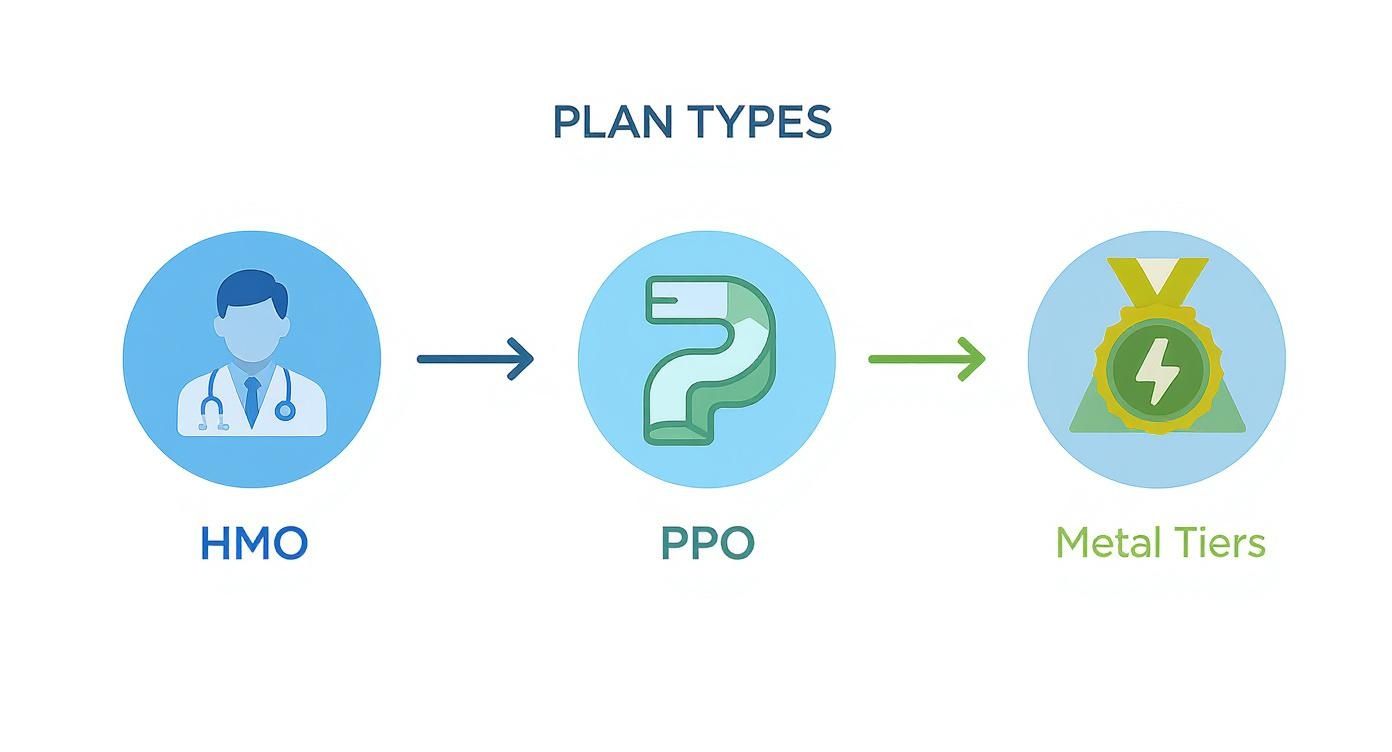
As you can see, your choice of plan type (like an HMO or PPO) and metal tier are connected, and the final price tag for each is directly shaped by the subsidies you qualify for.
The Hidden Power of Silver Plans and CSRs
Premium Tax Credits take care of your monthly bill, but what about the costs when you actually go to the doctor? That’s where another type of help comes in, called Cost-Sharing Reductions (CSRs). These are like a bonus discount that lowers your deductible, copayments, and coinsurance.
Think of it this way: the Premium Tax Credit makes your plan affordable to have, while Cost-Sharing Reductions make your plan affordable to use.
Now, here’s the most important part: you can only get these CSR benefits with a Silver-level plan. If your income is in the right range (usually up to 250% of the Federal Poverty Level), choosing a Silver plan can give you the lower out-of-pocket costs of a Gold or even Platinum plan, but you’re only paying the Silver price. For those who qualify, this is hands-down the best deal on the Marketplace.
Putting It All Together: A Practical Example
Let’s see how this plays out for a real-life freelancer in Florida.
- Meet Maria, a Freelance Web Developer in Tampa: Maria estimates her MAGI for the year will be $35,000. She’s single with no kids.
Based on that income, Maria qualifies for a hefty Premium Tax Credit. She finds a Silver plan with a full price of $450 a month. But after her “instant discount” is applied, her actual monthly premium plummets to just $60.
But it gets even better. Because her income also qualifies her for Cost-Sharing Reductions, that Silver plan gets supercharged. The standard deductible on that plan was $5,000, but for her, it’s only $500. Her copays for a regular doctor’s visit drop from $50 down to $15.
By understanding how these two subsidies work together, Maria found fantastic Florida health insurance for self employed individuals that protects her health and her bank account. She got top-notch coverage with incredibly low usage costs, all for a monthly premium that fits perfectly into her freelance budget.
Navigating Enrollment Periods and Deadlines

When it comes to getting health insurance, timing is everything. Unlike car insurance, you can’t just decide to sign up for a comprehensive health plan on any given Tuesday. The entire system is built around specific windows, and if you miss them, you could find yourself without coverage for months.
For self-employed Floridians, getting a handle on these timelines is a non-negotiable part of keeping your personal and business life on track. Think of it like a product launch: there’s a set period when the doors are open to everyone, and then there are special invitations for those with a unique reason to get in.
The Main Event: Open Enrollment
The biggest window for buying or changing your health insurance plan is called Open Enrollment. This is the one time of year when pretty much anyone can sign up for a new plan or switch their existing one, no questions asked.
In Florida, the ACA Marketplace’s Open Enrollment typically runs from November 1st through January 15th. It’s the annual, predictable period when the market is wide open. A key date to remember within that window is December 15th—that’s usually the deadline to enroll if you want your new coverage to kick in on January 1st.
This is your most important deadline of the year. Circle it on your calendar, set a dozen phone reminders—treat it like a critical business milestone. If you miss this window, you’ll likely have to wait an entire year for another shot at a comprehensive plan unless you have a very specific reason to enroll sooner.
Your Lifeline: Special Enrollment Periods
So, what happens if you need coverage outside that main window? As a freelancer or business owner, life and work can change in an instant. This is where Special Enrollment Periods (SEPs) become an absolute lifesaver.
An SEP is a 60-day window outside of Open Enrollment when you can sign up for a health plan. You don’t just get one for the asking; it has to be triggered by a specific Qualifying Life Event (QLE). And for solo entrepreneurs, these events are more common than you might think.
A Special Enrollment Period is your safety valve. It ensures that when major life changes happen—and they will—you aren’t left in a dangerous coverage gap, forced to wait until the next Open Enrollment season to protect yourself.
Understanding what counts as a QLE is the key to managing your Florida health insurance for self employed needs all year round. It’s your ticket to getting covered when life throws you a curveball.
Common Events That Trigger a Special Enrollment Period
Plenty of life changes can make you eligible for an SEP. Here are some of the most common situations that self-employed people in Florida run into:
- Losing Other Health Coverage: This is a big one. If you were on a spouse’s plan and they left their job, or if your COBRA coverage runs out, you get a special window to enroll in your own plan.
- Getting Married: Tying the knot allows you to add your new spouse to your plan or enroll in a brand-new plan together.
- Having or Adopting a Child: Growing your family is a major QLE that immediately lets you get coverage for your new dependent.
- Moving: A permanent move can also trigger an SEP. For instance, if you relocate from Miami to a new county like Sarasota or St. Petersburg where different plans are available, you get a new enrollment opportunity.
- Big Changes in Income: If your income shifts enough to affect your subsidy eligibility, you may qualify. For example, if your freelance business has a slow quarter and your income drops, you might suddenly become eligible for financial help you didn’t qualify for before.
Let’s put this into a real-world context. Imagine you’re a freelance consultant in Orlando covered under your spouse’s corporate plan. If your spouse decides to take the leap into their own business and you both lose that coverage, this event triggers a 60-day SEP. You now have two months to find and enroll in a new Marketplace plan.
This flexibility is absolutely essential for the self-employed, whose lives are often far more fluid than a W-2 employee’s. Knowing these triggers means you can act fast to maintain continuous health coverage, protecting both your well-being and your bottom line.
Growing Your Team? Time to Look at Small Group Plans
As your freelance business or one-person shop in Florida really starts to take off, you’ll hit a major milestone: hiring your first employee. That’s a huge deal. You’re officially shifting from a self-employed professional to a small business owner, and that means your health insurance strategy needs to grow up, too.
Once you have just one W-2 employee (who isn’t your spouse), you can move beyond an individual ACA plan and into the world of small business group health plans. This opens up a whole new set of options, often with different doctor networks and benefits. It’s like graduating from a solo gym membership to one that covers your whole family—it’s built for more than just one person.
When Does a Group Plan Make Sense?
Switching to a group plan isn’t just about ticking a box; it’s a smart business move. In a competitive market, offering health insurance is a powerful way to attract and keep great people. It sends a clear message that you’re invested in your team’s well-being and helps your new company look like a place people want to work.
You can find these plans through programs like the Small Business Health Options Program (SHOP) or by working directly with an insurance broker. They’re specifically designed for small teams and often provide more stable and predictable coverage as you continue to hire.
Breaking Down the Costs and Rules
Of course, moving to a group plan means thinking about a new set of costs. In Florida, small business group health insurance runs about $286 per employee each month, on average. That’s a real investment, but it can come with some nice tax benefits. You can dig into the specifics of these costs and the rules for small businesses over at floridaallrisk.com.
To help with the expense, the government created the Small Business Health Care Tax Credit. To see if you qualify, your business generally needs to:
- Have fewer than 25 full-time equivalent employees (FTEs).
- Pay average annual wages under $56,000 per employee.
- Cover at least 50% of your employees’ premium costs.
“Offering a group health plan is more than just a benefit; it’s a statement about the kind of company you’re building. It signals stability and a commitment to your team, which is invaluable during the early stages of growth.”
While the ACA doesn’t require businesses with 50 or fewer employees to offer coverage, doing so gives you a serious competitive edge. It’s a vital piece of planning for any self-employed person in Florida with ambitions to build a team.
Getting help from a local expert like Pounds Health Insurance can make this transition seamless. They can help you find a plan that fits your new business goals and your budget right from the start. Thinking ahead like this ensures your health coverage is ready for whatever exciting chapter comes next in your entrepreneurial journey.
Your Top Questions About Self-Employed Health Insurance in Florida, Answered
When you’re self-employed in Florida, trying to figure out health insurance can feel like you’re navigating a maze. A lot of specific questions pop up, and getting straight answers is key to feeling confident in your choice. Let’s tackle some of the most common questions freelancers and business owners ask.
Can I Write Off My Health Insurance Premiums?
Absolutely. In most cases, this is a huge perk of being your own boss. If you’re self-employed and turn a net profit for the year, you can typically deduct 100% of what you paid in health insurance premiums. This deduction covers not just you, but your spouse and dependents, too.
What makes this so valuable is that it’s an “above-the-line” deduction. In plain English, that means you don’t have to itemize to claim it. It directly reduces your adjusted gross income (AGI), which can lower your overall tax bill. Just keep one important rule in mind: you can’t take this deduction for any month you were eligible for a health plan through an employer, like your spouse’s job.
What Happens if I Guess My Income Wrong for Marketplace Subsidies?
This is a classic freelancer problem—income that goes up and down is the norm. Don’t worry, there’s a system in place for this. When you file your taxes, the IRS will “reconcile” your account. They’ll simply compare the income you estimated for the Marketplace with what you actually made.
If you earned more than you thought you would, you may have to pay back some of the subsidy you received. On the flip side, if you earned less, you might be due a larger tax credit, which could mean a bigger refund.
The best way to handle this is to stay on top of it. Whenever your income takes a significant jump or dip, log in to your HealthCare.gov account and update it. This helps keep your subsidy amount correct throughout the year and prevents a nasty surprise come tax season.
Are Short-Term Health Insurance Plans a Good Option?
Short-term plans can look really appealing with their low monthly costs, but they’re a risky bet and aren’t a real substitute for a solid ACA plan.
Here in Florida, these plans don’t have to cover the ten essential health benefits. That means you could be on the hook for services like maternity care, mental health treatment, and even prescription drugs. Even more critical, they can legally deny you coverage for pre-existing conditions.
Think of them as a temporary band-aid, not a long-term solution. They might make sense if you have a one-month gap between comprehensive plans and are perfectly healthy, but for real peace of mind, an ACA plan is always the smarter, safer choice.
Sorting through all these details is a lot easier when you have an expert in your corner. For one-on-one help with your Florida health insurance for self employed options, the team at Pounds Health Insurance can walk you through finding the right plan for your business and budget. You can get a free consultation and explore your choices on their website.