

Staring at a health plan that just isn't working for you anymore can be incredibly frustrating. It's a common feeling, but I'm here to tell you that you're not necessarily stuck until the end of the year. The good news is that switching health insurance mid-year is possible, provided you’ve gone through a specific life change that the government recognizes. These events open a special window, giving you the chance to find better coverage right now.
Why You Can Switch Your Health Plan Mid-Year

Most of us have been trained to think about health insurance just once a year during Open Enrollment. It's that designated time when anyone can shop for a new plan or adjust their current one. But life rarely lines up with a neat calendar. A new baby, a cross-country move, or an unexpected job loss can completely change your healthcare needs in an instant.
Thankfully, the system has a built-in safety net for these exact situations. It’s called a Special Enrollment Period (SEP), and it's triggered by what's known as a Qualifying Life Event (QLE). Think of it as your own personal enrollment window opening up right when you need it most.
So, What Are Special Enrollment Periods?
A Special Enrollment Period is simply a window of time outside the standard Open Enrollment when you’re allowed to sign up for new health coverage. The reality is, life happens. In fact, data shows that roughly 3 in 10 new enrollees on the ACA marketplace sign up through these SEPs, triggered by common events like losing other coverage, getting married, or moving.
This window usually gives you 60 days from the date of your qualifying event to pick and enroll in a new plan. It's a critical deadline—if you miss it, you'll likely have to wait until the next annual Open Enrollment, which could mean months without the right coverage. You can get a deeper dive into the standard timelines by reading our guide on what Open Enrollment for health insurance is.
And What Is a Qualifying Life Event?
A Qualifying Life Event (QLE) is the key that unlocks your Special Enrollment Period. These are significant changes in your life that directly affect your health insurance situation. While we’ll dig into the specifics later, they generally fall into a few key categories:
- Losing Other Health Coverage: This is by far the most common reason. It could mean leaving a job (and your employer's plan), turning 26 and aging off a parent’s plan, or losing eligibility for Medicaid.
- Changes in Your Household: Big family changes like getting married, having a baby, adopting a child, or going through a divorce all count as QLEs.
- A Change in Residence: Moving to a new ZIP code or county often opens up an SEP. This is because health plan options and pricing can vary dramatically from one location to another.
The bottom line is this: If a major life event throws your insurance situation into chaos, you shouldn't have to wait months to fix it. The system is designed to give you a chance to adapt when life demands it.
In this guide, we'll walk you through this entire process, step-by-step. My goal is to replace any confusion with a clear, straightforward plan so you can confidently switch your health insurance mid-year and find a plan that truly protects your health and your wallet.
Do You Qualify for a Special Enrollment Period?

So, how do you know if you can actually switch your health plan right now? The whole process boils down to one simple question: have you had a Qualifying Life Event (QLE)?
Think of a QLE as your golden ticket. It’s a specific, government-recognized life change that opens a personal 60-day window for you to shop for a new health insurance plan, even outside the standard Open Enrollment period.
This isn't some rare loophole. It's a built-in feature of our health insurance system designed to make sure that when life throws you a curveball, your health coverage can adapt right along with you. Most of these events fall into a few key categories, and figuring out where you fit is the first step.
Major Changes in Your Household
Life is always in motion, and many of the big shifts in your family life can trigger a Special Enrollment Period. Honestly, these are some of the most common reasons we see people needing to change plans.
Getting married, for instance, is a classic QLE. It gives you and your new spouse the chance to get on a plan together, which is often a smart move even if one or both of you already had coverage.
Other household changes that open this door include:
- Welcoming a new child: Whether you have a baby, adopt, or have a child placed with you for foster care, you can add them to your current plan or find a completely new one for the whole family.
- Getting divorced or legally separated: If your divorce means you’re losing the health insurance you had through your ex-spouse, you’re eligible to enroll in your own plan.
- A death in the family: If you were covered under a family member's plan and they pass away, this tragic event allows you to find new coverage for yourself without delay.
Each of these scenarios directly changes who needs coverage in your home, making them perfectly valid reasons to adjust your insurance. For a deeper dive, check out our guide on what counts as an insurance qualifying life event.
Losing Your Existing Health Coverage
This is, without a doubt, the most frequent reason people find themselves needing a new plan mid-year. The key here is that you lost your previous coverage involuntarily.
A perfect real-world example is leaving a job. Whether you quit, got laid off, or your hours were cut back, losing that employer-sponsored health plan immediately makes you eligible to shop for a new one.
Another common one we see all the time is turning 26 and aging off a parent's health plan. That birthday is your QLE, and it starts the clock on your enrollment window. The same goes for losing eligibility for Medicaid or CHIP; that change lets you transition to a new plan without a gap.
Losing Medicaid has become a huge driver for switching health insurance mid year. As pandemic-era protections ended, U.S. Medicaid and CHIP enrollment dropped by over 9% between March and December 2023. That’s about 9 million people, many of whom had to find new marketplace or private plans mid-year to maintain their care. You can find more data on this trend and insurer financial performance on KFF.org.
Moving to a New Area
Where you live has a massive impact on your health insurance options. Plans, doctor networks, and pricing are all incredibly local and can change dramatically just by moving to a new county.
That's why a permanent move often triggers a Special Enrollment Period. If you relocate to a new ZIP code, county, or state where your old plan isn't offered, you get a fresh chance to enroll in a new one that actually works where you now live.
Crucial Timing: The 60-Day Countdown
For almost every Qualifying Life Event, you have a strict 60-day window from the date the event happened to enroll in a new plan. If you miss this deadline, you will almost certainly have to wait until the next annual Open Enrollment Period in the fall.
Other Unique Qualifying Situations
Some QLEs are less common, but they are just as legitimate. These situations often involve changes to your income or your citizenship status.
For example, a big change in your household income could suddenly make you eligible for the tax credits that help lower your monthly premiums. This shift can grant you an SEP to pick a plan that makes more sense for your new budget. Other qualifying events include becoming a U.S. citizen or being released from incarceration—both open the door to getting health coverage right away.
Your Mid-Year Health Coverage Options: Finding the Right Fit
Okay, so you've confirmed you have a Qualifying Life Event, and that’s unlocked a Special Enrollment Period. Great! Now comes the big question: what kind of plan should you actually get?
The truth is, there's no single "best" answer. The right path for you depends entirely on your specific circumstances—your income, your family's health needs, and even just how long you need the new coverage to last.
Think of it less like a one-size-fits-all solution and more like choosing the right tool for the job. You might need a comprehensive, long-term plan, or you might just need a temporary bridge to get you through a few months. Let's walk through the main routes you can take.
ACA Marketplace Plans: The Go-To for Most
For the majority of individuals and families, the Health Insurance Marketplace (you might know it as the ACA Marketplace or even "Obamacare") is the most logical place to start your search. These are government-regulated plans, which means they come with a solid set of consumer protections and standardized benefits.
The real game-changer with Marketplace plans is the financial help available. Depending on your household's projected income for the year, you could qualify for:
- Premium Tax Credits: These are subsidies that directly lower what you pay each month for your plan. For many people, this makes coverage far more affordable than they imagined.
- Cost-Sharing Reductions: If your income falls below a certain level, you might also get a plan with a lower deductible and smaller out-of-pocket costs when you actually go to the doctor.
This financial assistance is only available through the Marketplace. This alone makes it the most cost-effective option for a huge number of people.
Off-Exchange Private Plans: More Choice, No Subsidies
You can also shop for a health plan directly from an insurance company or through a broker (like us here at Pounds Health Insurance). We call these "off-exchange" plans.
These plans still have to meet the core requirements of the Affordable Care Act, so you're still covered for pre-existing conditions and a list of essential health benefits. The main difference is that sometimes insurers offer plans off-exchange with unique provider networks or different benefit structures you won't find on the Marketplace. This can be a smart move if you're trying to keep a specific doctor who isn't in any of the Marketplace networks in your area.
The crucial trade-off? You can't use any premium tax credits or cost-sharing reductions on these plans. If you're confident your income is too high to qualify for subsidies anyway, going off-exchange can open up more variety.
Making a switch mid-year is becoming more critical. Global surveys of insurers show that 78% expect medical costs to climb significantly in the next three years. Putting off a switch to a better plan could be a real financial gamble if a new diagnosis pops up. You can read more about these rising healthcare trends from PwC.
Temporary Coverage Solutions: Bridging the Gaps
What if you just need coverage for a few months? This is where a couple of other options come into play. But a word of caution: these are not permanent replacements for real health insurance, and it's essential to understand their limitations.
COBRA Continuation Coverage
If you just left a job where you had health insurance, you'll likely get an offer to continue that exact same coverage through COBRA. The big plus here is that nothing changes—you keep your plan, your doctors, and your benefits, which is a huge relief. The downside? The price. You’ll have to pay 100% of the premium yourself, plus a small administrative fee. This often makes COBRA the most expensive option on the table. Our guide gives you a full breakdown of what COBRA continuation coverage entails.
Short-Term Health Plans
These plans are exactly what they sound like: temporary insurance designed to act as a safety net for a few months. They are almost always cheaper than ACA-compliant plans, but there's a very important reason for that—they don't have to play by the same rules.
Short-term plans can, and often do:
- Deny you coverage for pre-existing conditions.
- Leave out key benefits, like prescription drug or maternity care coverage.
- Place caps on how much they'll pay out in a year or over your lifetime.
They can be a lifesaver in very specific, short-term situations, but they are absolutely not a substitute for a major medical plan. As you weigh your options, it's also smart to look at resources that focus on managing your health, lifestyle, and well-being on a budget to make sure your choice fits your whole financial picture.
Your Practical Checklist For A Smooth Switch
Thinking about switching health insurance mid-year can feel daunting, but it doesn't have to be. The key is to approach it methodically. From years of guiding clients through this exact process, I've found that breaking it down into a few distinct stages—getting prepared, applying for the new plan, and then finalizing everything—makes all the difference.
Let's walk through it.
The infographic below gives you a bird's-eye view of the main avenues you can take when you need to change your coverage outside of the standard Open Enrollment window.
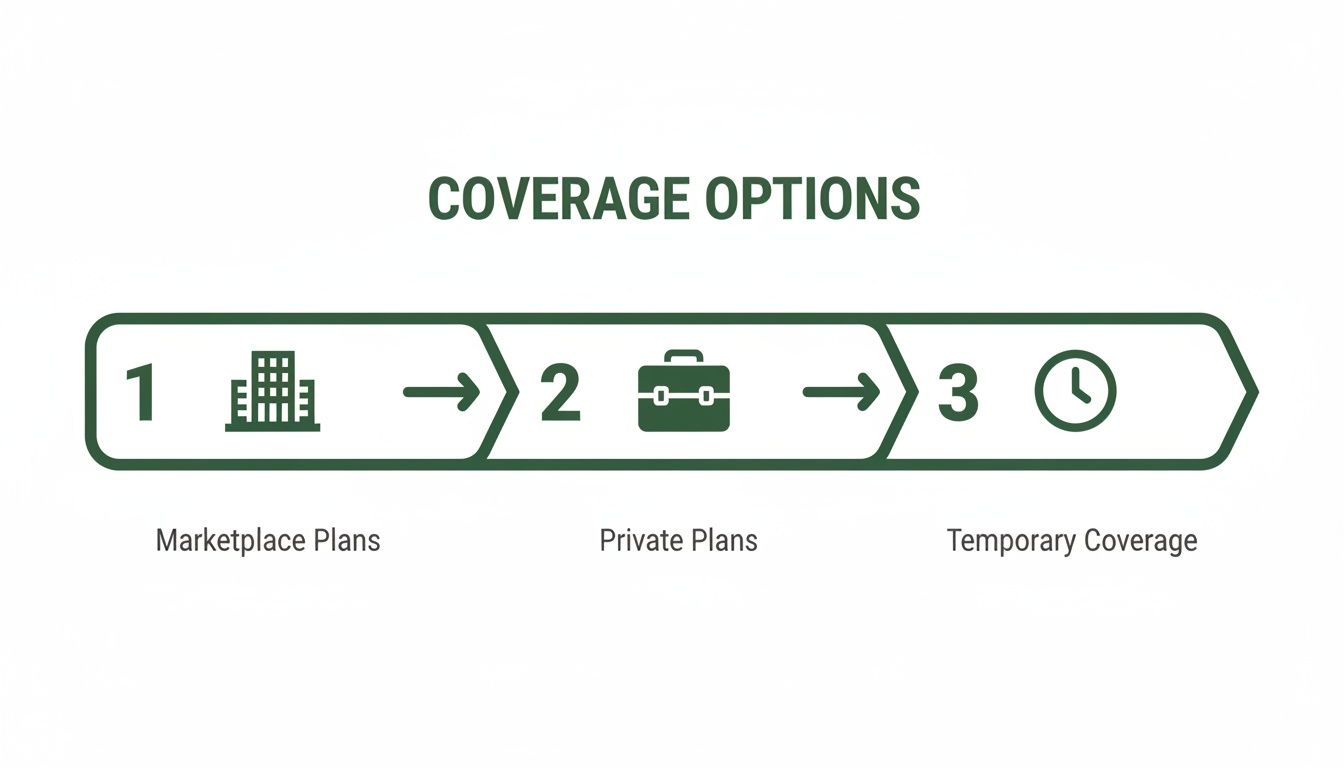
As you can see, your options generally fall into three buckets: Marketplace plans (if you have a QLE), private insurance, or temporary coverage to bridge a gap. Understanding which path is right for you is the first step.
The Preparation Phase
Before you even start comparing deductibles and copays, you need to get your ducks in a row. Doing this prep work first saves a ton of headaches later on.
First up, you need to prove your Qualifying Life Event (QLE). The insurance Marketplace and carriers won't just take your word for it; they need documentation to unlock that Special Enrollment Period.
Depending on your situation, this could be:
- For a household change: A marriage certificate, your baby's birth certificate, or official adoption papers.
- For losing other coverage: A formal letter from your old job or insurance company confirming the exact date your benefits ended.
- For a move: Recent utility bills, a new lease, or mortgage documents that clearly show your new address.
You'll also need to get your financial details together. If you're hoping for subsidies on the ACA Marketplace, you'll have to provide a good-faith estimate of your household's total income for the year. Grab your latest pay stubs, last year's tax return, and any other income records to make this easier.
The Application Phase
With your documents ready, now the real work begins: finding the right plan. The goal isn't just to get covered; it's to find coverage that actually works for your health needs and your wallet.
You can start by exploring plans on the ACA Marketplace or by working with an independent agent who can show you options from various carriers. Remember, the monthly premium is just one piece of the puzzle. You need to look at the whole picture. For a deeper dive, check out our guide on how to compare health insurance plans.
A Tip from Experience: Never assume your doctors are in-network. The best way to be sure is to call your doctor’s billing department directly. Ask them, "Do you accept this specific plan from this specific carrier?" Insurance company provider lists can be notoriously out of date, and this one phone call can save you a world of trouble.
If you take any regular medications, your next step is crucial. Find the plan's prescription drug formulary—the official list of covered drugs—and check for your specific prescriptions. You need to know if they're covered and what your out-of-pocket cost will be. This is a non-negotiable step to avoid sticker shock at the pharmacy.
The Finalization Phase
You've picked a plan and hit "submit" on the application. You're on the home stretch, but these last few steps are absolutely critical. Skipping them can cause major billing issues or, even worse, leave you without coverage when you thought you had it.
Your number one priority is to make your first premium payment. Your new policy is not active until that first payment is processed. Circle the due date on your calendar and don't rest until you have a receipt or confirmation that your coverage is officially effective. Save that confirmation.
At the same time, you have to formally cancel your old health plan. It won't just disappear on its own. Call your previous insurance company or your old HR department to disenroll. Always ask for written confirmation showing the exact date your old coverage terminated. This is your proof to avoid getting billed for two plans at once.
Finally, watch your mailbox for your new insurance cards and welcome packet. As soon as they arrive, go to the insurer's website and set up your online member portal. This will be your hub for checking benefits, finding doctors, and managing your plan from here on out.
You’ve successfully navigated the tricky part and confirmed you can switch health insurance mid-year—that's a huge win. But the path from here isn't without a few potential potholes. A small oversight can lead to frustrating gaps in your coverage, unexpected bills, or even missing your chance to enroll altogether.
Let’s walk through the most common slip-ups I see people make so you can sidestep them with confidence.
Waiting Too Long to Act
This is probably the most heartbreaking mistake because it's so preventable. When you have a Qualifying Life Event, the clock starts ticking on a strict 60-day Special Enrollment Period. It’s easy to procrastinate or think you have plenty of time, but that’s a massive gamble.
I once worked with a client who lost his job and waited nearly seven weeks before even starting his search for a new plan. He figured it would only take a day or two. By the time he got his documents together and started comparing his options, that 60-day window had slammed shut. He was left uninsured until the next Open Enrollment, a risky position that could have been easily avoided.
Just Assuming Your Doctor Is In-Network
This one is a classic—and costly—error. You find a plan with a great monthly premium, assume your trusted family doctor is covered, and then get hit with a massive out-of-network bill after your first visit.
Insurance networks can be incredibly specific, and they change all the time. Please, never rely on the insurance company's online provider directory alone. They can be outdated or inaccurate.
To be absolutely certain, you need to do a quick two-step verification:
- Call your doctor's billing office directly. Don't just ask if they "take" the insurance company. Ask them the specific question: "Do you participate in the
[Specific Plan Name]network from[Insurance Company]?" - Double-check with the insurance company. Call their member services line and have them confirm that your doctor is listed as an in-network provider for that exact plan.
This tiny bit of legwork is your best defense against hundreds or even thousands of dollars in surprise medical bills.
The Myth of the Transferring Deductible
Here’s a widespread misconception that needs to be cleared up right now: when you switch to a plan with a new insurance company, your deductible resets to $0. Any money you've already paid toward your old plan’s deductible simply does not carry over.
The thousands you've paid toward your old deductible and out-of-pocket maximum almost never transfer to a new insurance carrier. You're starting fresh with the new plan.
Forgetting this can cause a major financial shock. Imagine you’ve already paid $4,000 toward a $5,000 deductible and need a procedure. If you switch carriers, you are suddenly on the hook for the entire deductible on the new plan before it starts covering its share. Always, always factor a full deductible reset into your budget when you make a mid-year switch.
Miscalculating Your Income for Subsidies
If you're getting a plan through the ACA Marketplace, you'll need to estimate your household income for the entire calendar year. This is what determines your eligibility for premium tax credits (subsidies) that lower your monthly payments.
It's so easy to get this wrong.
- Underestimate your income? You might get a bigger subsidy each month, but you’ll have a nasty surprise when you file your taxes and have to pay it all back.
- Overestimate your income? You’re essentially giving the government an interest-free loan by overpaying for your insurance every single month.
Take the time to gather your pay stubs, freelance invoices, and last year’s tax return to make your best, most accurate projection. And remember, if your income changes significantly during the year, report it to the Marketplace right away so they can adjust your subsidy.
How An Expert Can Simplify Your Health Insurance Search
So, you see now that switching health insurance mid-year isn't just a possibility—it's often a necessity. But let's be honest, figuring out the rules, comparing plans, and making sure you don't miss a critical detail can feel like a second job. This is exactly where getting some professional guidance makes all the difference.
Instead of you spending your precious time trying to translate insurance jargon, an experienced broker does the heavy lifting. We dig into the nitty-gritty for you. That means sorting through the countless plans from different insurance companies, double-checking that your trusted doctors are in-network, and meticulously reviewing prescription drug lists.
Our entire goal is to match you with a policy that genuinely fits your family's health needs and your budget.
Your Advocate in a Complex System
Think of a good broker as your personal translator for the world of health insurance. We take all those confusing details about deductibles, premiums, and out-of-pocket maximums and turn them into clear, straightforward advice. You'll understand exactly what you're getting and what the trade-offs are.
Partnering with a professional removes the guesswork. We help you make a confident, well-informed decision without the stress of going it alone. It’s about getting the right coverage, not just any coverage.
It's like having an expert in your corner who knows the system inside and out. We know which questions to ask and how to find the answers that matter most, like confirming your eligibility for subsidies that could save you a significant amount of money.
And that support doesn't just vanish once you've picked a plan. We're here to help with any questions or issues that pop up all year long. To see how this works in more detail, our guide explains exactly what a health insurance broker does and how we always put your best interests first.
Common Questions About Switching Health Insurance Mid-Year
It's completely normal to have a lot of questions when you're looking at changing your health plan outside of the standard open enrollment season. Let's tackle some of the most common ones we hear from clients every day.
Will My Deductible Reset If I Switch Plans?
Yes, almost always. When you enroll in a completely new plan, especially with a different insurance company, your deductible and out-of-pocket maximum will reset to zero.
Think of it this way: the money you paid toward your old plan's deductible doesn't transfer over. It's a fresh start with the new policy. In very rare cases, if you switch to a different plan offered by the same insurance carrier, they might credit what you've already paid. But this is the exception, not the rule, and you absolutely must confirm it with them directly before making a move.
Can a New Plan Deny Me for a Pre-Existing Condition?
Absolutely not. As long as you're enrolling in an ACA-compliant health plan (which includes all Marketplace plans and most job-based or private plans), you are protected by law. An insurance company cannot refuse to cover you or charge you a higher premium because of a pre-existing condition.
This is one of the most important protections in modern health insurance. From day one of your new coverage, your pre-existing conditions must be covered.
What Happens If I Miss My 60-Day Special Enrollment Window?
Missing your 60-day window after a qualifying life event is a big deal. Once that deadline passes, your opportunity to get a comprehensive health plan for the rest of the year is usually gone.
Your next chance to secure coverage would be the annual Open Enrollment Period in the fall, with a new plan starting January 1st. If you find yourself in this gap, a short-term health plan might seem like an option. However, be very careful—these plans are not a true substitute. They often don't cover essential health benefits or pre-existing conditions, leaving you exposed to significant financial risk.
Navigating the rules and deadlines can feel overwhelming, but you don't have to figure it all out on your own. The team at Pounds Health Insurance is here to give you clear, straightforward advice based on your specific situation. Reach out to our office to see what options make sense for you.


